ajax loader

Loading...


Ride-the-Wave Strategy – Best for Stock Traders

Ride-the-Wave targets multi-day price momentum following a company’s earnings announcement (EA). With this strategy:

  1. Buy a stock one day post-EA if a stock reacts positively post-earnings:
    1. Near the close of trading the EA-day for a pre-market-EA
    2. Near the close of the following day for a post-market-EA
  2. Sell-to-close after 7-10 days, or possibly earlier if a desired price target is reached

Similarly,

  1. short a stock one day post-EA if a stock reacts negatively post-earnings:
    1. near the close of trading the EA-day for a premarket-EA
    2. near the close of the following day for a post-market-EA
  2. then buy-to-close after 7-10 days, or possibly earlier if a desired price target is reached

Important: Ride-the-Wave is predicated on significant price momentum triggered by an EA. The 7-10 day scenario is the maximum trade hold-time. If you see post EA-momentum is halted or reversed by a significant opposite move, re-evaluate your presence in the trade.

This popular StockEarnings screen below will give you a list of stocks that historically exhibit significant price momentum following an EA for the next seven days:

  1. Stocks exhibiting positive post-EA price moves are buy-candidates
  2. Stocks exhibiting negative post-EA price moves are sell/short-candidates

The screen includes those stocks whose Earnings just came out in last two days.

Screen criteria:

  1. Earnings Date Start Date : Current Date + -1 Day
  2. Earnings Date End Date : Current Date + -2 Days
  3. Predicted Move (Next Day) Max : 7%
  4. Predicted Move (On 7th Day) Min : 7%

Strategy Guideline:

  1. Buy the stock if stock has reacted positively. Short the stock if stock has reacted negatively (see above).
  2. Close the position in 7-10 days, or possibly earlier based on price move.

Volatility Crush Strategy - Best for Options Traders

The Volatility Crush strategy is used with stocks that typically experience relatively low-to-moderate price moves (≤4%) following their Earnings Announcements (EA). The basic trade idea is to sell put or call options right before the EA, collecting a credit when options premium is very high due to elevated implied volatility (IV). You then close the position right after the EA by buying the option back much cheaper due to the significant drop in IV that occurs after the mystery of the EA disappears. In assessing this trade, you need to do your homework to ensure you collect sufficient premium to make the trade worthwhile.

This trade is practical due to the low-to-moderate price-move after the EA, which generally won’t significantly affect the options price, unlike an “action” stock, which experience great price moves post-EA. With these symbols, if you’re on the right side of the price move, that’s a great thing. But if you’re on the wrong side of the move, not so great. Consequently, by minimizing the effect of the post-EA price move, you have a much better chance to profit from the reduction in IV without it being ruined by a violent price move.

For this trade, open the position either (1) the night before the EA when the company announces earnings or (2) during the EA day when it announces post-market, generally capturing IV at or close to its peak.

For this trade, open the position either (1) the night before the EA when the company announces earnings or (2) during the EA day when it announces post-market, generally capturing IV at or close to its peak.

This popular stockearnings screen will give you a list of stocks which do not react more than 4% fpost-EA. It includes only those stocks whose earnings are releasing next day.

Screen criteria:

  1. Earnings Date Start Date : Current Date + 1
  2. Earnings Date End Date : Current Date + 1
  3. Predicted Move (Next Day) Max : 4%
  4. Options Type: Weekly

Strategy Guideline:

  1. Options Strategy: Sell Call and Put
  2. Options Strike Price: Current Stock Price – (% Predicated Move x 2)
  3. Expiration Date: It should generally be the closest expiry immediately after the EA.
  4. Buy Insurance: Buying back Call and Put at Strike price which 10% lower than Sell Strike Price is optional but recommended.

Watch Video for More Detail

Volatility Rush Strategy - Best for Options Traders

The Volatility Rush takes advantage of increasing options premiums into earnings announcements (EA) caused by an anticipated rise in Implied Volatility (IV). With this strategy, Buy a Call and Put at-the-money (a long straddle) 2-3 weeks before the EA when IV is lower. Sell the position either (1) the night before the EA when the company announces earnings pre-market, or (2) during the EA day when it announces post-market, generally capturing IV at or close to its peak.

This popular screen will give you a list of stocks whose Options premiums tend to rise into Earnings. It includes only those stocks whose Earnings are at least two weeks away from today.

Screen criteria:

  1. Earnings Date Start Date : Current Date + 15 Days
  2. Earnings Date End Date : Current Date + 30 Days
  3. Predicted Move (Next Day) Min : 5%
  4. Options Type: Weekly or Monthly if that lines up with the two to three-week lead-time for entering the trade

Strategy Guideline:

  1. Buy a Straddle at or close to the money two to three weeks pre-EA.
  2. Sell the position either the night before the EA when the company announces earnings pre-market, or during the EA day when it announces post-market.
  3. Expiration date should generally be the closest expiry immediately after the EA.
  4. Straddle price should not be more 60% of predicted move.

Predicted Move (Volatility)

Similar to Implied Volatility in Options. Expected volatility % based on our Proprietary Volatility Predication Model. We are expecting that stock price will likely to reach % in either direction by the end of next trading session after Earnings are released and not necessarily the closing volatility %.

Why is it important?

    This indicator helps

  1. Knowing expected volatility in stocks after Earnings helps to decide trading stocks before Earnings Announcement.
  2. Taking Advantage of volatility collapse following Earnings Results by using Advance Options strategies such as Spread and Straddles.

Since Last Earnings

Change in share price since last Earnings release.

Why is it Important?

When share has gained more than 10% since it's last Earning release, it tends to over react to minor bad news and give up some gains if not all. So, it contains more downside volatility than upside When share has dropped more than 10% since it's last Earning release, it tends to over react to minor good news and recover some drops if not all. So, it contains more upside volatility than downside.

EPS Surprise (%)

Occurs when a company's reported quarterly or annual profits are above or below analysts' expectations. Here is the formula to derive % EPS Surprice:

Actual EPS - Estimated EPS
------------------------------------- x 100
Estimated EPS

Why is it Important?

Earnings surprises can have a huge impact on a company's stock price. Several studies suggest that positive earnings surprises not only lead to an immediate hike in a stock's price, but also to a gradual increase over time. Hence, it's not surprising that some companies are known for routinely beating earning projections. A negative earnings surprise will usually result in a decline in share price.

Next Day Price Change (%)

Next Regular trading session Closing price following Earnings result.

For After Market Close Earnings, It is a next trading day closing price. For Before Market Open Earnings, It is the same trading day closing price.

Why is it Important?

Next Day price change is a reaction of Earnings result.

Rivian Stock Offering Adds to the EV Cautionary Tale

Posted on Jul 08, 2026 by Chris Markoch

Rivian Stock Offering Adds to the EV Cautionary Tale

Rivian Automotive (NASDAQ: RIVN) shares plunged 18% Tuesday after the EV maker launched an underwritten public offering of 75 million shares of Class A common stock. Underwriters also received a 30-day option for an additional 11.25 million shares. Based on Monday’s closing price of $20.14, the base offering could raise roughly $1.51 billion — though the final price, set overnight, likely came in below that mark given how far the stock fell Tuesday. Rivian said proceeds will fund general corporate purposes, including equity contributions tied to its amended loan agreement with the U.S. Department of Energy.

The stock’s violent reaction isn’t new for Rivian shareholders. Since its blockbuster 2021 IPO, the company has repeatedly returned to equity markets, diluting existing holders along the way. This raise is simply the newest chapter in a familiar story. A company once billed as the future of American electric trucks is still burning cash and still leaning on shareholders to fund its ambitions.

Rivian was supposed to be different. It had the backing, the brand, and the hype. Instead, it has become a case study in how fast a “next big thing” narrative can turn into a waiting game.

Rivian’s Share Offering Revives the EV Bubble Debate


Investors are partying like it’s 2022, but Rivian shareholders should be sounding the alarm. Anyone who bought RIVN at its 2021 debut has spent years underwater. The toughest part for those holders: Rivian went public through a traditional IPO, not a SPAC. There’s no merger-partner scapegoat here, just a straight equity story that hasn’t delivered.

The buzz around EVs was deafening in 2021, but the risks were always in plain sight. This is a capital-intensive industry. It takes years to generate meaningful revenue, and even longer to turn a profit. The business model also needed near-zero interest rates to work, plus a consumer unworried about their job or inflation. Neither condition holds today.

The DOE-related equity contribution provides some rationale for this raise. It’s tied to unlocking below-market government debt for Rivian’s Georgia plant, not just plugging a cash hole. But rationale doesn’t erase dilution, and dilution doesn’t erase years of underperformance. Tuesday’s reaction suggests investors are tired of hearing the justification.

RIVN Stock Technical Analysis: Key Support Levels to Watch

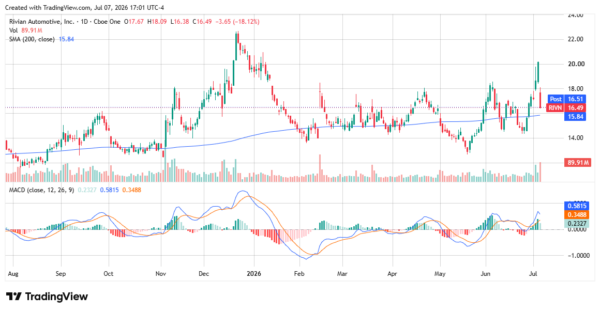
IVN opened Tuesday at $17.67, ran as high as $18.09, then collapsed to a $16.38 low before closing at $16.49. That’s a drop of $3.65, or 18.12%, on volume of nearly 90 million shares — well above the stock’s typical turnover.

Despite the plunge, RIVN closed above its 200-day simple moving average of $15.84. That level has acted as a rising trendline since early February, when the stock bottomed near $13. The rally off that low carried RIVN as high as the low-$20s in June before this pullback.

The MACD remains constructive for now, with the MACD line at 0.5815 sitting above the signal line at 0.3488 and a positive histogram reading of 0.2327. That suggests short-term momentum hasn’t fully broken down, even after Tuesday’s selloff. The key level to watch is the 200-day average near $15.84 — a close below that line would undo months of slow, grinding recovery and open the door to a retest of the February lows.
rivian - StockEarnings

Could eVTOL Stocks Be the Next Contrarian Investment Opportunity?

Unlike the irrational exuberance shown toward EV names in 2020 and 2021, investors seem irrationally pessimistic about the eVTOL space today. That gap between sentiment and fundamentals is exactly where opportunity tends to hide.

Patient investors are quietly accumulating eVTOL names while attention stays fixed on flashier trades. That’s a fundamentally different posture than buying RIVN at its 2021 peak and holding a heavy bag ever since. Entering a sector while it’s out of favor, rather than at the top of a hype cycle, is a structurally better starting point — even if the underlying risks (certification timelines, capital needs, years from commercial revenue) rhyme with what EV investors faced five years ago.

The parallel isn’t perfect. eVTOL companies face their own regulatory and capital hurdles, and none has reached Rivian’s production scale. But the sentiment setup is close to a mirror image of where EVs stood in 2021: overlooked instead of overhyped. That asymmetry is worth watching for investors willing to be patient.

rivian - StockEarnings

Key Takeaway: Rivian’s Capital Raise Highlights the Risks of Pre-Profit Growth Stocks

Contrary to the market’s initial reaction, Rivian’s latest offering isn’t reckless. It’s tied to a specific, negotiated capital structure meant to unlock cheaper government debt. But the market’s 18% reaction shows how little patience remains for a stock that’s diluted shareholders repeatedly since 2021 without a clear path to sustained profitability.

The lesson isn’t that EVs were a bad idea. It’s that capital-intensive, pre-profit industries need the right macro backdrop to reward early believers. Rivian launched into conditions that evaporated almost as soon as the ink dried on its IPO prospectus. Investors chasing the next EV-style story might find better odds in a sector the market has already given up on, rather than one still working through the hangover.


A former marketing copywriter turned freelance financial writer and market analyst. I have a passion for delivering insights to investors. I write regularly about stocks for StockEarnings and MarketBeat. Posts are not advice.

Join over 1.2M+ investors/traders who receive daily and weekly notable earnings alerts with predicted move