Last quarter, while most investors focused on Levi Strauss & Co.‘s (NYSE: LEVI) earnings beat, I argued that the bigger story was unfolding beneath the surface. The company was no longer simply benefiting from consumer demand. It was taking ownership of that demand by shifting toward a direct-to-consumer model, accepting higher marketing and operating costs in exchange for greater long-term control over its customers.
At the time, I thought that strategy introduced a new layer of risk because growth was becoming increasingly dependent on Levi’s ability to keep generating demand itself. This quarter changed the conversation.
Levi reported second-quarter revenue of $1.56 billion, up 8% year over year, while diluted earnings per share from continuing operations climbed to $0.24 from $0.20 a year ago. Those numbers comfortably exceeded expectations. More importantly, the very strategy that looked more expensive just three months ago is beginning to produce stronger margins, higher cash generation, and another increase in full-year guidance.
That raises a much more interesting question. At what point does an investment stop being a cost and start becoming an advantage?
The answer starts with how differently this earnings report reads compared to the previous quarter.
Three months ago, Levi’s direct-to-consumer strategy looked expensive. Selling, marketing, and technology investments were rising as management spent aggressively to strengthen the brand, expand digital capabilities, and reduce its dependence on wholesale partners. The strategy made long-term sense, but it also meant Levi had to continuously generate its own demand rather than rely on retailers to do part of that work. This quarter suggests those investments are beginning to compound.
Direct-to-consumer revenue increased 11% and now represents 51% of total company sales. E-commerce revenue climbed 19%, Beyond Yoga expanded another 16%, and wholesale still grew 5%, showing the business isn’t sacrificing one channel to grow another. Instead, Levi appears to be building a broader consumer ecosystem while maintaining healthy relationships across both distribution models.
What stood out to me even more was management’s confidence. Michelle Gass once again described Levi as a “DTC-first, denim lifestyle company,” while simultaneously raising full-year revenue and earnings guidance. Companies rarely increase their outlook unless they believe the underlying engine driving growth has become more durable rather than temporarily favorable.
The Cost Of Owning The Customer Is Becoming An Asset
This is where I think Wall Street’s debate becomes far more interesting than another earnings beat.
Normally, taking distribution in-house creates pressure on profitability. Operating stores, investing in e-commerce platforms, funding marketing campaigns, and building customer relationships all require significant upfront spending. That was the central risk I highlighted after the previous quarter.
Yet this report suggests Levi is beginning to cross an important threshold.
Gross margin expanded to 62.7% despite tariff and foreign exchange headwinds. Operating margin improved to 7.8%, while adjusted EBIT margin expanded 70 basis points to 9.0%. Operating cash flow for the first six months surged to $482.3 million from $238 million a year earlier, inventories declined 7%, and the company increased its quarterly dividend by 14% while continuing a $200 million accelerated share repurchase program.
These are signs that the operating leverage management has been investing toward is beginning to emerge.
Owning the customer always costs more at the beginning. Eventually, if the strategy succeeds, those same customer relationships begin producing higher lifetime value, stronger pricing power, and better cash generation. I think this quarter may represent the point where Levi starts moving from the first phase into the second.
Investors Are Buying The Next Phase
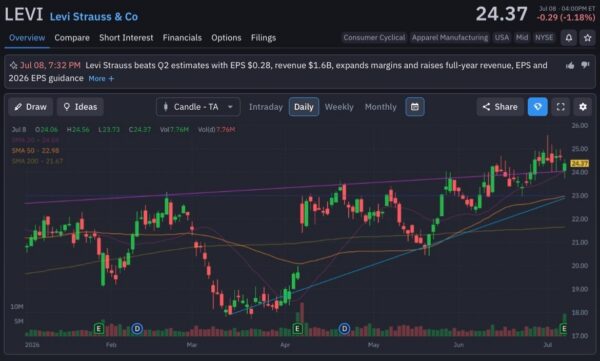
After spending much of the first quarter recovering from its March lows, Levi Strauss has steadily built a sequence of higher highs and higher lows, a classic sign that institutional conviction has been strengthening rather than fading. The stock now trades comfortably above its 20-day, 50-day, and 200-day moving averages, with those longer-term averages beginning to stack beneath the price. A technical structure typically associated with sustained uptrends rather than short-lived rallies.
Perhaps most telling was the market’s response to earnings. Shares briefly pushed above the $25 level on noticeably higher volume before settling around $24.37. While some profit-taking after such a move is hardly surprising, buyers were quick to defend the stock above its key moving averages instead of allowing the post-earnings enthusiasm to unwind.
That price action suggests investors are no longer rewarding Levi for simply beating quarterly estimates. They’re increasingly pricing in the possibility that the company’s direct-to-consumer transformation is reaching the stage where stronger execution translates into sustainably higher profitability.
This Quarter Changed The Investment Story
I don’t think Levi’s latest earnings eliminate every risk surrounding its direct-to-consumer strategy.
Management still needs to prove that higher marketing investment, digital expansion, and lifestyle diversification can continue generating attractive returns over multiple years, particularly if consumer spending eventually weakens.
What changed is where the burden of proof now sits. Three months ago, Levi needed to convince investors that spending more to control customer relationships would eventually improve the business. Today, the company has started producing the financial evidence supporting that argument through expanding margins, stronger cash flow, disciplined inventory management, and a higher full-year outlook.