ajax loader

Loading...


Ride-the-Wave Strategy – Best for Stock Traders

Ride-the-Wave targets multi-day price momentum following a company’s earnings announcement (EA). With this strategy:

  1. Buy a stock one day post-EA if a stock reacts positively post-earnings:
    1. Near the close of trading the EA-day for a pre-market-EA
    2. Near the close of the following day for a post-market-EA
  2. Sell-to-close after 7-10 days, or possibly earlier if a desired price target is reached

Similarly,

  1. short a stock one day post-EA if a stock reacts negatively post-earnings:
    1. near the close of trading the EA-day for a premarket-EA
    2. near the close of the following day for a post-market-EA
  2. then buy-to-close after 7-10 days, or possibly earlier if a desired price target is reached

Important: Ride-the-Wave is predicated on significant price momentum triggered by an EA. The 7-10 day scenario is the maximum trade hold-time. If you see post EA-momentum is halted or reversed by a significant opposite move, re-evaluate your presence in the trade.

This popular StockEarnings screen below will give you a list of stocks that historically exhibit significant price momentum following an EA for the next seven days:

  1. Stocks exhibiting positive post-EA price moves are buy-candidates
  2. Stocks exhibiting negative post-EA price moves are sell/short-candidates

The screen includes those stocks whose Earnings just came out in last two days.

Screen criteria:

  1. Earnings Date Start Date : Current Date + -1 Day
  2. Earnings Date End Date : Current Date + -2 Days
  3. Predicted Move (Next Day) Max : 7%
  4. Predicted Move (On 7th Day) Min : 7%

Strategy Guideline:

  1. Buy the stock if stock has reacted positively. Short the stock if stock has reacted negatively (see above).
  2. Close the position in 7-10 days, or possibly earlier based on price move.

Volatility Crush Strategy - Best for Options Traders

The Volatility Crush strategy is used with stocks that typically experience relatively low-to-moderate price moves (≤4%) following their Earnings Announcements (EA). The basic trade idea is to sell put or call options right before the EA, collecting a credit when options premium is very high due to elevated implied volatility (IV). You then close the position right after the EA by buying the option back much cheaper due to the significant drop in IV that occurs after the mystery of the EA disappears. In assessing this trade, you need to do your homework to ensure you collect sufficient premium to make the trade worthwhile.

This trade is practical due to the low-to-moderate price-move after the EA, which generally won’t significantly affect the options price, unlike an “action” stock, which experience great price moves post-EA. With these symbols, if you’re on the right side of the price move, that’s a great thing. But if you’re on the wrong side of the move, not so great. Consequently, by minimizing the effect of the post-EA price move, you have a much better chance to profit from the reduction in IV without it being ruined by a violent price move.

For this trade, open the position either (1) the night before the EA when the company announces earnings or (2) during the EA day when it announces post-market, generally capturing IV at or close to its peak.

For this trade, open the position either (1) the night before the EA when the company announces earnings or (2) during the EA day when it announces post-market, generally capturing IV at or close to its peak.

This popular stockearnings screen will give you a list of stocks which do not react more than 4% fpost-EA. It includes only those stocks whose earnings are releasing next day.

Screen criteria:

  1. Earnings Date Start Date : Current Date + 1
  2. Earnings Date End Date : Current Date + 1
  3. Predicted Move (Next Day) Max : 4%
  4. Options Type: Weekly

Strategy Guideline:

  1. Options Strategy: Sell Call and Put
  2. Options Strike Price: Current Stock Price – (% Predicated Move x 2)
  3. Expiration Date: It should generally be the closest expiry immediately after the EA.
  4. Buy Insurance: Buying back Call and Put at Strike price which 10% lower than Sell Strike Price is optional but recommended.

Watch Video for More Detail

Volatility Rush Strategy - Best for Options Traders

The Volatility Rush takes advantage of increasing options premiums into earnings announcements (EA) caused by an anticipated rise in Implied Volatility (IV). With this strategy, Buy a Call and Put at-the-money (a long straddle) 2-3 weeks before the EA when IV is lower. Sell the position either (1) the night before the EA when the company announces earnings pre-market, or (2) during the EA day when it announces post-market, generally capturing IV at or close to its peak.

This popular screen will give you a list of stocks whose Options premiums tend to rise into Earnings. It includes only those stocks whose Earnings are at least two weeks away from today.

Screen criteria:

  1. Earnings Date Start Date : Current Date + 15 Days
  2. Earnings Date End Date : Current Date + 30 Days
  3. Predicted Move (Next Day) Min : 5%
  4. Options Type: Weekly or Monthly if that lines up with the two to three-week lead-time for entering the trade

Strategy Guideline:

  1. Buy a Straddle at or close to the money two to three weeks pre-EA.
  2. Sell the position either the night before the EA when the company announces earnings pre-market, or during the EA day when it announces post-market.
  3. Expiration date should generally be the closest expiry immediately after the EA.
  4. Straddle price should not be more 60% of predicted move.

Predicted Move (Volatility)

Similar to Implied Volatility in Options. Expected volatility % based on our Proprietary Volatility Predication Model. We are expecting that stock price will likely to reach % in either direction by the end of next trading session after Earnings are released and not necessarily the closing volatility %.

Why is it important?

    This indicator helps

  1. Knowing expected volatility in stocks after Earnings helps to decide trading stocks before Earnings Announcement.
  2. Taking Advantage of volatility collapse following Earnings Results by using Advance Options strategies such as Spread and Straddles.

Since Last Earnings

Change in share price since last Earnings release.

Why is it Important?

When share has gained more than 10% since it's last Earning release, it tends to over react to minor bad news and give up some gains if not all. So, it contains more downside volatility than upside When share has dropped more than 10% since it's last Earning release, it tends to over react to minor good news and recover some drops if not all. So, it contains more upside volatility than downside.

EPS Surprise (%)

Occurs when a company's reported quarterly or annual profits are above or below analysts' expectations. Here is the formula to derive % EPS Surprice:

Actual EPS - Estimated EPS
------------------------------------- x 100
Estimated EPS

Why is it Important?

Earnings surprises can have a huge impact on a company's stock price. Several studies suggest that positive earnings surprises not only lead to an immediate hike in a stock's price, but also to a gradual increase over time. Hence, it's not surprising that some companies are known for routinely beating earning projections. A negative earnings surprise will usually result in a decline in share price.

Next Day Price Change (%)

Next Regular trading session Closing price following Earnings result.

For After Market Close Earnings, It is a next trading day closing price. For Before Market Open Earnings, It is the same trading day closing price.

Why is it Important?

Next Day price change is a reaction of Earnings result.

Pepsi Earnings Just Complicated The Story Investors Already Believed

Posted on Jul 09, 2026 by Grayson Cavern

Pepsi Earnings Just Complicated The Story Investors Already Believed

Long before PepsiCo Inc. (NASDAQ: PEP) reported second-quarter earnings, many investors had already made up their minds. The debate had shifted away from quarterly results toward something much bigger: whether Pepsi had become another “ex-great” consumer stock. The reasoning sounded convincing. Consumers were moving toward healthier eating habits. GLP-1 weight-loss drugs threatened demand for salty snacks and sugary drinks. Years of price increases and shrinkflation had pushed shoppers toward cheaper private-label alternatives. Even loyal customers began questioning whether a bag of Doritos or a bottle of Pepsi was still worth the premium.

The market reflected that pessimism. Pepsi shares entered earnings down sharply from their highs, with investors treating these headwinds less as temporary challenges and more as signs of permanent decline.

Then PEP reported second-quarter revenue of $24.18 billion and core earnings per share of $2.20, both ahead of expectations, while reaffirming its full-year outlook. Those results don’t prove the bearish narrative is wrong. They do, however, force investors to confront a more uncomfortable possibility. What if Pepsi’s decline isn’t as irreversible as the market has already priced in? 

How Pepsi Is Challenging The Bear Case


One strong quarter doesn’t erase the structural challenges facing Pepsi.

Consumers are undeniably becoming more health-conscious. GLP-1 adoption continues expanding. Private-label brands remain aggressive competitors, particularly as shoppers search for cheaper alternatives. Pepsi itself acknowledged a difficult consumer environment and higher input costs.

But the earnings also contained several data points that don’t neatly fit the market’s narrative.

Organic volume returned to growth, rising 1%, while organic revenue increased 2.4%. Rather than relying entirely on higher prices, PEP generated growth through a combination of pricing, innovation and improving demand. North American Convenient Foods gained volume market share, supported by affordability initiatives and new product launches, suggesting consumers haven’t abandoned the company’s brands altogether. 

This means that the market has been pricing Pepsi as though consumer behavior has permanently shifted against its business. But these results now suggest consumers may be changing how they spend, but not necessarily who they spend with.

Adaptation, Not Denial, Is Driving Pepsi’s Response

What impressed me most wasn’t the earnings beat itself. It was management’s response to the challenges investors have been highlighting for months.

Pepsi isn’t pretending GLP-1 drugs don’t exist. It isn’t dismissing changing consumer preferences or assuming shoppers will eventually accept endless price increases. Instead, the company appears focused on adapting through affordability initiatives, product innovation and disciplined execution.

That strategy showed up across the financials. Core operating profit increased 4% while core operating margin reached 16.8%. Operating cash flow more than doubled to $2.37 billion during the first half of the year, allowing Pepsi to reaffirm plans to return approximately $8.9 billion to shareholders through dividends and share repurchases in 2026. 

Simply put, PEP is trying to stabilize demand while preserving profitability. Whether that strategy ultimately succeeds remains an open question. What this quarter demonstrates is that Pepsi still has meaningful levers to pull before investors can declare the company’s best days permanently behind 

Wall Street Still Isn’t Buying It

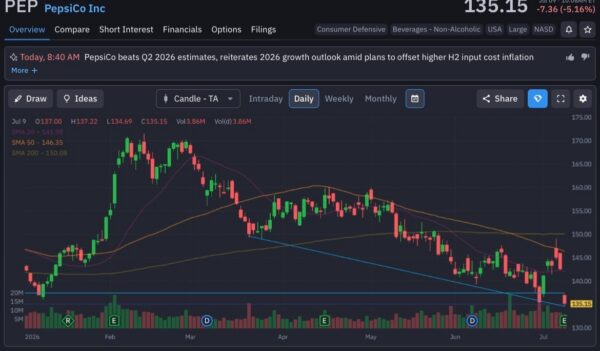
The chart suggests investors remain unconvinced despite PEP’s better-than-expected quarter. Shares continue trading below their 20-day, 50-day and 200-day moving averages, preserving the downtrend that’s been in place for months. 

Even after briefly rebounding from the $135 support area late last month, the post-earnings selloff pushed shares back toward those lows, showing that sellers remain eager to fade any signs of optimism rather than chase the company’s improving fundamentals.

If Wall Street believed Pepsi had already turned the corner, the stock would likely be reclaiming key technical levels instead of drifting back toward recent lows. For now, the tape says investors still view this as a company trying to stabilize, not one that’s already returned to sustainable growth. That’s exactly why these earnings deserve a closer look.
pepsi-StockEarnings

Has The Market Become Too Pessimistic?

That brings us to valuation.

At roughly $135 per share, PEP trades at a forward earnings multiple that sits below its historical average and at a discount to several large consumer staples peers, despite continuing to generate positive organic growth, substantial cash flow and one of the strongest dividend records in the market. If that discount reflects a business facing permanent decline, the valuation makes sense.

But here’s the thing, the market has largely valued Pepsi as though changing consumer habits, GLP-1 adoption and private-label competition will erode the company’s competitive position for years to come. This quarter didn’t invalidate those concerns, but it did provide evidence that Pepsi is adapting more effectively than many investors expected. Positive organic volume growth, market share gains in North American Convenient Foods, reaffirmed guidance and stronger cash generation all point toward a business that’s proving more resilient than the prevailing narrative suggests. 

Now, while I don’t think one quarter is enough to declare Pepsi undervalued…I do think it’s enough to question whether Wall Street has already priced in the worst possible outcome. Because sometimes, that’s where the most interesting investment opportunities begin.


Join over 1.2M+ investors/traders who receive daily and weekly notable earnings alerts with predicted move