ajax loader

Loading...


Ride-the-Wave Strategy – Best for Stock Traders

Ride-the-Wave targets multi-day price momentum following a company’s earnings announcement (EA). With this strategy:

  1. Buy a stock one day post-EA if a stock reacts positively post-earnings:
    1. Near the close of trading the EA-day for a pre-market-EA
    2. Near the close of the following day for a post-market-EA
  2. Sell-to-close after 7-10 days, or possibly earlier if a desired price target is reached

Similarly,

  1. short a stock one day post-EA if a stock reacts negatively post-earnings:
    1. near the close of trading the EA-day for a premarket-EA
    2. near the close of the following day for a post-market-EA
  2. then buy-to-close after 7-10 days, or possibly earlier if a desired price target is reached

Important: Ride-the-Wave is predicated on significant price momentum triggered by an EA. The 7-10 day scenario is the maximum trade hold-time. If you see post EA-momentum is halted or reversed by a significant opposite move, re-evaluate your presence in the trade.

This popular StockEarnings screen below will give you a list of stocks that historically exhibit significant price momentum following an EA for the next seven days:

  1. Stocks exhibiting positive post-EA price moves are buy-candidates
  2. Stocks exhibiting negative post-EA price moves are sell/short-candidates

The screen includes those stocks whose Earnings just came out in last two days.

Screen criteria:

  1. Earnings Date Start Date : Current Date + -1 Day
  2. Earnings Date End Date : Current Date + -2 Days
  3. Predicted Move (Next Day) Max : 7%
  4. Predicted Move (On 7th Day) Min : 7%

Strategy Guideline:

  1. Buy the stock if stock has reacted positively. Short the stock if stock has reacted negatively (see above).
  2. Close the position in 7-10 days, or possibly earlier based on price move.

Volatility Crush Strategy - Best for Options Traders

The Volatility Crush strategy is used with stocks that typically experience relatively low-to-moderate price moves (≤4%) following their Earnings Announcements (EA). The basic trade idea is to sell put or call options right before the EA, collecting a credit when options premium is very high due to elevated implied volatility (IV). You then close the position right after the EA by buying the option back much cheaper due to the significant drop in IV that occurs after the mystery of the EA disappears. In assessing this trade, you need to do your homework to ensure you collect sufficient premium to make the trade worthwhile.

This trade is practical due to the low-to-moderate price-move after the EA, which generally won’t significantly affect the options price, unlike an “action” stock, which experience great price moves post-EA. With these symbols, if you’re on the right side of the price move, that’s a great thing. But if you’re on the wrong side of the move, not so great. Consequently, by minimizing the effect of the post-EA price move, you have a much better chance to profit from the reduction in IV without it being ruined by a violent price move.

For this trade, open the position either (1) the night before the EA when the company announces earnings or (2) during the EA day when it announces post-market, generally capturing IV at or close to its peak.

For this trade, open the position either (1) the night before the EA when the company announces earnings or (2) during the EA day when it announces post-market, generally capturing IV at or close to its peak.

This popular stockearnings screen will give you a list of stocks which do not react more than 4% fpost-EA. It includes only those stocks whose earnings are releasing next day.

Screen criteria:

  1. Earnings Date Start Date : Current Date + 1
  2. Earnings Date End Date : Current Date + 1
  3. Predicted Move (Next Day) Max : 4%
  4. Options Type: Weekly

Strategy Guideline:

  1. Options Strategy: Sell Call and Put
  2. Options Strike Price: Current Stock Price – (% Predicated Move x 2)
  3. Expiration Date: It should generally be the closest expiry immediately after the EA.
  4. Buy Insurance: Buying back Call and Put at Strike price which 10% lower than Sell Strike Price is optional but recommended.

Watch Video for More Detail

Volatility Rush Strategy - Best for Options Traders

The Volatility Rush takes advantage of increasing options premiums into earnings announcements (EA) caused by an anticipated rise in Implied Volatility (IV). With this strategy, Buy a Call and Put at-the-money (a long straddle) 2-3 weeks before the EA when IV is lower. Sell the position either (1) the night before the EA when the company announces earnings pre-market, or (2) during the EA day when it announces post-market, generally capturing IV at or close to its peak.

This popular screen will give you a list of stocks whose Options premiums tend to rise into Earnings. It includes only those stocks whose Earnings are at least two weeks away from today.

Screen criteria:

  1. Earnings Date Start Date : Current Date + 15 Days
  2. Earnings Date End Date : Current Date + 30 Days
  3. Predicted Move (Next Day) Min : 5%
  4. Options Type: Weekly or Monthly if that lines up with the two to three-week lead-time for entering the trade

Strategy Guideline:

  1. Buy a Straddle at or close to the money two to three weeks pre-EA.
  2. Sell the position either the night before the EA when the company announces earnings pre-market, or during the EA day when it announces post-market.
  3. Expiration date should generally be the closest expiry immediately after the EA.
  4. Straddle price should not be more 60% of predicted move.

Predicted Move (Volatility)

Similar to Implied Volatility in Options. Expected volatility % based on our Proprietary Volatility Predication Model. We are expecting that stock price will likely to reach % in either direction by the end of next trading session after Earnings are released and not necessarily the closing volatility %.

Why is it important?

    This indicator helps

  1. Knowing expected volatility in stocks after Earnings helps to decide trading stocks before Earnings Announcement.
  2. Taking Advantage of volatility collapse following Earnings Results by using Advance Options strategies such as Spread and Straddles.

Since Last Earnings

Change in share price since last Earnings release.

Why is it Important?

When share has gained more than 10% since it's last Earning release, it tends to over react to minor bad news and give up some gains if not all. So, it contains more downside volatility than upside When share has dropped more than 10% since it's last Earning release, it tends to over react to minor good news and recover some drops if not all. So, it contains more upside volatility than downside.

EPS Surprise (%)

Occurs when a company's reported quarterly or annual profits are above or below analysts' expectations. Here is the formula to derive % EPS Surprice:

Actual EPS - Estimated EPS
------------------------------------- x 100
Estimated EPS

Why is it Important?

Earnings surprises can have a huge impact on a company's stock price. Several studies suggest that positive earnings surprises not only lead to an immediate hike in a stock's price, but also to a gradual increase over time. Hence, it's not surprising that some companies are known for routinely beating earning projections. A negative earnings surprise will usually result in a decline in share price.

Next Day Price Change (%)

Next Regular trading session Closing price following Earnings result.

For After Market Close Earnings, It is a next trading day closing price. For Before Market Open Earnings, It is the same trading day closing price.

Why is it Important?

Next Day price change is a reaction of Earnings result.

Palo Alto Networks Stock: Is 86X Forward Earnings Too Expensive?

Posted on Nov 19, 2026 by Grayson Cavern

Palo Alto Networks Stock: Is 86X Forward Earnings Too Expensive?

CrowdStrike (NASDAQ: CRWD) trades at approximately 188 times forward earnings, while Fortinet (NASDAQ: FTNT) and Zscaler (NASDAQ: ZS) trade around 34 and 40 times, respectively. Palo Alto Networks (NASDAQ: PANW) sits between those extremes at nearly 80 times forward earnings, a premium that climbed above 86 times after its latest earnings rally.

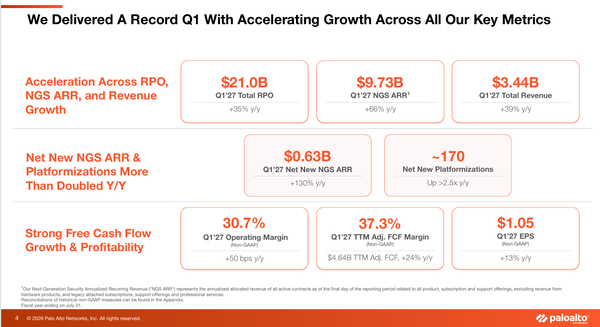
Investors are paying heavily for Palo Alto’s growth, and Q1 FY2027 earnings gave them fresh reasons to do so. Revenue jumped 39% to $3.445 billion, while Next-Generation Security ARR surged 66% to $9.73 billion. But the quarter also exposed a much weaker GAAP operating picture and a multibillion-dollar commitment to AI infrastructure. My goal is to know whether PANW’s expansion can justify the price investors are being asked to pay.

Platformization Is Turning Cybersecurity Into A Larger Wallet Share Opportunity


Palo Alto’s valuation rests partly on its ability to capture more of the cybersecurity budget already flowing through its customer relationships. Instead of selling isolated security products, the company wants enterprises to consolidate more of their protection under its platform. That strategy gives Palo Alto multiple opportunities to expand revenue within accounts it has already won.

Q1 produced approximately 170 net new platformizations, more than 2.5 times the year-ago figure. Those customers now account for two-thirds of NGS ARR, while net retention exceeds 120%. The result is a business with more room to grow inside existing accounts, supported by recurring revenue and a broader product footprint.
palo alto - StockEarnings

Network and AI Security revenue grew 20% to $2.282 billion, while Cortex climbed 53% to $647 million. Idira contributed $353 million following the CyberArk acquisition. Total revenue increased 39%, although acquisitions make that figure an imperfect measure of organic growth. Management raised FY2027 revenue guidance to $14.52–$14.57 billion, implying 26%–27% growth.

The AI opportunity adds another layer to this strategy. Enterprises deploying models and AI agents need to manage access, identities, data exposure, and runtime threats. Prisma AIRS generated approximately $170 million in ARR, up 45% sequentially, with more than 1,100 customers. Palo Alto is already selling into a security problem that grows as enterprise AI adoption expands.

The Premium Looks Different When GAAP Numbers Enter The Picture

A 30.7% non-GAAP operating margin gives investors a strong profitability figure to support PANW’s premium. Non-GAAP operating income reached $1.059 billion, up 50 basis points in margin year over year. GAAP operating income, however, fell from $309 million to just $96 million, leaving a margin of roughly 2.8%.

The reconciliation includes $622 million in stock-based compensation, $282 million in acquired-intangible amortization, and $55 million in acquisition-related costs. Stock compensation alone consumed approximately 18% of revenue. That is a substantial cost to shareholders through dilution, especially when the company continues to use acquisitions to expand its platform. GAAP net income of $482 million also benefited from a $457 million income tax benefit. Pretax income was only $25 million, making the reported bottom line a poor indicator of recurring profitability. 

Cash generation offers a stronger part of the investment case. Operating cash flow reached $1.93 billion and free cash flow $1.84 billion, compared with $1.77 billion and $1.69 billion a year earlier. However, accounts receivable released $1.586 billion in cash during the quarter. That working-capital contribution matters when judging how repeatable the cash conversion will be. Palo Alto generates real cash, but I wouldn’t treat every dollar of this quarter’s operating cash flow as a sustainable run rate.

Applied Compute’s Impact

Palo Alto’s $4.5 billion all-stock acquisition of Applied Compute pushes the company beyond securing enterprise AI deployments and toward supplying infrastructure behind them. Applied Compute develops post-training and inference technology for open-weight AI models, allowing businesses to customize and run models while retaining control over their data and deployments.

The startup has reached approximately $100 million in annualized revenue, and management expects it to contribute $1 billion in NGS ARR by FY2029. That’s roughly tenfold growth in three years. At approximately 45 times current annualized revenue, the acquisition price assumes Palo Alto can scale the business quickly and distribute its technology across its existing customer base.

The infrastructure requirements make that ambition more complicated. Management expects cumulative capital expenditure below $3 billion through FY2030, primarily for GPUs and servers. Operating margin dilution could reach 100 basis points in FY2027 and 200 basis points in FY2028 before returning to the 29%–30% range in FY2029.

Palo Alto expects adjusted free-cash-flow margins above 38% in FY2028, excluding data-center capex. I would pay close attention to that exclusion. Servers and GPUs still consume shareholder capital even when management leaves those costs outside its preferred margin calculation. The $1 billion ARR target is promising, but investors need to see what remains after the infrastructure investment required to produce it.

86x Leaves Little Room For Disappointment

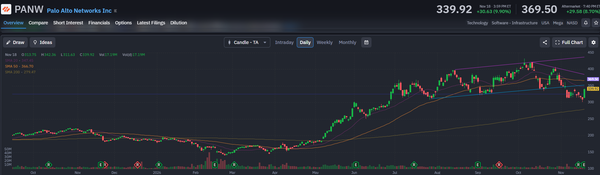
PANW closed at $339.92, up 9.9%, before reaching $369.50 after hours. The regular-session close remained below its 20-day moving average of $347.45 and 50-day average of $366.70. The after-hours rally cleared both levels, putting 366–370 in focus as the first area buyers need to defend. Above that, the 400-420 region represents the next resistance zone. The 200-day average at $279.47 remains the longer-term trend reference.

At $369.50, PANW trades at approximately 86 times the midpoint of FY2027 non-GAAP EPS guidance of $4.28. Its historical forward P/E has generally been closer to 49–57 times across recent fiscal years. The question is how much more investors should pay when GAAP operating profitability remains thin, and its newest growth initiative requires billions in infrastructure spending.

I wouldn’t chase PANW at 86 times forward earnings. I’d rather see stronger GAAP operating profitability and evidence that Applied Compute can deliver its growth targets without permanently weighing on margins and cash generation. Palo Alto is building a business worth owning. At this valuation, I’d wait for a better entry point.
palo alto - StockEarnings

Join over 1.2M+ investors/traders who receive daily and weekly notable earnings alerts with predicted move