ajax loader

Loading...


Ride-the-Wave Strategy – Best for Stock Traders

Ride-the-Wave targets multi-day price momentum following a company’s earnings announcement (EA). With this strategy:

  1. Buy a stock one day post-EA if a stock reacts positively post-earnings:
    1. Near the close of trading the EA-day for a pre-market-EA
    2. Near the close of the following day for a post-market-EA
  2. Sell-to-close after 7-10 days, or possibly earlier if a desired price target is reached

Similarly,

  1. short a stock one day post-EA if a stock reacts negatively post-earnings:
    1. near the close of trading the EA-day for a premarket-EA
    2. near the close of the following day for a post-market-EA
  2. then buy-to-close after 7-10 days, or possibly earlier if a desired price target is reached

Important: Ride-the-Wave is predicated on significant price momentum triggered by an EA. The 7-10 day scenario is the maximum trade hold-time. If you see post EA-momentum is halted or reversed by a significant opposite move, re-evaluate your presence in the trade.

This popular StockEarnings screen below will give you a list of stocks that historically exhibit significant price momentum following an EA for the next seven days:

  1. Stocks exhibiting positive post-EA price moves are buy-candidates
  2. Stocks exhibiting negative post-EA price moves are sell/short-candidates

The screen includes those stocks whose Earnings just came out in last two days.

Screen criteria:

  1. Earnings Date Start Date : Current Date + -1 Day
  2. Earnings Date End Date : Current Date + -2 Days
  3. Predicted Move (Next Day) Max : 7%
  4. Predicted Move (On 7th Day) Min : 7%

Strategy Guideline:

  1. Buy the stock if stock has reacted positively. Short the stock if stock has reacted negatively (see above).
  2. Close the position in 7-10 days, or possibly earlier based on price move.

Volatility Crush Strategy - Best for Options Traders

The Volatility Crush strategy is used with stocks that typically experience relatively low-to-moderate price moves (≤4%) following their Earnings Announcements (EA). The basic trade idea is to sell put or call options right before the EA, collecting a credit when options premium is very high due to elevated implied volatility (IV). You then close the position right after the EA by buying the option back much cheaper due to the significant drop in IV that occurs after the mystery of the EA disappears. In assessing this trade, you need to do your homework to ensure you collect sufficient premium to make the trade worthwhile.

This trade is practical due to the low-to-moderate price-move after the EA, which generally won’t significantly affect the options price, unlike an “action” stock, which experience great price moves post-EA. With these symbols, if you’re on the right side of the price move, that’s a great thing. But if you’re on the wrong side of the move, not so great. Consequently, by minimizing the effect of the post-EA price move, you have a much better chance to profit from the reduction in IV without it being ruined by a violent price move.

For this trade, open the position either (1) the night before the EA when the company announces earnings or (2) during the EA day when it announces post-market, generally capturing IV at or close to its peak.

For this trade, open the position either (1) the night before the EA when the company announces earnings or (2) during the EA day when it announces post-market, generally capturing IV at or close to its peak.

This popular stockearnings screen will give you a list of stocks which do not react more than 4% fpost-EA. It includes only those stocks whose earnings are releasing next day.

Screen criteria:

  1. Earnings Date Start Date : Current Date + 1
  2. Earnings Date End Date : Current Date + 1
  3. Predicted Move (Next Day) Max : 4%
  4. Options Type: Weekly

Strategy Guideline:

  1. Options Strategy: Sell Call and Put
  2. Options Strike Price: Current Stock Price – (% Predicated Move x 2)
  3. Expiration Date: It should generally be the closest expiry immediately after the EA.
  4. Buy Insurance: Buying back Call and Put at Strike price which 10% lower than Sell Strike Price is optional but recommended.

Watch Video for More Detail

Volatility Rush Strategy - Best for Options Traders

The Volatility Rush takes advantage of increasing options premiums into earnings announcements (EA) caused by an anticipated rise in Implied Volatility (IV). With this strategy, Buy a Call and Put at-the-money (a long straddle) 2-3 weeks before the EA when IV is lower. Sell the position either (1) the night before the EA when the company announces earnings pre-market, or (2) during the EA day when it announces post-market, generally capturing IV at or close to its peak.

This popular screen will give you a list of stocks whose Options premiums tend to rise into Earnings. It includes only those stocks whose Earnings are at least two weeks away from today.

Screen criteria:

  1. Earnings Date Start Date : Current Date + 15 Days
  2. Earnings Date End Date : Current Date + 30 Days
  3. Predicted Move (Next Day) Min : 5%
  4. Options Type: Weekly or Monthly if that lines up with the two to three-week lead-time for entering the trade

Strategy Guideline:

  1. Buy a Straddle at or close to the money two to three weeks pre-EA.
  2. Sell the position either the night before the EA when the company announces earnings pre-market, or during the EA day when it announces post-market.
  3. Expiration date should generally be the closest expiry immediately after the EA.
  4. Straddle price should not be more 60% of predicted move.

Predicted Move (Volatility)

Similar to Implied Volatility in Options. Expected volatility % based on our Proprietary Volatility Predication Model. We are expecting that stock price will likely to reach % in either direction by the end of next trading session after Earnings are released and not necessarily the closing volatility %.

Why is it important?

    This indicator helps

  1. Knowing expected volatility in stocks after Earnings helps to decide trading stocks before Earnings Announcement.
  2. Taking Advantage of volatility collapse following Earnings Results by using Advance Options strategies such as Spread and Straddles.

Since Last Earnings

Change in share price since last Earnings release.

Why is it Important?

When share has gained more than 10% since it's last Earning release, it tends to over react to minor bad news and give up some gains if not all. So, it contains more downside volatility than upside When share has dropped more than 10% since it's last Earning release, it tends to over react to minor good news and recover some drops if not all. So, it contains more upside volatility than downside.

EPS Surprise (%)

Occurs when a company's reported quarterly or annual profits are above or below analysts' expectations. Here is the formula to derive % EPS Surprice:

Actual EPS - Estimated EPS
------------------------------------- x 100
Estimated EPS

Why is it Important?

Earnings surprises can have a huge impact on a company's stock price. Several studies suggest that positive earnings surprises not only lead to an immediate hike in a stock's price, but also to a gradual increase over time. Hence, it's not surprising that some companies are known for routinely beating earning projections. A negative earnings surprise will usually result in a decline in share price.

Next Day Price Change (%)

Next Regular trading session Closing price following Earnings result.

For After Market Close Earnings, It is a next trading day closing price. For Before Market Open Earnings, It is the same trading day closing price.

Why is it Important?

Next Day price change is a reaction of Earnings result.

Meta Is Building The 4th Cloud And July 29 Is The Day Zuckerberg Talks

Posted on Jul 27, 2026 by Grayson Cavern

Meta Is Building The 4th Cloud And July 29 Is The Day Zuckerberg Talks

Wall Street has spent six months asking the wrong question about Meta Platforms Inc (NASDAQ: META). The debate has centered entirely on whether $145 billion in capital expenditures can be justified by an advertising business, and while there’s nothing inherently wrong with that, that framing misses what has been happening in plain sight: a systematic, deliberate construction of the infrastructure, the silicon, the partnerships, and the executive talent required to sell compute to the world. Not as a side project. As a business.

And Meta earnings call on July 29 may be the moment that debate becomes irrelevant.

The Capex Isn’t A Cost But A Down Payment


When Meta published “What Is Compute Power?” on June 10 for a general audience, explaining CPUs, GPUs, FLOPS, and gigawatts in language a first-year student could follow, most people read it as a PR exercise. 

I see it as a product announcement without a price tag. Companies don’t publish infrastructure primers for consumers unless they’re building toward something that requires public understanding before they can sell it to them. AWS didn’t explain cloud computing to the general public until it needed the public to buy cloud computing.

The June publication also revealed Meta is building custom MTIA chips in partnership with Broadcom, co-developing Arm’s first data-center processor built specifically for AI workloads, and running partnerships simultaneously with AWS, AMD, and Nvidia to supply the broader compute portfolio. 

Four new chip generations deploying within two years. This is beyond the scope of a company buying infrastructure to run Facebook better. Meta is now building a vertically integrated compute stack – custom silicon through data centers through models – that mirrors what Amazon Inc (NASDAQ: AMZN) assembled before AWS became a $100 billion annual revenue business.

Meta is also in early talks to lease $10 billion in compute to Anthropic over two years, its own direct AI competitor. The internal name for the cloud effort is already circulating: Meta Compute. And the company hired Dave Brown, a former senior Amazon Web Services executive with 19 years building AWS’s compute and machine learning services, with a mandate to build that business and a reporting line directly to Meta’s head of infrastructure. You don’t hire an architect of AWS to run a data center cost center.

Meta Is Growing Faster Than Its Own Stock Price Admits

The advertising business has never been stronger, and the market still sold the stock down nearly 10% year-to-date to $595. Q1 revenue grew 33%, the fastest pace since 2021, ad impressions increased 19%, and average price per ad climbed 12%. 

Consensus for Q2 sits at $60.26 billion in revenue and $7.23 in EPS, with Polymarket traders assigning an 87.1% probability of another beat. 

To be honest, the ad business hasn’t given investors any reasons to be spooked yet. Rather, investors’ skepticism is about what the $145 billion buys beyond it, and whether EPS growth of just 1.3% year-over-year against 26.8% revenue growth represents structural margin compression or temporary investment cost that eventually generates a second revenue stream. 

That’s the uncertainty being priced at 18x forward earnings, cheap for a business growing revenue at 33%, and it’s the uncertainty that resolves if Zuckerberg walks onto the call on July 29 and confirms Meta Compute as a named, funded, publicly committed cloud business rather than a Zuckerberg offhand comment from Q1.

Every Rally Since February Has Failed At The Same Trendline

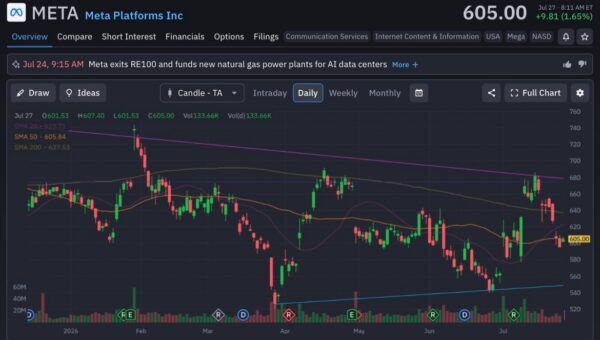
Meta trades at $605, essentially pinned against its 50-day moving average at $605.84 on volume of 133,660 shares: a quiet, controlled session that tells you institutions are holding rather than distributing ahead of a binary catalyst two days away. The 20-day sits at $623.71 above, the 200-day at $637.53 further above, and the descending trendline drawn from the February high near $740 continues pressing down toward current price. Every meaningful rally attempt since February has failed beneath that trendline, which means the stock has been repricing lower while the business has been accelerating higher… a divergence that either resolves through a fundamental re-rating or confirms that the capex concern wins the argument.

A confirmed Meta Compute announcement on July 29 doesn’t just beat an earnings estimate. It changes the valuation framework entirely. A cloud business valued on infrastructure multiples, where AWS alone contributes over $100 billion annually to Amazon’s revenue, sitting on top of an ad machine already growing at 33% produces a different stock price than an ad company spending aggressively on unproven AI ambitions. The trendline resistance near $680 and the 200-day at $637 become the first levels worth watching if the call delivers confirmation.
meta-StockEarnings

If Zuckerberg Names It, The Multiple Has To Change

Revenue and EPS are largely priced. The beat is expected. What I want from Zuckerberg is specificity, not a passing reference to “monetizing excess capacity” but a named business, a revenue timeline, and a clear signal that the Anthropic deal and the Dave Brown hire represent the beginning of a cloud revenue strategy rather than opportunistic infrastructure management.

If that confirmation arrives, Meta stops being an ad company with an expensive AI habit and starts being priced as the only company in the world simultaneously running the largest social advertising network on earth and building the compute infrastructure to lease to everyone else building the future on top of AI. 

The Canada data center, the Anthropic talks, the infrastructure explainer, the AWS executive hire, none of these are coincidental. They’re sequential. And July 29 is where the sequence either gets named or gets delayed another quarter.

I’m bullish. The stock at 18x forward earnings for a business with this growth profile and this optionality is mispriced even before Meta Compute enters the conversation. The confirmation just accelerates the timeline for the market to figure that out.


Join over 1.2M+ investors/traders who receive daily and weekly notable earnings alerts with predicted move