ajax loader

Loading...


Ride-the-Wave Strategy – Best for Stock Traders

Ride-the-Wave targets multi-day price momentum following a company’s earnings announcement (EA). With this strategy:

  1. Buy a stock one day post-EA if a stock reacts positively post-earnings:
    1. Near the close of trading the EA-day for a pre-market-EA
    2. Near the close of the following day for a post-market-EA
  2. Sell-to-close after 7-10 days, or possibly earlier if a desired price target is reached

Similarly,

  1. short a stock one day post-EA if a stock reacts negatively post-earnings:
    1. near the close of trading the EA-day for a premarket-EA
    2. near the close of the following day for a post-market-EA
  2. then buy-to-close after 7-10 days, or possibly earlier if a desired price target is reached

Important: Ride-the-Wave is predicated on significant price momentum triggered by an EA. The 7-10 day scenario is the maximum trade hold-time. If you see post EA-momentum is halted or reversed by a significant opposite move, re-evaluate your presence in the trade.

This popular StockEarnings screen below will give you a list of stocks that historically exhibit significant price momentum following an EA for the next seven days:

  1. Stocks exhibiting positive post-EA price moves are buy-candidates
  2. Stocks exhibiting negative post-EA price moves are sell/short-candidates

The screen includes those stocks whose Earnings just came out in last two days.

Screen criteria:

  1. Earnings Date Start Date : Current Date + -1 Day
  2. Earnings Date End Date : Current Date + -2 Days
  3. Predicted Move (Next Day) Max : 7%
  4. Predicted Move (On 7th Day) Min : 7%

Strategy Guideline:

  1. Buy the stock if stock has reacted positively. Short the stock if stock has reacted negatively (see above).
  2. Close the position in 7-10 days, or possibly earlier based on price move.

Volatility Crush Strategy - Best for Options Traders

The Volatility Crush strategy is used with stocks that typically experience relatively low-to-moderate price moves (≤4%) following their Earnings Announcements (EA). The basic trade idea is to sell put or call options right before the EA, collecting a credit when options premium is very high due to elevated implied volatility (IV). You then close the position right after the EA by buying the option back much cheaper due to the significant drop in IV that occurs after the mystery of the EA disappears. In assessing this trade, you need to do your homework to ensure you collect sufficient premium to make the trade worthwhile.

This trade is practical due to the low-to-moderate price-move after the EA, which generally won’t significantly affect the options price, unlike an “action” stock, which experience great price moves post-EA. With these symbols, if you’re on the right side of the price move, that’s a great thing. But if you’re on the wrong side of the move, not so great. Consequently, by minimizing the effect of the post-EA price move, you have a much better chance to profit from the reduction in IV without it being ruined by a violent price move.

For this trade, open the position either (1) the night before the EA when the company announces earnings or (2) during the EA day when it announces post-market, generally capturing IV at or close to its peak.

For this trade, open the position either (1) the night before the EA when the company announces earnings or (2) during the EA day when it announces post-market, generally capturing IV at or close to its peak.

This popular stockearnings screen will give you a list of stocks which do not react more than 4% fpost-EA. It includes only those stocks whose earnings are releasing next day.

Screen criteria:

  1. Earnings Date Start Date : Current Date + 1
  2. Earnings Date End Date : Current Date + 1
  3. Predicted Move (Next Day) Max : 4%
  4. Options Type: Weekly

Strategy Guideline:

  1. Options Strategy: Sell Call and Put
  2. Options Strike Price: Current Stock Price – (% Predicated Move x 2)
  3. Expiration Date: It should generally be the closest expiry immediately after the EA.
  4. Buy Insurance: Buying back Call and Put at Strike price which 10% lower than Sell Strike Price is optional but recommended.

Watch Video for More Detail

Volatility Rush Strategy - Best for Options Traders

The Volatility Rush takes advantage of increasing options premiums into earnings announcements (EA) caused by an anticipated rise in Implied Volatility (IV). With this strategy, Buy a Call and Put at-the-money (a long straddle) 2-3 weeks before the EA when IV is lower. Sell the position either (1) the night before the EA when the company announces earnings pre-market, or (2) during the EA day when it announces post-market, generally capturing IV at or close to its peak.

This popular screen will give you a list of stocks whose Options premiums tend to rise into Earnings. It includes only those stocks whose Earnings are at least two weeks away from today.

Screen criteria:

  1. Earnings Date Start Date : Current Date + 15 Days
  2. Earnings Date End Date : Current Date + 30 Days
  3. Predicted Move (Next Day) Min : 5%
  4. Options Type: Weekly or Monthly if that lines up with the two to three-week lead-time for entering the trade

Strategy Guideline:

  1. Buy a Straddle at or close to the money two to three weeks pre-EA.
  2. Sell the position either the night before the EA when the company announces earnings pre-market, or during the EA day when it announces post-market.
  3. Expiration date should generally be the closest expiry immediately after the EA.
  4. Straddle price should not be more 60% of predicted move.

Predicted Move (Volatility)

Similar to Implied Volatility in Options. Expected volatility % based on our Proprietary Volatility Predication Model. We are expecting that stock price will likely to reach % in either direction by the end of next trading session after Earnings are released and not necessarily the closing volatility %.

Why is it important?

    This indicator helps

  1. Knowing expected volatility in stocks after Earnings helps to decide trading stocks before Earnings Announcement.
  2. Taking Advantage of volatility collapse following Earnings Results by using Advance Options strategies such as Spread and Straddles.

Since Last Earnings

Change in share price since last Earnings release.

Why is it Important?

When share has gained more than 10% since it's last Earning release, it tends to over react to minor bad news and give up some gains if not all. So, it contains more downside volatility than upside When share has dropped more than 10% since it's last Earning release, it tends to over react to minor good news and recover some drops if not all. So, it contains more upside volatility than downside.

EPS Surprise (%)

Occurs when a company's reported quarterly or annual profits are above or below analysts' expectations. Here is the formula to derive % EPS Surprice:

Actual EPS - Estimated EPS
------------------------------------- x 100
Estimated EPS

Why is it Important?

Earnings surprises can have a huge impact on a company's stock price. Several studies suggest that positive earnings surprises not only lead to an immediate hike in a stock's price, but also to a gradual increase over time. Hence, it's not surprising that some companies are known for routinely beating earning projections. A negative earnings surprise will usually result in a decline in share price.

Next Day Price Change (%)

Next Regular trading session Closing price following Earnings result.

For After Market Close Earnings, It is a next trading day closing price. For Before Market Open Earnings, It is the same trading day closing price.

Why is it Important?

Next Day price change is a reaction of Earnings result.

Kroger Q2 2026 Earnings: Enough to Keep Buy-and-Hold Investors In

Posted on Sep 15, 2026 by Chris Markoch

Kroger Q2 2026 Earnings: Enough to Keep Buy-and-Hold Investors In

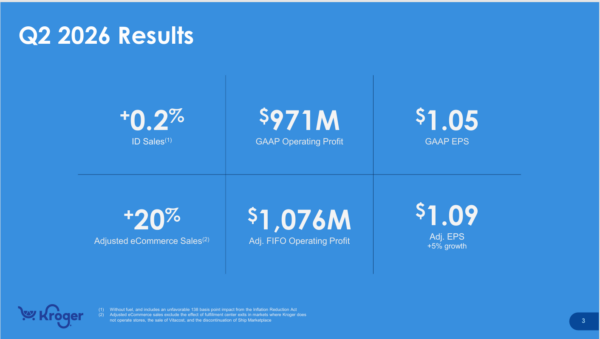
Kroger (NYSE: KR) delivered a Q2 2026 earnings report that didn’t contain numbers that would be considered a blockbuster by any standard. For example, Identical sales excluding fuel rose just 0.2%, and management trimmed full-year identical sales guidance to a range of 0.2% to 0.8%, down from 1.0% to 2.0% as of June. GAAP earnings per share came in at $1.05, with adjusted EPS at $1.09.

None of that tells a growth story. But does it need to?

Kroger operates in a grocery sector defined by thin margins, price-sensitive shoppers, and competitors like Walmart (NASDAQ: WMT), Amazon (NASDAQ: AMZN), and Costco (NASDAQ; COST) that all have different levers to pull when it comes to revenue. Kroger can’t win a pure growth argument against any of them.

What it can do is give buy-and-hold investors just enough reasons to stay put. In this case, the dividend continues to grow. E-commerce is expanding at a rate that outpaces the core business. And the stock’s technical picture, while still messy, showed a real bounce on earnings day. That combination — not any single headline number — is the actual takeaway from this report.

A Dividend That Keeps Doing the Heavy Lifting


Kroger’s dividend story remains the clearest argument for staying invested. The company declared $0.39 per share this quarter, up from $0.35 a year ago. That continues a streak of 19 consecutive years of dividend growth.

At current prices, that works out to a 2.56% yield. On its own, that number isn’t dramatic. Plenty of stocks pay more.

But yield alone misses the point. Nineteen years of consecutive increases mean Kroger has raised its payout through recessions, a pandemic, and a failed merger attempt with Albertsons (NYSE: ACI). That consistency is the asset, not the yield itself.

Kroger also backed a cash payout target of 5% to 6% of sales toward dividends and buybacks. Treasury stock purchases already total $1.27 billion year-to-date, more than six times last year’s pace. For income-focused investors, this is a management team treating shareholder return as a core discipline, not an afterthought.

E-Commerce Growth Offers a Different Kind of Upside

The most intriguing number in this report wasn’t the earnings line. It was the 20% year-over-year growth in adjusted e-commerce sales, led by strong delivery growth.
kroger - StockEarnings

Kroger isn’t going to out-scale Amazon or Walmart in e-commerce. That’s not the argument here. The argument is that Kroger can grow this piece of the business fast enough to make a meaningful difference.

Adjusted e-commerce sales for full-year 2025 totaled roughly $16 billion, under Kroger’s restated sales definitions. That’s a meaningful base. Growing it at 20% annually compounds quickly over several years.

This matters more given another trend in the report: new store growth is slowing. Kroger’s physical footprint sits at roughly 2,700 stores, a number that isn’t expanding aggressively. If e-commerce can keep growing at double-digit rates, it can offset that slower physical expansion. It gives Kroger a second growth lever that doesn’t depend on real estate.

Kroger Precision Marketing, the company’s retail media arm, adds a third leg. That segment grew profit 24% this quarter, its best pace since 2021. Together, e-commerce and media represent Kroger’s attempt to build margin-accretive growth on top of a low-margin grocery base.

What the Chart Is Saying

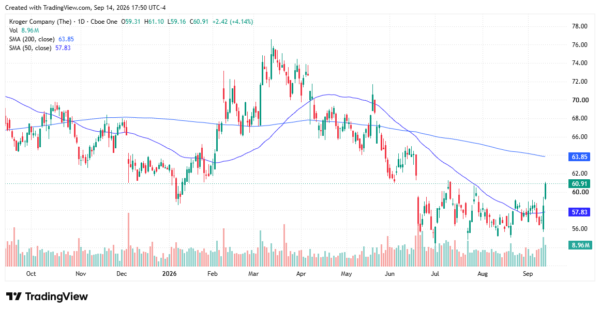
KR shares jumped 4.14% on earnings day, closing near $60.91. That’s a notable one-day move for a grocery stock.

The stock remains below both its 50-day ($57.83) and 200-day ($63.85) moving averages, though the gap to the shorter-term average has now closed. Shares have fallen from a March 2026 high near $76 to a summer low around $54, and this rally attempts to reverse that trend. It’s a step in the right direction, but not yet a confirmed trend change.
kroger - StockEarnings

Perception vs. Fundamentals: Time Will Tell

The perception around Kroger right now is mixed. Slowing identical sales and reduced guidance read as disappointing on the surface. But underneath that headline, the fundamentals tell a steadier story: a growing dividend, an accelerating e-commerce segment, and disciplined capital returns.

That gap between perception and fundamentals is where the buy-and-hold case lives. Kroger isn’t offering investors a growth story. It’s offering a durability story, backed by nearly two decades of dividend increases and a diversified profit engine beyond the grocery aisle.

Whether that’s enough to satisfy the market in the longer term is a separate question from whether it’s enough to satisfy patient shareholders today. For now, the stock gave buy-and-hold investors just enough to stay involved. Time will likely be the best way to determine the stock’s direction from here.


A former marketing copywriter turned freelance financial writer and market analyst. I have a passion for delivering insights to investors. I write regularly about stocks for StockEarnings and MarketBeat. Posts are not advice.

Join over 1.2M+ investors/traders who receive daily and weekly notable earnings alerts with predicted move