ajax loader

Loading...


Ride-the-Wave Strategy – Best for Stock Traders

Ride-the-Wave targets multi-day price momentum following a company’s earnings announcement (EA). With this strategy:

  1. Buy a stock one day post-EA if a stock reacts positively post-earnings:
    1. Near the close of trading the EA-day for a pre-market-EA
    2. Near the close of the following day for a post-market-EA
  2. Sell-to-close after 7-10 days, or possibly earlier if a desired price target is reached

Similarly,

  1. short a stock one day post-EA if a stock reacts negatively post-earnings:
    1. near the close of trading the EA-day for a premarket-EA
    2. near the close of the following day for a post-market-EA
  2. then buy-to-close after 7-10 days, or possibly earlier if a desired price target is reached

Important: Ride-the-Wave is predicated on significant price momentum triggered by an EA. The 7-10 day scenario is the maximum trade hold-time. If you see post EA-momentum is halted or reversed by a significant opposite move, re-evaluate your presence in the trade.

This popular StockEarnings screen below will give you a list of stocks that historically exhibit significant price momentum following an EA for the next seven days:

  1. Stocks exhibiting positive post-EA price moves are buy-candidates
  2. Stocks exhibiting negative post-EA price moves are sell/short-candidates

The screen includes those stocks whose Earnings just came out in last two days.

Screen criteria:

  1. Earnings Date Start Date : Current Date + -1 Day
  2. Earnings Date End Date : Current Date + -2 Days
  3. Predicted Move (Next Day) Max : 7%
  4. Predicted Move (On 7th Day) Min : 7%

Strategy Guideline:

  1. Buy the stock if stock has reacted positively. Short the stock if stock has reacted negatively (see above).
  2. Close the position in 7-10 days, or possibly earlier based on price move.

Volatility Crush Strategy - Best for Options Traders

The Volatility Crush strategy is used with stocks that typically experience relatively low-to-moderate price moves (≤4%) following their Earnings Announcements (EA). The basic trade idea is to sell put or call options right before the EA, collecting a credit when options premium is very high due to elevated implied volatility (IV). You then close the position right after the EA by buying the option back much cheaper due to the significant drop in IV that occurs after the mystery of the EA disappears. In assessing this trade, you need to do your homework to ensure you collect sufficient premium to make the trade worthwhile.

This trade is practical due to the low-to-moderate price-move after the EA, which generally won’t significantly affect the options price, unlike an “action” stock, which experience great price moves post-EA. With these symbols, if you’re on the right side of the price move, that’s a great thing. But if you’re on the wrong side of the move, not so great. Consequently, by minimizing the effect of the post-EA price move, you have a much better chance to profit from the reduction in IV without it being ruined by a violent price move.

For this trade, open the position either (1) the night before the EA when the company announces earnings or (2) during the EA day when it announces post-market, generally capturing IV at or close to its peak.

For this trade, open the position either (1) the night before the EA when the company announces earnings or (2) during the EA day when it announces post-market, generally capturing IV at or close to its peak.

This popular stockearnings screen will give you a list of stocks which do not react more than 4% fpost-EA. It includes only those stocks whose earnings are releasing next day.

Screen criteria:

  1. Earnings Date Start Date : Current Date + 1
  2. Earnings Date End Date : Current Date + 1
  3. Predicted Move (Next Day) Max : 4%
  4. Options Type: Weekly

Strategy Guideline:

  1. Options Strategy: Sell Call and Put
  2. Options Strike Price: Current Stock Price – (% Predicated Move x 2)
  3. Expiration Date: It should generally be the closest expiry immediately after the EA.
  4. Buy Insurance: Buying back Call and Put at Strike price which 10% lower than Sell Strike Price is optional but recommended.

Watch Video for More Detail

Volatility Rush Strategy - Best for Options Traders

The Volatility Rush takes advantage of increasing options premiums into earnings announcements (EA) caused by an anticipated rise in Implied Volatility (IV). With this strategy, Buy a Call and Put at-the-money (a long straddle) 2-3 weeks before the EA when IV is lower. Sell the position either (1) the night before the EA when the company announces earnings pre-market, or (2) during the EA day when it announces post-market, generally capturing IV at or close to its peak.

This popular screen will give you a list of stocks whose Options premiums tend to rise into Earnings. It includes only those stocks whose Earnings are at least two weeks away from today.

Screen criteria:

  1. Earnings Date Start Date : Current Date + 15 Days
  2. Earnings Date End Date : Current Date + 30 Days
  3. Predicted Move (Next Day) Min : 5%
  4. Options Type: Weekly or Monthly if that lines up with the two to three-week lead-time for entering the trade

Strategy Guideline:

  1. Buy a Straddle at or close to the money two to three weeks pre-EA.
  2. Sell the position either the night before the EA when the company announces earnings pre-market, or during the EA day when it announces post-market.
  3. Expiration date should generally be the closest expiry immediately after the EA.
  4. Straddle price should not be more 60% of predicted move.

Predicted Move (Volatility)

Similar to Implied Volatility in Options. Expected volatility % based on our Proprietary Volatility Predication Model. We are expecting that stock price will likely to reach % in either direction by the end of next trading session after Earnings are released and not necessarily the closing volatility %.

Why is it important?

    This indicator helps

  1. Knowing expected volatility in stocks after Earnings helps to decide trading stocks before Earnings Announcement.
  2. Taking Advantage of volatility collapse following Earnings Results by using Advance Options strategies such as Spread and Straddles.

Since Last Earnings

Change in share price since last Earnings release.

Why is it Important?

When share has gained more than 10% since it's last Earning release, it tends to over react to minor bad news and give up some gains if not all. So, it contains more downside volatility than upside When share has dropped more than 10% since it's last Earning release, it tends to over react to minor good news and recover some drops if not all. So, it contains more upside volatility than downside.

EPS Surprise (%)

Occurs when a company's reported quarterly or annual profits are above or below analysts' expectations. Here is the formula to derive % EPS Surprice:

Actual EPS - Estimated EPS
------------------------------------- x 100
Estimated EPS

Why is it Important?

Earnings surprises can have a huge impact on a company's stock price. Several studies suggest that positive earnings surprises not only lead to an immediate hike in a stock's price, but also to a gradual increase over time. Hence, it's not surprising that some companies are known for routinely beating earning projections. A negative earnings surprise will usually result in a decline in share price.

Next Day Price Change (%)

Next Regular trading session Closing price following Earnings result.

For After Market Close Earnings, It is a next trading day closing price. For Before Market Open Earnings, It is the same trading day closing price.

Why is it Important?

Next Day price change is a reaction of Earnings result.

DAL Stock: Great Earnings, But Is the Rally Losing Altitude?

Posted on Jul 13, 2026 by Chris Markoch

DAL Stock: Great Earnings, But Is the Rally Losing Altitude?

There was nothing wrong with the Delta Air Lines Inc. (NYSE: DAL) earnings report for Q2 2026. The company delivered record quarterly revenue of $17.7 billion, up 14% year over year. The airline also delivered adjusted earnings per share (EPS) of $1.56 and a 9% operating margin, both of which beat its prior guidance. Furthermore, Delta reiterated its prior full-year guidance and struck a bullish tone regarding the travel outlook for the rest of the year.  

Overall, the report affirmed what many investors (yours truly included) believe about airline stocks. They can be a tough investment, but if there’s one to own, DAL would be it. In 2026 specifically, Delta’s business model, which caters to a more affluent consumer, puts it in the right lane.  

But after getting an early lift from the earnings report, DAL hit some turbulence and was trading almost exactly where it was before earnings at the market close on July 10. That continues a trend that started at the beginning of July. It’s not even a 10% slide from that high of around $95 per share. However, it’s a reminder that earnings reports are best viewed with one eye in the rearview mirror, with a more important focus on what’s ahead. 

Why Affluent Travelers Keep Delta Airborne 


Anecdotal evidence (which is neither right nor wrong to consider) shows that Delta is correct in reporting strong demand. Crowded airports and full flights are a sign that demand for luxury and business travel is not abating.  

And why should it? Look all around the travel industry: Hyatt Hotels (NYSE: H)Viking Holdings (NYSE: VIK), and Live Nation Entertainment (NYSE: LYV) are all trading at or near 52-week highs as of July 10. These companies have a common denominator: their core consumers are not impacted by inflation and higher-for-longer interest rates. When you consider that many baby boomers, who make up a significant cohort of the luxury travel market, are not buying new homes. They have the means to travel and are doing so. 

As it relates to Delta, that demand shouldn’t be dismissed as a one-off due to the 2026 FIFA World Cup. About 75% of Delta’s revenue still comes from inside the United States. The company made a point of highlighting structural changes it believes will support firmer pricing, making it difficult for low-cost carriers to undercut its fares on a sustainable basis.  

Delta’s New Basic Business Class: Growth Move or Warning Sign? 

But in the category of “I see your anecdote and raise you another anecdote,” Delta has announced a new entry-level premium tier that attempts to capture more revenue by unbundling luxury travel. The new tier offers lower fares in exchange for a reduction in traditional perks such as advance seat selection and full baggage allowances.  

This is another example of beauty being in the eye of the beholder. You could make a case that Delta is doing this to capture additional market share from its competitors. However, according to Brian Sumers of The Airline Observer, “Basic economy was one of the biggest genius moves at the time because it allowed those airlines to compete with discounters on an equal level. Basic business class (Delta’s new tier) is not competing with anybody.”  

Except maybe itself. That’s something to consider. The conventional narrative is that the economy is running hot. But this is a move that suggests Delta may be trying to head off travel softness, either for businesses or for some consumers who are straddling the upper and lower legs of the K-shaped economy.  

Is DAL Priced for Perfection?  

It’s only a couple of days removed from earnings as I write this. So far, analyst forecasts have been bullish. For example, Morgan Stanley and Jefferies both gave DAL bullish price targets of $125 and $110, respectively. The $125 target would represent a 26% increase from the stock’s July 10 closing price of $87.48. When you factor in the company’s dividend, which yields 0.98%, that growth is in line with the total return investors have received over the last three years.  

However, DAL is up more than 50% in the last 12 months. Bulls will say that’s appropriate because the airline sector is at the beginning of a super cycle. There’s an argument for that. If higher fuel prices caused by inflation, then the U.S. conflict with Iran, hasn’t slowed momentum, maybe it’s nothing but blue skies ahead.  

On the other hand, Delta maintained its guidance after a record-setting quarter for revenue. Don’t get me wrong, that’s a prudent decision, but it’s also something for investors to consider. 

The “what if” argument goes both ways. What if interest rates move higher, even by just 25 basis points? What if a prolonged conflict with Iran sets a much higher floor for oil prices and inflation expectations? Those are questions that argue that investors who are on the sidelines may want to wait for a larger pullback before taking a position.  

Chart Check: Has Delta’s Rally Run Out of Runway? 

The chart tells a more cautious story than the earnings reaction alone. DAL spent the back half of June and the first days of July climbing from the low-$80s to an intraday high near $95, a run that pushed the stock well above its 50-day simple moving average, currently sitting at $80.11. That gap between price and trend line was already stretched before earnings even hit the tape. 

Since topping out, DAL has pulled back to $87.39, a decline of roughly 8% from the high. That’s a normal, healthy pullback by most technical standards, not a trend reversal. But the MACD indicator adds a note of caution: the MACD line has crossed below its signal line, and the histogram has moved into negative territory. That’s typically read as fading upside momentum, even if the broader trend (price still well above the 50-day SMA) remains intact. 

Put simply, the daily chart is telling a “cooling off” story that echoes the fundamental debate. The stock isn’t broken, but it’s due for either a period of consolidation or a deeper pullback toward the 50-day SMA before the next leg higher can be trusted. 
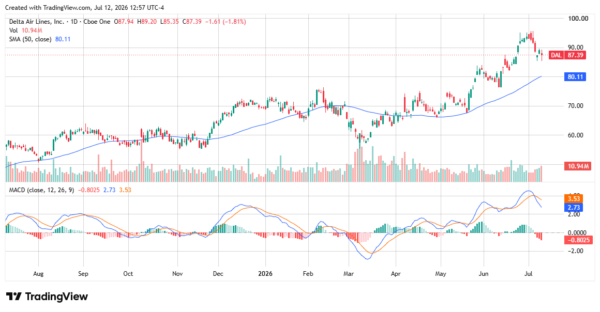
DAL - StockEarnings

A former marketing copywriter turned freelance financial writer and market analyst. I have a passion for delivering insights to investors. I write regularly about stocks for StockEarnings and MarketBeat. Posts are not advice.

Join over 1.2M+ investors/traders who receive daily and weekly notable earnings alerts with predicted move