Turnarounds have a funny way of moving the goalposts. First, investors want proof the company can stop getting worse. Once that happens, they immediately start demanding evidence that things can get materially better.
Last quarter, Boeing (NYSE: BA) graduated from proving it could build airplanes again. This quarter, it had to prove those airplanes could start repairing the business itself. I’d say it passed. Not because BA suddenly became a polished business overnight. It didn’t. In its Q2 earnings report, the company still reported a core loss of $0.76 per share, weighed down by a $280 million charge tied to the Air Force One programme. If that’s all you looked at, you’d probably come away thinking this was another mixed quarter.
Look a little deeper, and you’ll discover that revenue climbed 17% to $24.56 billion. Operating cash flow reached $4.1 billion, free cash flow improved to $3.4 billion, and commercial deliveries rose to 171 aircraft. BA also walked away with a record backlog of more than $619 billion, giving it years of production already spoken for. This means that the conversation is changing. For the last few years, every Boeing quarter began and ended with the factory floor. This one nudged my attention to the cash those factories are finally beginning to produce.
No Standing Ovation
One reason BA didn’t receive a standing ovation after earnings is that investors are buying the next few years more than this quarter.
On that front, the company gave them plenty to work with. Boeing ended the quarter with a record backlog exceeding $619 billion, including more than 6,200 commercial aircraft. That’s not just a large number to drop into an earnings release. It’s years of contracted demand sitting in the queue, giving management unusual visibility into future production.
Of course, a backlog has never been Boeing’s problem. Turning orders into delivered aircraft – and delivered aircraft into profitable cash flow – has been.
That’s why I paid closer attention to management’s comments around production. The 737 programme continues to move toward a monthly production rate of 38 aircraft, while the 787 programme remains on track to reach seven per month later this year. Those aren’t flashy milestones, but they determine how quickly the company converts that backlog into revenue and, more importantly, cash.
To me, that’s the bigger takeaway. Demand no longer needs defending. Execution still does.
Boeing’s Chart Is Waiting For Management To Blink First
Boeing’s fundamentals have improved faster than its stock. That’s not unusual. Markets tend to demand repetition before handing out higher valuations.
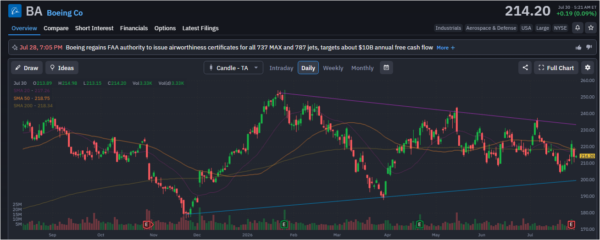
Since February, BA has failed three separate attempts to break above its long-term descending trendline, most recently after this quarter’s earnings. At the same time, buyers have continued defending a rising trendline that’s been intact since the April low, creating a tightening range that neither side has been able to break.
Shares are now trading just below the 20-day, 50-day, and 200-day moving averages, which have compressed into a narrow band around 217-219. Instead of providing support, they’ve become a ceiling that the company has struggled to reclaim.
To me, that’s a market waiting for evidence rather than doubting the story. The easy part of Boeing’s rerating came when investors realised the company wasn’t falling apart. The next leg probably won’t begin until management strings together enough quarters of improving cash flow and execution to force that resistance out of the way.
My Scorecard For Boeing Just Changed
A few quarters ago, I was judging Boeing by a simple standard: Can it build airplanes consistently again?
I don’t think that’s the right question anymore. The company has shown it can steadily increase production, rebuild its order book and generate meaningful cash even with legacy programme charges still weighing on results. That’s enough for me to move the goalposts.
From here, I want to see something different. I want operating improvements to become routine rather than newsworthy. I want Commercial Airplanes to produce healthier margins as production rates increase. Most importantly, I want Boeing to prove this quarter wasn’t an isolated step forward but the beginning of a repeatable financial profile.
That’s a much higher bar than simply celebrating every additional aircraft that leaves the factory. And for long-term investors, I think that’s good news.
Companies don’t earn premium valuations because they solve yesterday’s problems. They earn them by making investors stop worrying about those problems altogether. Boeing isn’t there yet, but it’s closer than it’s been in years. The business is finally generating the kind of cash that gives management options instead of excuses.
I remain bullish on BA because the operational turnaround is becoming a financial one, and if management keeps executing, I think the stock still has room to catch up with the business.