Market uncertainty has a way of making speculative investments look especially risky. When broader indexes are choppy and macro headwinds dominate the headlines, parking money in clinical-stage biotech companies, stocks with no guaranteed revenue and multiyear timelines before a meaningful payoff, can feel borderline reckless.
But long-term investors who have done this homework before know that volatility cuts both ways. Biotech stocks can crater on a single trial miss, yes. But they can also deliver extraordinary gains when science and timing align — and the best time to accumulate shares is often when nobody else wants to look.
This is precisely the moment to consider three small biotech stocks focused on oncology and related cell therapies: ImmunityBio (NASDAQ: IBRX), Crescent Biopharma (NASDAQ: CBIO), and Cabaletta Bio (NASDAQ: CABA). None of these are household names. All three trade at relatively low prices and carry real clinical risk. But each has a credible story backed by analyst support, and all three are operating in oncology, a therapeutic area where unmet medical need is so vast that it can support dozens of competing approaches simultaneously. There is no such thing as too many treatments in this market.
Owning these stocks is not a trade. It is a thesis, one that requires patience, a tolerance for volatility, and the discipline not to panic when the charts look ugly. For investors with a three-to-five-year horizon and a stomach for speculative risk, this dip may be worth acting on.
A Commercial-Stage Bladder Cancer Immunotherapy With Global Ambitions
ImmunityBio may be the most compelling of the three from a near-term commercial standpoint. The company has already crossed from development-stage to revenue-generating, with its lead product, Anktiva — an interleukin-15 receptor superagonist designed to activate natural killer cells and cytotoxic T cells — now approved in the U.S. for BCG-unresponsive non-muscle-invasive bladder cancer (NMIBC).
The commercial ramp has been striking. IBRX reported Anktiva’s net product revenue of approximately $113 million in 2025, representing around 700% year-over-year growth, with Q4 2025 revenue of $38.3 million. That kind of growth trajectory in a newly launched oncology drug attracts serious attention.
The regulatory footprint is expanding rapidly beyond U.S. borders. ANKTIVA holds full approvals for BCG-unresponsive NMIBC in the U.S., UK, and Saudi Arabia, with conditional EU authorization granted in early 2026, and is covered by more than 240 million U.S. lives. On the international front, ImmunityBio’s partner, Accord Healthcare, is set to deploy commercial teams across 31 European countries, with Germany as a priority early launch market.
The pipeline extends well beyond the bladder. IBRX is running trials across NSCLC, pancreatic cancer — where it holds RMAT designation — glioblastoma, NHL, and HPV-related tumors. The RMAT designation for pancreatic cancer is particularly notable; the FDA reserves it for regenerative therapies showing early evidence of meaningful patient benefit. Glioblastoma data readouts are among the catalysts analysts are watching most closely.
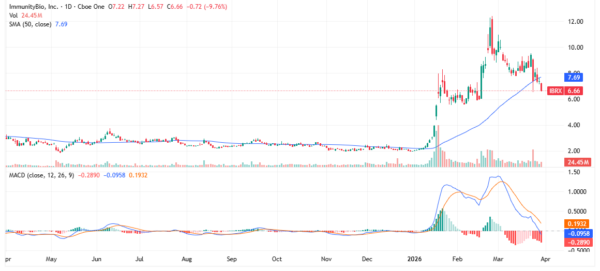
The chart tells a cautionary tale. After a spectacular run from roughly $2 to above $12 between late 2025 and early 2026, IBRX has pulled back significantly, closing around $6.66 on March 30 — below its 50-day moving average of $7.69, with a bearish MACD reading. For momentum traders, this is a red flag. For long-term patient investors, it may be an entry point worth considering, as the stock digests its gains while the underlying business continues to grow.
A Next-Generation Oncology Upstart Built for Speed
Crescent Biopharma is a younger and earlier-stage story, but one built with deliberate urgency. The company’s lead asset, CR-001, is a tetravalent PD-1 x VEGF bispecific antibody — a class of drug designed to simultaneously block two of the most validated targets in modern oncology. CR-001 was intentionally designed to replicate the cooperative pharmacology of ivonescimab, which demonstrated superior efficacy compared to market-leading pembrolizumab in a large Phase 3 trial in non-small cell lung cancer.
Crescent has moved quickly since its June 2025 merger with GlycoMimetics and a subsequent $185 million private placement. The ASCEND Phase 1/2 global clinical trial is now underway, evaluating CR-001 in advanced solid tumors, with three additional clinical trials across the portfolio expected to initiate in 2026, and the financing providing cash runway into 2028. ASCEND may enroll up to 290 patients across the U.S., Europe, and Asia Pacific, with proof-of-concept data targeted for Q1 2027.
Alongside CR-001, Crescent is advancing CR-002, a topoisomerase inhibitor antibody-drug conjugate targeting PD-L1, and CR-003, an ADC targeting integrin beta-6, which is overexpressed in many solid tumors but is minimally expressed in most normal tissues — a design intended to reduce systemic toxicity. The combination strategy — using CR-001 as an immuno-oncology backbone paired with ADCs — mirrors the direction the entire field is moving.
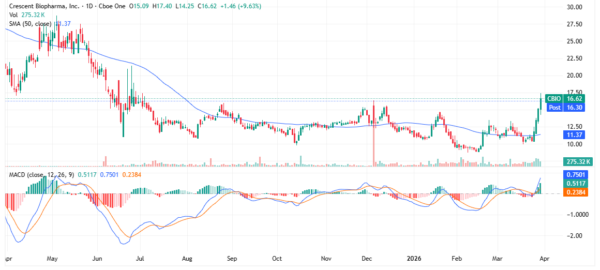
CBIO’s chart shows a dramatic surge on heavy volume in late March 2026, with the stock jumping from around $10 to close at $16.62 — well above its 50-day moving average of $11.37. The MACD is bullishly crossed and climbing. This kind of momentum can be fleeting for clinical-stage companies, and investors should be prepared for pullbacks as early trial data is awaited. But the combination of funded runway, credible science, and an experienced team makes CBIO worth watching for longer-term positioning.
CAR-T Technology Aimed at Diseases With No Good Options
Cabaletta Bio occupies a fascinating intersection between oncology and autoimmune disease. The company’s lead therapy, rese-cel (resecabtagene autoleucel), is a CAR-T cell therapy — a technology pioneered in cancer — now being applied to a set of devastating autoimmune conditions, including systemic lupus erythematosus, myositis, systemic sclerosis, and generalized myasthenia gravis. The idea is elegant: use the same machinery that wipes out cancer B cells to reset a malfunctioning immune system.
Morgan Stanley and Jefferies have each reiterated Buy ratings on the stock, forecasting upside potential of more than 350% from recent levels, with Jefferies highlighting the company’s use of automated manufacturing technology that could allow production for thousands of patients annually with limited capital investment.
The clinical story is gaining momentum. Cabaletta initiated an FDA-aligned registrational cohort for dermatomyositis and antisynthetase syndrome in December 2025, affecting approximately 70,000 U.S. patients, with a 16-week primary endpoint measuring improvement while off immunomodulators and on no or low-dose steroids. The company also gained clearance to use Cellares’ fully automated Cell Shuttle platform to manufacture rese-cel — described as a first for an autologous CAR-T program — with clinical manufacturing data expected in the first half of 2026.
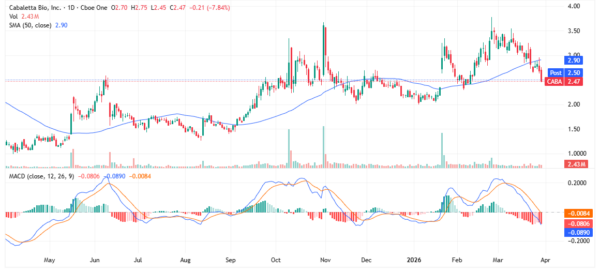
CABA’s chart shows the stock trading near $2.47, below its 50-day moving average of $2.90, with bearish MACD momentum after a period of strength in early 2026. The cash runway extends into the second half of 2026, meaning a fundraise may be on the horizon — a common risk for clinical-stage biotechs. Still, a BLA submission is being planned for 2027, and the technology has regulatory backing, including FDA Fast Track and RMAT designations.
Why These Biotech Stocks Aren’t for Everyone
Owning speculative biotech stocks requires a clear-eyed understanding of the risks. All three companies carry significant clinical uncertainty — a single failed trial can erase years of gains overnight. IBRX, despite its commercial traction, faces competition from Johnson & Johnson’s Inlexzo in bladder cancer and continues to burn cash at scale. CBIO is entirely pre-revenue, with proof-of-concept data not expected until 2027, and proof-of-concept is not the same as approval. CABA faces a capital crunch — its runway only extends into late 2026 — and while automated manufacturing is promising, the economics of autologous CAR-T therapies at scale remain unproven.
The broader macro environment is also unfavorable for speculative names, with interest rates keeping investors risk-averse. Any of these companies could also become acquisition targets, which sounds appealing until a deal closes at a disappointing premium.
Accumulate Slowly, Watch the Science
The case for these three biotech stocks is not about the next three months. It is about what the oncology and cell therapy landscape looks like in 2028 and 2030. ImmunityBio is building real revenue around a differentiated immunotherapy platform. Crescent Biopharma is executing a best-in-class strategy in one of the hottest areas of cancer drug development. Cabaletta Bio is applying breakthrough cell therapy science to diseases that desperately need better answers.
None of these investments is comfortable. But for investors with time on their side and a portfolio that can absorb some volatility, the current prices may look like gifts in hindsight — or lessons. Either way, the science is worth following.