ajax loader

Loading...


Ride-the-Wave Strategy – Best for Stock Traders

Ride-the-Wave targets multi-day price momentum following a company’s earnings announcement (EA). With this strategy:

  1. Buy a stock one day post-EA if a stock reacts positively post-earnings:
    1. Near the close of trading the EA-day for a pre-market-EA
    2. Near the close of the following day for a post-market-EA
  2. Sell-to-close after 7-10 days, or possibly earlier if a desired price target is reached

Similarly,

  1. short a stock one day post-EA if a stock reacts negatively post-earnings:
    1. near the close of trading the EA-day for a premarket-EA
    2. near the close of the following day for a post-market-EA
  2. then buy-to-close after 7-10 days, or possibly earlier if a desired price target is reached

Important: Ride-the-Wave is predicated on significant price momentum triggered by an EA. The 7-10 day scenario is the maximum trade hold-time. If you see post EA-momentum is halted or reversed by a significant opposite move, re-evaluate your presence in the trade.

This popular StockEarnings screen below will give you a list of stocks that historically exhibit significant price momentum following an EA for the next seven days:

  1. Stocks exhibiting positive post-EA price moves are buy-candidates
  2. Stocks exhibiting negative post-EA price moves are sell/short-candidates

The screen includes those stocks whose Earnings just came out in last two days.

Screen criteria:

  1. Earnings Date Start Date : Current Date + -1 Day
  2. Earnings Date End Date : Current Date + -2 Days
  3. Predicted Move (Next Day) Max : 7%
  4. Predicted Move (On 7th Day) Min : 7%

Strategy Guideline:

  1. Buy the stock if stock has reacted positively. Short the stock if stock has reacted negatively (see above).
  2. Close the position in 7-10 days, or possibly earlier based on price move.

Volatility Crush Strategy - Best for Options Traders

The Volatility Crush strategy is used with stocks that typically experience relatively low-to-moderate price moves (≤4%) following their Earnings Announcements (EA). The basic trade idea is to sell put or call options right before the EA, collecting a credit when options premium is very high due to elevated implied volatility (IV). You then close the position right after the EA by buying the option back much cheaper due to the significant drop in IV that occurs after the mystery of the EA disappears. In assessing this trade, you need to do your homework to ensure you collect sufficient premium to make the trade worthwhile.

This trade is practical due to the low-to-moderate price-move after the EA, which generally won’t significantly affect the options price, unlike an “action” stock, which experience great price moves post-EA. With these symbols, if you’re on the right side of the price move, that’s a great thing. But if you’re on the wrong side of the move, not so great. Consequently, by minimizing the effect of the post-EA price move, you have a much better chance to profit from the reduction in IV without it being ruined by a violent price move.

For this trade, open the position either (1) the night before the EA when the company announces earnings or (2) during the EA day when it announces post-market, generally capturing IV at or close to its peak.

For this trade, open the position either (1) the night before the EA when the company announces earnings or (2) during the EA day when it announces post-market, generally capturing IV at or close to its peak.

This popular stockearnings screen will give you a list of stocks which do not react more than 4% fpost-EA. It includes only those stocks whose earnings are releasing next day.

Screen criteria:

  1. Earnings Date Start Date : Current Date + 1
  2. Earnings Date End Date : Current Date + 1
  3. Predicted Move (Next Day) Max : 4%
  4. Options Type: Weekly

Strategy Guideline:

  1. Options Strategy: Sell Call and Put
  2. Options Strike Price: Current Stock Price – (% Predicated Move x 2)
  3. Expiration Date: It should generally be the closest expiry immediately after the EA.
  4. Buy Insurance: Buying back Call and Put at Strike price which 10% lower than Sell Strike Price is optional but recommended.

Watch Video for More Detail

Volatility Rush Strategy - Best for Options Traders

The Volatility Rush takes advantage of increasing options premiums into earnings announcements (EA) caused by an anticipated rise in Implied Volatility (IV). With this strategy, Buy a Call and Put at-the-money (a long straddle) 2-3 weeks before the EA when IV is lower. Sell the position either (1) the night before the EA when the company announces earnings pre-market, or (2) during the EA day when it announces post-market, generally capturing IV at or close to its peak.

This popular screen will give you a list of stocks whose Options premiums tend to rise into Earnings. It includes only those stocks whose Earnings are at least two weeks away from today.

Screen criteria:

  1. Earnings Date Start Date : Current Date + 15 Days
  2. Earnings Date End Date : Current Date + 30 Days
  3. Predicted Move (Next Day) Min : 5%
  4. Options Type: Weekly or Monthly if that lines up with the two to three-week lead-time for entering the trade

Strategy Guideline:

  1. Buy a Straddle at or close to the money two to three weeks pre-EA.
  2. Sell the position either the night before the EA when the company announces earnings pre-market, or during the EA day when it announces post-market.
  3. Expiration date should generally be the closest expiry immediately after the EA.
  4. Straddle price should not be more 60% of predicted move.

Predicted Move (Volatility)

Similar to Implied Volatility in Options. Expected volatility % based on our Proprietary Volatility Predication Model. We are expecting that stock price will likely to reach % in either direction by the end of next trading session after Earnings are released and not necessarily the closing volatility %.

Why is it important?

    This indicator helps

  1. Knowing expected volatility in stocks after Earnings helps to decide trading stocks before Earnings Announcement.
  2. Taking Advantage of volatility collapse following Earnings Results by using Advance Options strategies such as Spread and Straddles.

Since Last Earnings

Change in share price since last Earnings release.

Why is it Important?

When share has gained more than 10% since it's last Earning release, it tends to over react to minor bad news and give up some gains if not all. So, it contains more downside volatility than upside When share has dropped more than 10% since it's last Earning release, it tends to over react to minor good news and recover some drops if not all. So, it contains more upside volatility than downside.

EPS Surprise (%)

Occurs when a company's reported quarterly or annual profits are above or below analysts' expectations. Here is the formula to derive % EPS Surprice:

Actual EPS - Estimated EPS
------------------------------------- x 100
Estimated EPS

Why is it Important?

Earnings surprises can have a huge impact on a company's stock price. Several studies suggest that positive earnings surprises not only lead to an immediate hike in a stock's price, but also to a gradual increase over time. Hence, it's not surprising that some companies are known for routinely beating earning projections. A negative earnings surprise will usually result in a decline in share price.

Next Day Price Change (%)

Next Regular trading session Closing price following Earnings result.

For After Market Close Earnings, It is a next trading day closing price. For Before Market Open Earnings, It is the same trading day closing price.

Why is it Important?

Next Day price change is a reaction of Earnings result.

3 High-Yield Dividend Stocks to Buy Before Earnings

Posted on Jul 16, 2026 by Chris Markoch

3 High-Yield Dividend Stocks to Buy Before Earnings

Investors chasing artificial intelligence stocks may be overlooking one of the market’s most reliable high-yield dividend plays: energy. And with the sector heading into another round of earnings, now is a good time to take a closer look at high-yield dividend names built to pay you while you wait.

The renewed U.S.-Iran conflict is pushing crude oil prices higher again, with Brent crude trading in the upper $70s after a fresh round of strikes around the Strait of Hormuz. That’s grabbing headlines, and understandably so. But the case for higher, more durable energy prices didn’t start with this latest flare-up.

Global oil and gas demand has been climbing for a more permanent reason: the buildout of AI data centers, which need enormous, reliable amounts of power. That’s a story that runs through this decade and beyond, geopolitics aside.

The best part is that many of the companies positioned to benefit also pay generous dividends. Some trade at prices low enough that patient investors can accumulate meaningful positions over time. Hold long enough, and the dividend income alone may cover your needs without ever touching the principal.

With that in mind, here are three high-yield energy names reporting earnings soon that are worth a look now.

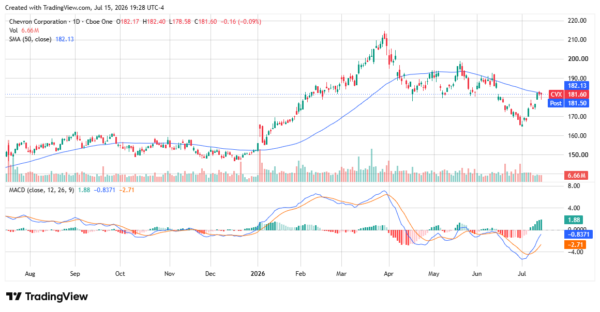
Chevron (CVX): A Blue-Chip Yield With Upstream Momentum


Chevron (NYSE: CVX) pays a dividend yield of around 4%, a level that’s roughly double the S&P 500 average, and it hasn’t cut that payout in 25 years. The board raised the quarterly dividend to $1.78 per share earlier this year, extending a 38-year streak of annual increases.

The company’s first-quarter 2026 results showed why the underlying business supports that track record. U.S. production topped 2 million barrels of oil equivalent per day for a third straight quarter, boosted by the Hess acquisition and growth in the Permian Basin and Gulf of America. Adjusted earnings came in below year-ago levels, largely due to unfavorable timing effects tied to derivatives and inventory accounting, rather than a deterioration in the core business.

Chevron reports second-quarter results on July 31, ahead of its Friday earnings call. With Brent prices elevated again on Middle East tensions, and refining throughput running at multi-quarter highs, investors get a rare combination: a steady blue-chip dividend plus real upside if oil stays firm through the back half of the year.
high-yield dividend - StockEarnings

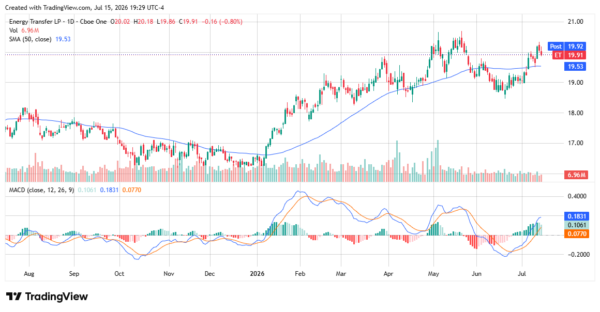
Energy Transfer (ET): A High Yield Tied to the AI Power Boom

Energy Transfer (NYSE: ET) offers one of the more attractive yields in the space, sitting near 7% at a unit price around $20. Unlike Chevron, Energy Transfer isn’t really an oil price bet. About 90% of its adjusted EBITDA comes from fee-based contracts, meaning cash flow holds up regardless of where crude or natural gas prices go.

What makes Energy Transfer especially interesting right now is its direct line to the AI infrastructure buildout. The company has signed long-term natural gas supply deals with Oracle, Entergy Louisiana, and the Nexus Hubbard AI hyperscale campus in Texas, part of a backlog of contracted pipeline capacity exceeding 6 billion cubic feet per day with an 18-year average life. Management now expects more than $25 billion in future revenue from these agreements alone.

First-quarter adjusted EBITDA came in at $4.94 billion, and Energy Transfer raised its full-year 2026 guidance to $18.2 billion-$18.6 billion. The distribution was also increased for the quarter, up more than 3% year over year. Energy Transfer reports second-quarter earnings on August 4, giving investors a near-term catalyst to watch alongside that yield.
high-yield dividend - StockEarnings

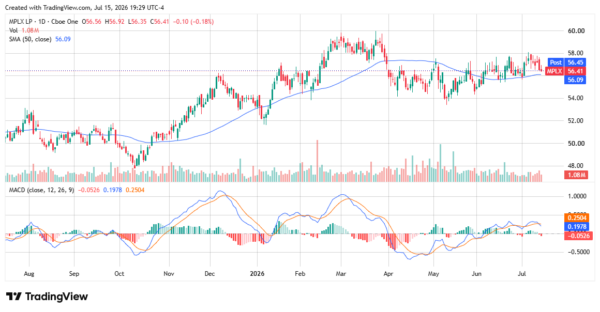
MPLX (MPLX): A 7%-Plus Payout Built for Growing Gas Demand

Rounding out the list is MPLX (NYSE: MPLX), the midstream partnership spun out of Marathon Petroleum. MPLX currently yields north of 7%, backed by a dividend that has grown for 12 straight years and is covered by distributable cash flow, even after a recent double-digit dividend increase.

Like Energy Transfer, MPLX’s business is dominated by long-term, fee-based contracts across gathering, processing, and pipeline transportation, which limits its direct exposure to commodity price swings. That combination of natural gas exposure and a well-covered payout fits the same demand-pull story playing out with data centers and gas-fired power generation across the industry.

MPLX is scheduled to report second-quarter results on August 4, the same day as Energy Transfer. For investors building out a diversified income sleeve in the midstream space, that overlap makes early August a useful checkpoint for both names.
high-yield dividend - StockEarnings

Why These High-Yield Dividend Stocks Stand Out Before Earnings

None of these high-yield dividend stocks requires a bet on the Iran conflict resolving one way or another. Each pays a well-covered, above-average dividend tied to structural demand trends, from Permian growth to AI-driven natural gas contracts, that predate the current headlines and should outlast them. With earnings dates clustered between July 31 and August 4, investors have a natural window to revisit position sizing before the next print.


A former marketing copywriter turned freelance financial writer and market analyst. I have a passion for delivering insights to investors. I write regularly about stocks for StockEarnings and MarketBeat. Posts are not advice.

Join over 1.2M+ investors/traders who receive daily and weekly notable earnings alerts with predicted move