ajax loader

Loading...


Ride-the-Wave Strategy – Best for Stock Traders

Ride-the-Wave targets multi-day price momentum following a company’s earnings announcement (EA). With this strategy:

  1. Buy a stock one day post-EA if a stock reacts positively post-earnings:
    1. Near the close of trading the EA-day for a pre-market-EA
    2. Near the close of the following day for a post-market-EA
  2. Sell-to-close after 7-10 days, or possibly earlier if a desired price target is reached

Similarly,

  1. short a stock one day post-EA if a stock reacts negatively post-earnings:
    1. near the close of trading the EA-day for a premarket-EA
    2. near the close of the following day for a post-market-EA
  2. then buy-to-close after 7-10 days, or possibly earlier if a desired price target is reached

Important: Ride-the-Wave is predicated on significant price momentum triggered by an EA. The 7-10 day scenario is the maximum trade hold-time. If you see post EA-momentum is halted or reversed by a significant opposite move, re-evaluate your presence in the trade.

This popular StockEarnings screen below will give you a list of stocks that historically exhibit significant price momentum following an EA for the next seven days:

  1. Stocks exhibiting positive post-EA price moves are buy-candidates
  2. Stocks exhibiting negative post-EA price moves are sell/short-candidates

The screen includes those stocks whose Earnings just came out in last two days.

Screen criteria:

  1. Earnings Date Start Date : Current Date + -1 Day
  2. Earnings Date End Date : Current Date + -2 Days
  3. Predicted Move (Next Day) Max : 7%
  4. Predicted Move (On 7th Day) Min : 7%

Strategy Guideline:

  1. Buy the stock if stock has reacted positively. Short the stock if stock has reacted negatively (see above).
  2. Close the position in 7-10 days, or possibly earlier based on price move.

Volatility Crush Strategy - Best for Options Traders

The Volatility Crush strategy is used with stocks that typically experience relatively low-to-moderate price moves (≤4%) following their Earnings Announcements (EA). The basic trade idea is to sell put or call options right before the EA, collecting a credit when options premium is very high due to elevated implied volatility (IV). You then close the position right after the EA by buying the option back much cheaper due to the significant drop in IV that occurs after the mystery of the EA disappears. In assessing this trade, you need to do your homework to ensure you collect sufficient premium to make the trade worthwhile.

This trade is practical due to the low-to-moderate price-move after the EA, which generally won’t significantly affect the options price, unlike an “action” stock, which experience great price moves post-EA. With these symbols, if you’re on the right side of the price move, that’s a great thing. But if you’re on the wrong side of the move, not so great. Consequently, by minimizing the effect of the post-EA price move, you have a much better chance to profit from the reduction in IV without it being ruined by a violent price move.

For this trade, open the position either (1) the night before the EA when the company announces earnings or (2) during the EA day when it announces post-market, generally capturing IV at or close to its peak.

For this trade, open the position either (1) the night before the EA when the company announces earnings or (2) during the EA day when it announces post-market, generally capturing IV at or close to its peak.

This popular stockearnings screen will give you a list of stocks which do not react more than 4% fpost-EA. It includes only those stocks whose earnings are releasing next day.

Screen criteria:

  1. Earnings Date Start Date : Current Date + 1
  2. Earnings Date End Date : Current Date + 1
  3. Predicted Move (Next Day) Max : 4%
  4. Options Type: Weekly

Strategy Guideline:

  1. Options Strategy: Sell Call and Put
  2. Options Strike Price: Current Stock Price – (% Predicated Move x 2)
  3. Expiration Date: It should generally be the closest expiry immediately after the EA.
  4. Buy Insurance: Buying back Call and Put at Strike price which 10% lower than Sell Strike Price is optional but recommended.

Watch Video for More Detail

Volatility Rush Strategy - Best for Options Traders

The Volatility Rush takes advantage of increasing options premiums into earnings announcements (EA) caused by an anticipated rise in Implied Volatility (IV). With this strategy, Buy a Call and Put at-the-money (a long straddle) 2-3 weeks before the EA when IV is lower. Sell the position either (1) the night before the EA when the company announces earnings pre-market, or (2) during the EA day when it announces post-market, generally capturing IV at or close to its peak.

This popular screen will give you a list of stocks whose Options premiums tend to rise into Earnings. It includes only those stocks whose Earnings are at least two weeks away from today.

Screen criteria:

  1. Earnings Date Start Date : Current Date + 15 Days
  2. Earnings Date End Date : Current Date + 30 Days
  3. Predicted Move (Next Day) Min : 5%
  4. Options Type: Weekly or Monthly if that lines up with the two to three-week lead-time for entering the trade

Strategy Guideline:

  1. Buy a Straddle at or close to the money two to three weeks pre-EA.
  2. Sell the position either the night before the EA when the company announces earnings pre-market, or during the EA day when it announces post-market.
  3. Expiration date should generally be the closest expiry immediately after the EA.
  4. Straddle price should not be more 60% of predicted move.

Predicted Move (Volatility)

Similar to Implied Volatility in Options. Expected volatility % based on our Proprietary Volatility Predication Model. We are expecting that stock price will likely to reach % in either direction by the end of next trading session after Earnings are released and not necessarily the closing volatility %.

Why is it important?

    This indicator helps

  1. Knowing expected volatility in stocks after Earnings helps to decide trading stocks before Earnings Announcement.
  2. Taking Advantage of volatility collapse following Earnings Results by using Advance Options strategies such as Spread and Straddles.

Since Last Earnings

Change in share price since last Earnings release.

Why is it Important?

When share has gained more than 10% since it's last Earning release, it tends to over react to minor bad news and give up some gains if not all. So, it contains more downside volatility than upside When share has dropped more than 10% since it's last Earning release, it tends to over react to minor good news and recover some drops if not all. So, it contains more upside volatility than downside.

EPS Surprise (%)

Occurs when a company's reported quarterly or annual profits are above or below analysts' expectations. Here is the formula to derive % EPS Surprice:

Actual EPS - Estimated EPS
------------------------------------- x 100
Estimated EPS

Why is it Important?

Earnings surprises can have a huge impact on a company's stock price. Several studies suggest that positive earnings surprises not only lead to an immediate hike in a stock's price, but also to a gradual increase over time. Hence, it's not surprising that some companies are known for routinely beating earning projections. A negative earnings surprise will usually result in a decline in share price.

Next Day Price Change (%)

Next Regular trading session Closing price following Earnings result.

For After Market Close Earnings, It is a next trading day closing price. For Before Market Open Earnings, It is the same trading day closing price.

Why is it Important?

Next Day price change is a reaction of Earnings result.

3 Blue-Chip Stocks to Help Investors Survive Potential Stagflation 

Posted on Sep 08, 2026 by Chris Markoch

3 Blue-Chip Stocks to Help Investors Survive Potential Stagflation 

Inflation and interest rates are becoming like those unwelcome guests at your cookout that outstay their welcome. As investors look for opportunities after Labor Day, those guests will be demanding attention again.

This means that if you were hoping for a reprieve from the year-long market volatility, you have more waiting to do. The good news is that there are several blue-chip stocks that can give you stability in a volatile market without sacrificing the potential for future growth.

Why Stagflation Is a Concern


On Sept. 10, the latest reading on producer prices will be released. That will be followed on Sept. 11 by the consumer price index (CPI). Since 2021, the rate of inflation has exceeded the Federal Reserve’s preferred 2% target. This week’s report will be more of the same.

That’s leading to expectations (and some will say hopes) that the Federal Reserve will raise interest rates at the next Federal Reserve Open Market Committee (FOMC) meeting on Sept. 15 and 16. The CME FedWatch tool puts the odds of a 25-basis point (0.25%) hike at around 60%.

This is where stagflation becomes a concern. Not all inflation is the same. In 2021, the surge in inflation was fueled by significant monetary stimulus that had the desired effect (until it wasn’t) of stoking consumer demand.

This time around, the inflation is largely supply-driven. The burgeoning AI economy is increasing productivity, but perhaps not enough to offset lower demand. That’s a recipe for stagflation.

I’m not predicting that. First, I believe that the Fed won’t raise interest rates for reasons that belong in another article for another time. However, for the purpose of this article, let’s say rates do tick higher. Where should investors look for opportunities? That gets us back to those blue-chip stock opportunities. Here are three names to consider.

Blue-Chip Stock to Buy: Eli Lilly

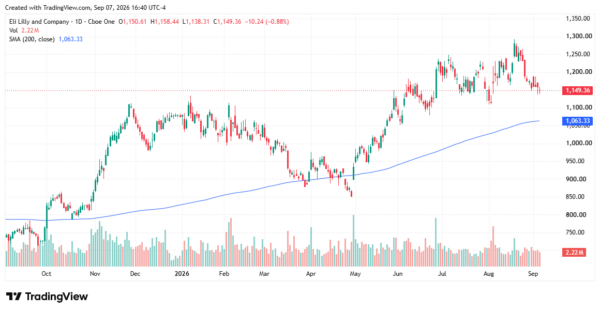
Healthcare demand doesn’t disappear when the economy stalls, and that’s the core appeal of Eli Lilly (NYSE: LLY) as a blue-chip stock for a stagflation scenario. Patients don’t stop taking prescribed medications because rates ticked higher, which gives Lilly’s revenue a defensive quality that cyclical sectors simply don’t have.

The fundamentals back this up. Lilly’s second-quarter 2026 revenue grew nearly 50% year over year, powered by its GLP-1 franchise for diabetes and obesity treatment. That demand has proven remarkably inelastic even as consumers pull back elsewhere. EBITDA growth topped 90% in the same period, a pace few blue-chip names can match regardless of the macro backdrop.

Lilly isn’t cheap. Shares trade near 40 times earnings, a premium that assumes the growth streak continues. Belief in that future growth means looking at Lilly’s pipeline, which includes oncology and autoimmune diseases.

Another reason to hold LLY for the long haul is that the company has raised its dividend for 12 consecutive years, and its payout ratio sits around 22%, leaving ample room for further increases even if margins compress under cost pressure. For investors worried about stagflation eroding discretionary spending, Lilly offers exposure to a demand curve that bends less than most.
blue-chip - StockEarnings

Blue-Chip Stock to Buy: Lockheed Martin

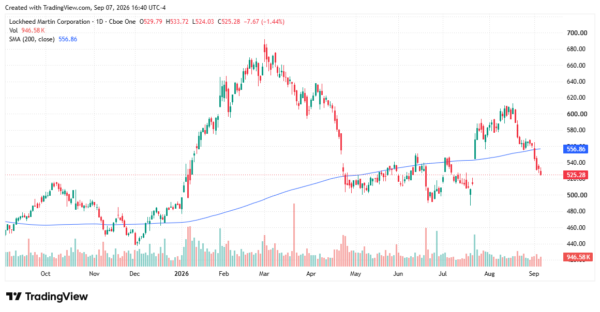
Lockheed Martin (NYSE: LMT) represents a different flavor of stagflation protection: revenue largely insulated from consumer behavior. Defense contractors get paid by the federal government under multi-year contracts, not by households deciding whether to tighten their budgets. That’s a structural advantage when the “stag” half of stagflation starts to bite.

The numbers illustrate why. Lockheed closed the second quarter of 2026 with a record $230 billion backlog, roughly two and a half years of sales already booked. Revenue rose 11% to $20.06 billion, beating estimates, and management raised full-year guidance to $80.75 billion. Rising geopolitical tension and climbing global defense budgets have only added to that order pipeline.

Income investors get rewarded, too. Lockheed has increased its dividend for 23 consecutive years, and shares currently yield around 2.6%. Because the company’s growth is tied to appropriations and contract awards rather than consumer wallets, higher interest rates do less damage to Lockheed’s core business than they do to retailers, homebuilders, or discretionary-spending names.
blue-chip - StockEarnings

Blue-Chip Stock to Buy: Visa

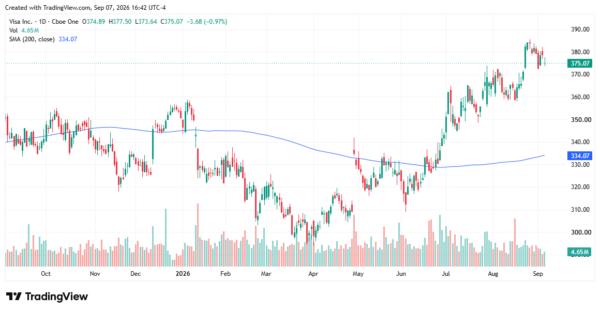
Visa (NYSE: V) is the trickiest of the three, and that’s worth being upfront about. Management has said plainly that Visa’s business model, while resilient, isn’t immune to inflation, since higher prices can eventually curb the consumer spending that generates its transaction fees. This is a case where perception and fundamentals genuinely diverge, and investors need to watch both.

So far, the fundamentals have held up better than the inflation narrative suggests. Fiscal second-quarter 2026 revenue climbed 17% year over year, with cross-border transaction volume up 21%. Visa’s capital-light model produces operating margins near 68%, among the highest of any blue-chip stock, which gives it room to absorb a slowdown without the earnings damage a lower-margin retailer would face.

Visa has grown its dividend for 17 straight years, and a $20 billion buyback program signals management’s confidence in cash generation. The risk is real: if stagflation deepens and consumers pull back on spending, Visa’s volume-based revenue will feel it before Lockheed’s contracted backlog or Lilly’s prescription-driven demand does. It’s a blue-chip name to own, but one to watch closely as CPI data rolls in.
blue-chip - StockEarnings

Blue-Chip Stocks Help You Prepare For Whatever Comes Next

Stagflation isn’t a certainty, and I still lean toward the Fed holding rates steady rather than hiking this month. But investors don’t need to predict the exact outcome to position sensibly. Blue-chip stocks with defensive earnings drivers — inelastic healthcare demand, government-backed contracts, or dominant market share with high margins — tend to hold up better than cyclical names when inflation and slow growth coincide.

Eli Lilly, Lockheed Martin, and Visa each offer a different route to that stability. Lilly’s growth is tied to patient need rather than consumer confidence. Lockheed’s backlog is contracted years in advance. Visa’s margins give it a cushion even if spending growth cools. None of the three is immune to a genuine stagflation shock, but all three are built to weather one better than the average name in the S&P 500. As the September inflation data and the FOMC decision approach, that kind of durability is what blue-chip stocks are supposed to provide.


A former marketing copywriter turned freelance financial writer and market analyst. I have a passion for delivering insights to investors. I write regularly about stocks for StockEarnings and MarketBeat. Posts are not advice.

Join over 1.2M+ investors/traders who receive daily and weekly notable earnings alerts with predicted move