We’re sitting ducks. After all these years, you’d think we’d be better prepared for cyberattacks. We’re not. Cities, hospitals, schools, businesses and even government agencies continue to struggle with the growing threat of cybercrime. And the attacks aren’t getting simpler. They’re becoming more sophisticated, more automated and, increasingly, powered by artificial intelligence.
That’s a big reason cybersecurity has become one of the hottest corners of the technology market. Businesses aren’t spending money on cybersecurity because it’s a nice-to-have. They’re spending because they’re realizing they have very little choice.
Investors are taking notice.
Zscaler’s Strong Earnings Show Rising Demand for Cybersecurity
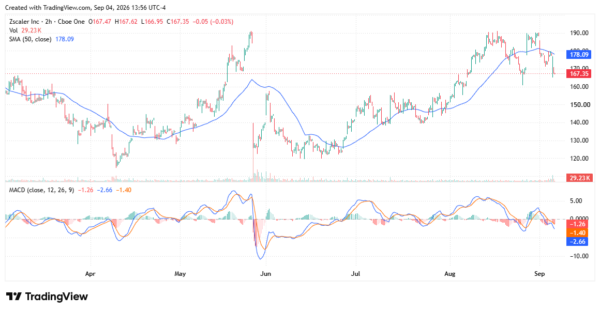
One company benefiting from that urgency is Zscaler (NASDAQ: ZS), the cloud security company whose shares are jumping after it delivered better-than-expected fiscal fourth-quarter results. The company’s performance offered another reminder that, in an increasingly AI-driven world, protecting digital systems is becoming a much bigger business.
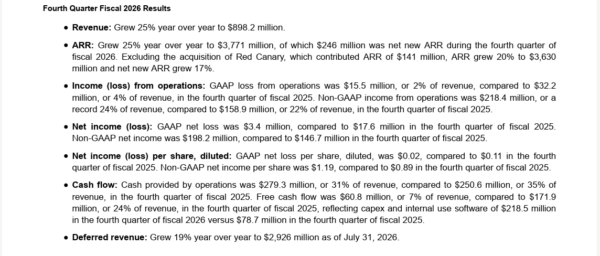
Zscaler reported adjusted earnings of $1.19 per share, comfortably ahead of the $1.09 expected by analysts. Revenue came in at $898 million, beating Wall Street’s $877 million estimate.
That’s not exactly a rounding error.
Revenue increased 25% from roughly $719 million a year earlier. Zscaler still reported a net loss of $3.4 million, or 2 cents per share, but that was an improvement from the $17.6 million loss, or 11 cents per share, it reported a year earlier. Perhaps more importantly, the company’s annual recurring revenue climbed 25% to $3.77 billion. That topped the $3.75 billion analysts had been expecting. In other words, customers keep paying.
AI Agents Are Creating a New Cybersecurity Challenge
And they’re increasingly paying for protection against something that didn’t really exist at this scale a few years ago: AI agents.
That’s where Zscaler CEO Jay Chaudhry sees substantial opportunity. Zscaler has been pushing its Zero Trust security architecture, which operates on the principle that no user, device or application should be automatically trusted simply because it has gained access to a network. Now the company is applying that philosophy to AI agents, software systems capable of taking actions and completing tasks with increasing levels of autonomy.
Chaudhry told CNBC that he is “very bullish” on Zscaler’s recently launched Zero Trust approach for AI agents. The opportunity is still relatively young, but he expects it to accelerate significantly in fiscal 2028 and 2029.
That could turn out to be a very big deal.
Zero Trust Security Could Become Critical in the AI Era
Think about what happens when companies start giving AI agents access to sensitive information, internal systems, financial data and customer records. Suddenly, cybersecurity isn’t just about stopping a hacker from breaking into a computer. It’s about controlling what an AI system can access, what it can do and who or what it is allowed to interact with.
That’s a much bigger cybersecurity problem. And potentially a much bigger market.
Zscaler says bookings related to AI security totaled $100 million over the past year, while those bookings grew more than 50% sequentially in the latest quarter. It’s still early, but the growth suggests companies are beginning to take the problem seriously.
Zscaler Raises Guidance as AI Security Spending Accelerates
It also offered a stronger outlook.
For its fiscal fourth quarter, Zscaler expects revenue of between $935 million and $939 million, above Wall Street’s $927 million estimate. Adjusted earnings are expected to come in between $1.15 and $1.16 per share, compared with an analyst estimate of $1.08. For the full fiscal year, Zscaler expects revenue between $3.91 billion and $3.94 billion, slightly above the $3.90 billion consensus estimate. Adjusted earnings are projected at $4.86 to $4.90 per share, compared with expectations of $4.60.
That’s the kind of guidance investors like to see.
And we’re likely to see even more opportunity with the stock.
That’s because we’re still sitting ducks.
Why Cybersecurity Remains a Long-Term Investment Opportunity
We’ve built an incredibly connected world, but we haven’t built an equally secure one. The more technology we put into our businesses, hospitals, schools, cities and governments, the more attractive those targets become.
And AI is raising the stakes even further. Cybersecurity isn’t going away.
Neither is the spending required to defend against it. For investors, that creates an unusual kind of opportunity: a market where demand isn’t being driven simply by companies wanting to grow, but by companies needing to protect what they already have. We may still be sitting ducks. But increasingly, businesses are realizing they need to buy the armor.