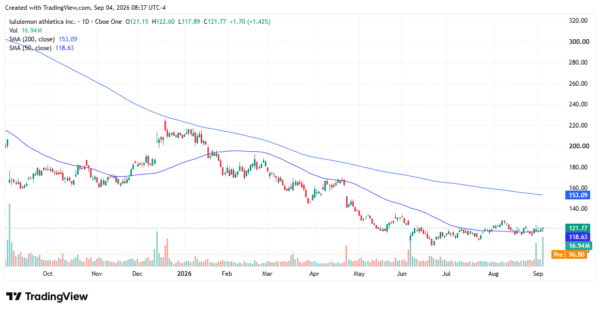
Lululemon (NASDAQ: LULU) is having a tough year. And unfortunately, its Q2 2026 earnings report isn’t helping. Instead, it sent the stock down about 18%, or by $22.12, during after-hours trading on Sept. 3. Not only did the company deliver another disappointing quarter, but it also significantly lowered its outlook for the rest of the year.
The results mark another setback for a brand that was once one of the biggest success stories in retail. Lululemon built a powerful following around its leggings, yoga clothes and premium athleticwear, but lately, the company has struggled to keep customers as excited about its products as they once were.
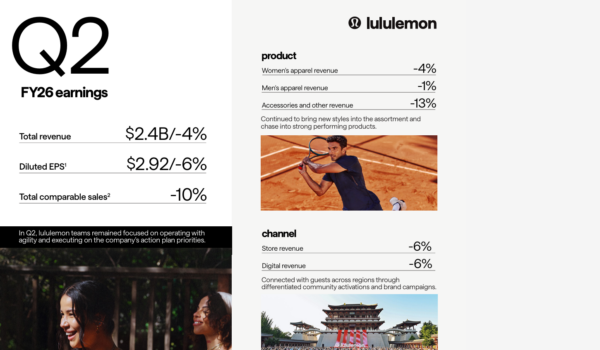
For the second fiscal quarter, Lululemon reported revenue of $2.42 billion, falling short of Wall Street’s expectation of $2.46 billion. Revenue declined 4% from the same period a year earlier, while comparable sales dropped 9%.
That is a pretty significant slowdown for a company that has spent years posting strong growth.
And this wasn’t Lululemon’s first warning sign. The retailer had already lowered its guidance during the previous quarter.
Slowing Demand for Leggings and Core Products Creates New Challenges
Interim CEO Meghan Frank acknowledged the challenges during a call with analysts, citing both shifting customer preferences and negative online conversations about the brand. Frank said Lululemon experienced “negative commentary” on social media during the second quarter that affected its performance. At the same time, the company saw a “greater-than-expected” slowdown in some of its core product categories, including leggings.
That last point is especially important.
Leggings and other core apparel have long been central to Lululemon’s identity. If customers are becoming less interested in those products, the company has to figure out how to convince shoppers that there is something new and exciting worth buying. Frank said the company has seen positive reactions to some of its newer styles and marketing activations. But overall, she acknowledged that the response to product launches has been inconsistent.
“While we are seeing good guest reaction to our activations and some of our newer styles, the overall response to our product launches remains inconsistent, and we’ve continued to see pressure on the brand in both of our largest markets,” Frank said, as quoted by CNBC.
Lululemon Lowers Full-Year Guidance for the Second Straight Quarter
The financial outlook for the rest of the year only added to investors’ concerns.
For the third fiscal quarter, Lululemon expects revenue between $2.29 billion and $2.32 billion. That would represent a decline of roughly 10% to 11% compared with the same period last year. The company expects earnings of between 93 cents and 98 cents per share.
For the full year, Lululemon now expects net revenue between $10.35 billion and $10.5 billion. That represents a decline of about 5% to 7% and is well below the company’s previous forecast of $11 billion to $11.15 billion.
Its earnings outlook also took a major hit. Lululemon now expects full-year earnings of $9.48 to $9.73 per share, compared with its previous guidance of $10.95 to $11.15 per share.
Interestingly, that new outlook already includes a boost from tariff refunds.
Lululemon’s second-quarter profit also fell. The company reported net income of $329.2 million, or $2.92 per share, compared with $370.9 million, or $3.10 per share, in the same quarter a year earlier. Gross profit declined 1% to $1.5 billion.
New CEO Heidi O’Neill Faces a Critical Turnaround Challenge
A turnaround effort could be boosted by a new CEO.
Lululemon’s incoming CEO, Heidi O’Neill, is set to take the reins next week. Her arrival comes at a critical moment for the company, as it tries to regain momentum in two of its largest markets and rebuild its connection with customers.
The company clearly still has a recognizable name, a large customer base and a strong position in athleticwear. But recent results suggest that brand strength alone may not be enough.
Customers want fresh products and a reason to come back. Lululemon’s challenge is figuring out exactly what that reason should be.
With a new CEO arriving and management promising new styles, tighter inventory, and a renewed focus on customers, the retailer is betting that it can turn things around.