ajax loader

Loading...


Ride-the-Wave Strategy – Best for Stock Traders

Ride-the-Wave targets multi-day price momentum following a company’s earnings announcement (EA). With this strategy:

  1. Buy a stock one day post-EA if a stock reacts positively post-earnings:
    1. Near the close of trading the EA-day for a pre-market-EA
    2. Near the close of the following day for a post-market-EA
  2. Sell-to-close after 7-10 days, or possibly earlier if a desired price target is reached

Similarly,

  1. short a stock one day post-EA if a stock reacts negatively post-earnings:
    1. near the close of trading the EA-day for a premarket-EA
    2. near the close of the following day for a post-market-EA
  2. then buy-to-close after 7-10 days, or possibly earlier if a desired price target is reached

Important: Ride-the-Wave is predicated on significant price momentum triggered by an EA. The 7-10 day scenario is the maximum trade hold-time. If you see post EA-momentum is halted or reversed by a significant opposite move, re-evaluate your presence in the trade.

This popular StockEarnings screen below will give you a list of stocks that historically exhibit significant price momentum following an EA for the next seven days:

  1. Stocks exhibiting positive post-EA price moves are buy-candidates
  2. Stocks exhibiting negative post-EA price moves are sell/short-candidates

The screen includes those stocks whose Earnings just came out in last two days.

Screen criteria:

  1. Earnings Date Start Date : Current Date + -1 Day
  2. Earnings Date End Date : Current Date + -2 Days
  3. Predicted Move (Next Day) Max : 7%
  4. Predicted Move (On 7th Day) Min : 7%

Strategy Guideline:

  1. Buy the stock if stock has reacted positively. Short the stock if stock has reacted negatively (see above).
  2. Close the position in 7-10 days, or possibly earlier based on price move.

Volatility Crush Strategy - Best for Options Traders

The Volatility Crush strategy is used with stocks that typically experience relatively low-to-moderate price moves (≤4%) following their Earnings Announcements (EA). The basic trade idea is to sell put or call options right before the EA, collecting a credit when options premium is very high due to elevated implied volatility (IV). You then close the position right after the EA by buying the option back much cheaper due to the significant drop in IV that occurs after the mystery of the EA disappears. In assessing this trade, you need to do your homework to ensure you collect sufficient premium to make the trade worthwhile.

This trade is practical due to the low-to-moderate price-move after the EA, which generally won’t significantly affect the options price, unlike an “action” stock, which experience great price moves post-EA. With these symbols, if you’re on the right side of the price move, that’s a great thing. But if you’re on the wrong side of the move, not so great. Consequently, by minimizing the effect of the post-EA price move, you have a much better chance to profit from the reduction in IV without it being ruined by a violent price move.

For this trade, open the position either (1) the night before the EA when the company announces earnings or (2) during the EA day when it announces post-market, generally capturing IV at or close to its peak.

For this trade, open the position either (1) the night before the EA when the company announces earnings or (2) during the EA day when it announces post-market, generally capturing IV at or close to its peak.

This popular stockearnings screen will give you a list of stocks which do not react more than 4% fpost-EA. It includes only those stocks whose earnings are releasing next day.

Screen criteria:

  1. Earnings Date Start Date : Current Date + 1
  2. Earnings Date End Date : Current Date + 1
  3. Predicted Move (Next Day) Max : 4%
  4. Options Type: Weekly

Strategy Guideline:

  1. Options Strategy: Sell Call and Put
  2. Options Strike Price: Current Stock Price – (% Predicated Move x 2)
  3. Expiration Date: It should generally be the closest expiry immediately after the EA.
  4. Buy Insurance: Buying back Call and Put at Strike price which 10% lower than Sell Strike Price is optional but recommended.

Watch Video for More Detail

Volatility Rush Strategy - Best for Options Traders

The Volatility Rush takes advantage of increasing options premiums into earnings announcements (EA) caused by an anticipated rise in Implied Volatility (IV). With this strategy, Buy a Call and Put at-the-money (a long straddle) 2-3 weeks before the EA when IV is lower. Sell the position either (1) the night before the EA when the company announces earnings pre-market, or (2) during the EA day when it announces post-market, generally capturing IV at or close to its peak.

This popular screen will give you a list of stocks whose Options premiums tend to rise into Earnings. It includes only those stocks whose Earnings are at least two weeks away from today.

Screen criteria:

  1. Earnings Date Start Date : Current Date + 15 Days
  2. Earnings Date End Date : Current Date + 30 Days
  3. Predicted Move (Next Day) Min : 5%
  4. Options Type: Weekly or Monthly if that lines up with the two to three-week lead-time for entering the trade

Strategy Guideline:

  1. Buy a Straddle at or close to the money two to three weeks pre-EA.
  2. Sell the position either the night before the EA when the company announces earnings pre-market, or during the EA day when it announces post-market.
  3. Expiration date should generally be the closest expiry immediately after the EA.
  4. Straddle price should not be more 60% of predicted move.

Predicted Move (Volatility)

Similar to Implied Volatility in Options. Expected volatility % based on our Proprietary Volatility Predication Model. We are expecting that stock price will likely to reach % in either direction by the end of next trading session after Earnings are released and not necessarily the closing volatility %.

Why is it important?

    This indicator helps

  1. Knowing expected volatility in stocks after Earnings helps to decide trading stocks before Earnings Announcement.
  2. Taking Advantage of volatility collapse following Earnings Results by using Advance Options strategies such as Spread and Straddles.

Since Last Earnings

Change in share price since last Earnings release.

Why is it Important?

When share has gained more than 10% since it's last Earning release, it tends to over react to minor bad news and give up some gains if not all. So, it contains more downside volatility than upside When share has dropped more than 10% since it's last Earning release, it tends to over react to minor good news and recover some drops if not all. So, it contains more upside volatility than downside.

EPS Surprise (%)

Occurs when a company's reported quarterly or annual profits are above or below analysts' expectations. Here is the formula to derive % EPS Surprice:

Actual EPS - Estimated EPS
------------------------------------- x 100
Estimated EPS

Why is it Important?

Earnings surprises can have a huge impact on a company's stock price. Several studies suggest that positive earnings surprises not only lead to an immediate hike in a stock's price, but also to a gradual increase over time. Hence, it's not surprising that some companies are known for routinely beating earning projections. A negative earnings surprise will usually result in a decline in share price.

Next Day Price Change (%)

Next Regular trading session Closing price following Earnings result.

For After Market Close Earnings, It is a next trading day closing price. For Before Market Open Earnings, It is the same trading day closing price.

Why is it Important?

Next Day price change is a reaction of Earnings result.

Strong August Jobs Report Highlights Opportunities for 3 Stocks

Posted on Sep 04, 2026 by Chris Markoch

Strong August Jobs Report Highlights Opportunities for 3 Stocks

The August jobs report from the U.S. Bureau of Labor Statistics gave the market a reason to rethink the slowdown narrative. The U.S. economy added 162,000 jobs last month, the Labor Department reported Sept. 4. That number blew past forecasts and marked a sharp rebound from July’s revised 21,000 gain.

The jobs report wasn’t uniformly strong. Economists still point to a “low-hire, low-fire” dynamic that makes it hard for unemployed workers to land new jobs, even as existing payrolls hold steady. But the sector-level detail told a more encouraging story:

  • Construction added 22,000 roles
  • Manufacturing gained 16,000.

And a separate ADP report released on Sept. 2 showed that education and health services added 45,000 positions.

For investors, sector-level hiring data is the signal from this jobs report that’s worth watching closely. Payroll growth tends to show up in a company’s numbers before it shows up in a headline. When a sector is adding workers at scale, it’s usually because demand already justifies the expansion.

That makes three stocks worth a fresh look right now. Cigna Group (NYSE: CI) sits at the center of health services hiring. Fluor Corp. (NYSE: FLR) is riding a construction and infrastructure wave. Vertiv (NYSE: VRT) is capturing the manufacturing buildout tied to AI data centers. Each one lines up with a sector that just posted real job growth, and each has company-specific momentum backing up the macro story. Here’s why they deserve a spot on your watchlist this week.

Cigna Benefits From a Health Sector Still Adding Jobs


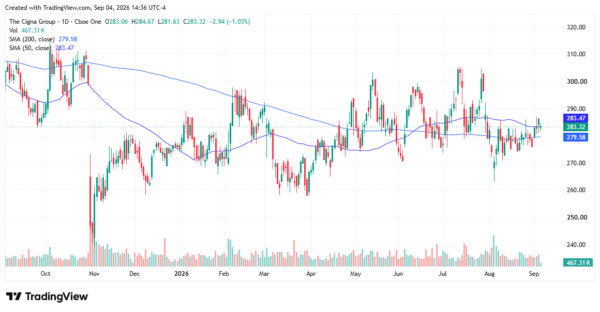
Health services added 45,000 jobs in the ADP report, the strongest sector gain by far. Cigna Group sits right in the middle of that growth. The company’s Evernorth Health Services division posted a 6.3% revenue increase in the second quarter. Cigna Healthcare’s adjusted revenue climbed 9.1% over the same stretch.

Management has raised guidance twice this year. Full-year adjusted earnings targets now sit at $30.45 per share, up from an original $30.35 estimate. That’s a meaningful upward revision for a company already generating tens of billions in quarterly revenue.

Cigna also trades at a relatively modest valuation. Shares carry a forward price-to-earnings ratio near 12, well below the broader market. Wall Street’s average price target implies double-digit upside from current levels.

The stock hasn’t kept pace with the market this year, gaining just over 3% while the broader healthcare industry rose more than 20%. That gap, paired with rising guidance and steady hiring in its sector, makes Cigna a name worth watching as investor sentiment catches up to the fundamentals.
jobs report - StockEarnings

Fluor Rides the Construction Sector’s Hiring Surge

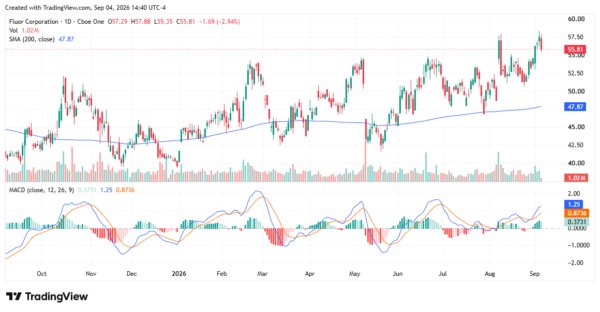
The jobs report showed construction added 22,000 jobs in August, and Fluor Corp. is positioned to capture the demand behind that growth. The engineering and construction firm posted a blowout second quarter, with adjusted earnings of 91 cents per share against a 70-cent estimate. Revenue also came in well above forecasts.

New awards reached $6.1 billion in the quarter, pushing Fluor’s total backlog to $26.9 billion. That backlog is nearly four times the company’s market capitalization, a gap that suggests the market hasn’t fully priced in Fluor’s project pipeline. Roughly 85% of that backlog carries reimbursable contract terms, which limits the company’s exposure to cost overruns.

Fluor’s growth is tied to some of the same forces driving construction hiring broadly: data centers, power infrastructure, and large industrial projects. Analysts point to opportunities in LNG, nuclear, and defense-related construction as additional tailwinds heading into next year.

Shares have climbed more than 39% year to date, yet the stock still trades at a forward P/E near 20, a discount to many industrial peers. For investors looking to play the construction hiring trend directly, Fluor offers a backlog-backed growth story at a reasonable price.
jobs report - StockEarnings

Vertiv Captures the Manufacturing Boom Behind AI Infrastructure

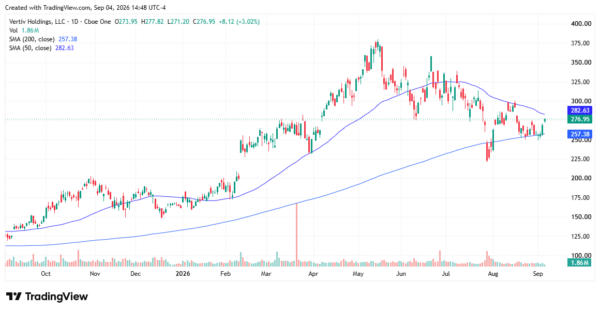
The jobs report showed manufacturing added 16,000 jobs in August, and few companies illustrate why better than Vertiv. The data center infrastructure manufacturer posted 30% revenue growth in its most recent quarter, driven by a 53% surge in Americas sales. That growth comes almost entirely from AI-related data center buildouts.

Vertiv’s adjusted operating margin expanded by more than four percentage points last quarter, a sign that scale is translating into real profitability rather than just top-line growth. The company’s project backlog now exceeds $15 billion, and full-year guidance calls for revenue between $13.5 billion and $14 billion.

The stock isn’t cheap. Shares trade near 41times forward earnings, a steep premium versus industrial peers like Schneider Electric and Eaton. That valuation reflects just how central Vertiv has become to the power and cooling systems AI data centers require.

Investors comfortable with that premium get direct exposure to one of the clearest beneficiaries of the manufacturing hiring wave. Multiple analysts have raised price targets in recent months, citing durable demand tied to hyperscale infrastructure spending.
jobs report - StockEarnings

What the Latest Jobs Report Means for Investors

August’s jobs report offered more than a single headline number. It showed hiring strength concentrated in construction, manufacturing, and health services, three sectors where Fluor, Vertiv, and Cigna each hold a leading position.

None of these stocks is without risk. Cigna faces ongoing medical cost pressure. Fluor still carries legacy project exposure. Vertiv’s valuation leaves little room for error if AI spending slows. But each company’s recent results back up the sector-level hiring data, which strengthens the underlying investment case.

For investors trying to translate a strong jobs report into actionable ideas, these three names offer a direct link between macro data and company fundamentals. That combination is worth watching as the labor market’s next chapter unfolds.


A former marketing copywriter turned freelance financial writer and market analyst. I have a passion for delivering insights to investors. I write regularly about stocks for StockEarnings and MarketBeat. Posts are not advice.

Join over 1.2M+ investors/traders who receive daily and weekly notable earnings alerts with predicted move