Weakness may be an attractive opportunity for Broadcom (NASDAQ: AVGO). While the semiconductor giant recently delivered another quarter of record-breaking financial results, the stock has pulled back roughly 13%, creating what some analysts believe could be an appealing entry point for long-term investors. The decline comes despite strong fundamentals and continued confidence in the company’s long-term growth prospects, particularly in the rapidly expanding artificial intelligence market.
For its most recent quarter, Broadcom reported revenue of $22.2 billion, slightly ahead of Wall Street expectations of $22.1 billion. Earnings per share came in at $2.44, topping analyst estimates of $2.39.
However, despite the strong quarterly performance, investors focused on the company’s forward guidance – especially after CEO Hock Tan chose not to raise the company’s long-term AI revenue outlook. Instead, he reiterated Broadcom’s expectation that AI-related revenue could exceed $100 billion by fiscal 2027. While some investors were hoping for a more aggressive forecast, the existing target remains highly impressive and reflects the company’s confidence in the ongoing buildout of AI infrastructure worldwide.
Analysts See Significant Upside After the Decline
Several Wall Street firms continue to express strong confidence in Broadcom’s future growth trajectory. Among them is Goldman Sachs, which recently reiterated its buy rating and maintained a price target of $525 per share.
Goldman Sachs stated that it would be an aggressive buyer of the stock following the recent pullback. The firm emphasized that Broadcom continues to present a compelling long-term growth story, supported by substantial opportunities in AI semiconductors and custom silicon solutions.
Goldman also highlighted several reasons for its optimism. First, the firm noted that Broadcom still expects fiscal 2027 AI semiconductor revenue to significantly exceed $100 billion, supported by approximately 10 gigawatts of data center deployments. This projection underscores the magnitude of AI investment taking place across the technology industry and Broadcom’s central role in supplying critical infrastructure.
Morgan Stanley recently reiterated its overweight rating on Broadcom and maintained a price target of $502. The firm continues to view the company as one of the strongest beneficiaries of AI-related capital spending and believes long-term demand trends remain intact despite short-term market volatility.
Meanwhile, analysts at Bernstein acknowledged that AI revenue can be somewhat “lumpy” from quarter to quarter. However, they also pointed out that Broadcom’s projected AI growth remains extraordinary. The company expects AI-related revenue to increase roughly 200% year over year in the upcoming quarter, while its long-term revenue targets continue to reflect substantial demand from hyperscale customers and large-scale data center deployments.
Pullback Tests Key Support Levels
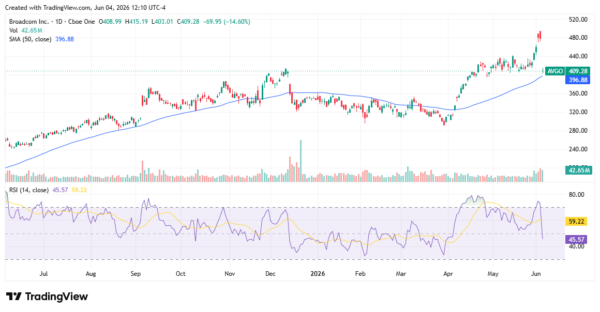
Broadcom shares experienced a sharp post-earnings decline, falling from recent highs near $485 to around $409. While the move looks dramatic, the stock remains above its rising 50-day simple moving average near $397, a level that often serves as support during healthy uptrends.
The recent selloff also pushed the Relative Strength Index (RSI) down to approximately 46, a significant reset from overbought readings above 70 seen in May. That suggests much of the near-term excess optimism has been worked out of the stock.
For bullish investors, the $395-$400 area is an important support zone to monitor. If shares stabilize above that level, the longer-term uptrend remains intact. Resistance now sits near $440, followed by the recent highs around $485. A recovery through those levels could signal renewed momentum as investors refocus on Broadcom’s AI-driven growth story.
Why Broadcom Remains an Attractive AI Investment
That’s again creating a solid long-term opportunity. Plus, while we wait for the stock to recover lost ground, we can collect its recently declared dividend of 65 cents per share. That’s payable on June 30 to shareholders of record as of June 22.
That follows a cash dividend of 65 cents per share paid on March 31.
In short, for investors willing to look beyond short-term market reactions, the recent weakness could represent an attractive buying opportunity. With AI spending expected to remain a powerful secular growth trend for years to come, Broadcom remains one of the most compelling ways to gain exposure to the next phase of the artificial intelligence revolution.