ajax loader

Loading...


Ride-the-Wave Strategy – Best for Stock Traders

Ride-the-Wave targets multi-day price momentum following a company’s earnings announcement (EA). With this strategy:

  1. Buy a stock one day post-EA if a stock reacts positively post-earnings:
    1. Near the close of trading the EA-day for a pre-market-EA
    2. Near the close of the following day for a post-market-EA
  2. Sell-to-close after 7-10 days, or possibly earlier if a desired price target is reached

Similarly,

  1. short a stock one day post-EA if a stock reacts negatively post-earnings:
    1. near the close of trading the EA-day for a premarket-EA
    2. near the close of the following day for a post-market-EA
  2. then buy-to-close after 7-10 days, or possibly earlier if a desired price target is reached

Important: Ride-the-Wave is predicated on significant price momentum triggered by an EA. The 7-10 day scenario is the maximum trade hold-time. If you see post EA-momentum is halted or reversed by a significant opposite move, re-evaluate your presence in the trade.

This popular StockEarnings screen below will give you a list of stocks that historically exhibit significant price momentum following an EA for the next seven days:

  1. Stocks exhibiting positive post-EA price moves are buy-candidates
  2. Stocks exhibiting negative post-EA price moves are sell/short-candidates

The screen includes those stocks whose Earnings just came out in last two days.

Screen criteria:

  1. Earnings Date Start Date : Current Date + -1 Day
  2. Earnings Date End Date : Current Date + -2 Days
  3. Predicted Move (Next Day) Max : 7%
  4. Predicted Move (On 7th Day) Min : 7%

Strategy Guideline:

  1. Buy the stock if stock has reacted positively. Short the stock if stock has reacted negatively (see above).
  2. Close the position in 7-10 days, or possibly earlier based on price move.

Volatility Crush Strategy - Best for Options Traders

The Volatility Crush strategy is used with stocks that typically experience relatively low-to-moderate price moves (≤4%) following their Earnings Announcements (EA). The basic trade idea is to sell put or call options right before the EA, collecting a credit when options premium is very high due to elevated implied volatility (IV). You then close the position right after the EA by buying the option back much cheaper due to the significant drop in IV that occurs after the mystery of the EA disappears. In assessing this trade, you need to do your homework to ensure you collect sufficient premium to make the trade worthwhile.

This trade is practical due to the low-to-moderate price-move after the EA, which generally won’t significantly affect the options price, unlike an “action” stock, which experience great price moves post-EA. With these symbols, if you’re on the right side of the price move, that’s a great thing. But if you’re on the wrong side of the move, not so great. Consequently, by minimizing the effect of the post-EA price move, you have a much better chance to profit from the reduction in IV without it being ruined by a violent price move.

For this trade, open the position either (1) the night before the EA when the company announces earnings or (2) during the EA day when it announces post-market, generally capturing IV at or close to its peak.

For this trade, open the position either (1) the night before the EA when the company announces earnings or (2) during the EA day when it announces post-market, generally capturing IV at or close to its peak.

This popular stockearnings screen will give you a list of stocks which do not react more than 4% fpost-EA. It includes only those stocks whose earnings are releasing next day.

Screen criteria:

  1. Earnings Date Start Date : Current Date + 1
  2. Earnings Date End Date : Current Date + 1
  3. Predicted Move (Next Day) Max : 4%
  4. Options Type: Weekly

Strategy Guideline:

  1. Options Strategy: Sell Call and Put
  2. Options Strike Price: Current Stock Price – (% Predicated Move x 2)
  3. Expiration Date: It should generally be the closest expiry immediately after the EA.
  4. Buy Insurance: Buying back Call and Put at Strike price which 10% lower than Sell Strike Price is optional but recommended.

Watch Video for More Detail

Volatility Rush Strategy - Best for Options Traders

The Volatility Rush takes advantage of increasing options premiums into earnings announcements (EA) caused by an anticipated rise in Implied Volatility (IV). With this strategy, Buy a Call and Put at-the-money (a long straddle) 2-3 weeks before the EA when IV is lower. Sell the position either (1) the night before the EA when the company announces earnings pre-market, or (2) during the EA day when it announces post-market, generally capturing IV at or close to its peak.

This popular screen will give you a list of stocks whose Options premiums tend to rise into Earnings. It includes only those stocks whose Earnings are at least two weeks away from today.

Screen criteria:

  1. Earnings Date Start Date : Current Date + 15 Days
  2. Earnings Date End Date : Current Date + 30 Days
  3. Predicted Move (Next Day) Min : 5%
  4. Options Type: Weekly or Monthly if that lines up with the two to three-week lead-time for entering the trade

Strategy Guideline:

  1. Buy a Straddle at or close to the money two to three weeks pre-EA.
  2. Sell the position either the night before the EA when the company announces earnings pre-market, or during the EA day when it announces post-market.
  3. Expiration date should generally be the closest expiry immediately after the EA.
  4. Straddle price should not be more 60% of predicted move.

Predicted Move (Volatility)

Similar to Implied Volatility in Options. Expected volatility % based on our Proprietary Volatility Predication Model. We are expecting that stock price will likely to reach % in either direction by the end of next trading session after Earnings are released and not necessarily the closing volatility %.

Why is it important?

    This indicator helps

  1. Knowing expected volatility in stocks after Earnings helps to decide trading stocks before Earnings Announcement.
  2. Taking Advantage of volatility collapse following Earnings Results by using Advance Options strategies such as Spread and Straddles.

Since Last Earnings

Change in share price since last Earnings release.

Why is it Important?

When share has gained more than 10% since it's last Earning release, it tends to over react to minor bad news and give up some gains if not all. So, it contains more downside volatility than upside When share has dropped more than 10% since it's last Earning release, it tends to over react to minor good news and recover some drops if not all. So, it contains more upside volatility than downside.

EPS Surprise (%)

Occurs when a company's reported quarterly or annual profits are above or below analysts' expectations. Here is the formula to derive % EPS Surprice:

Actual EPS - Estimated EPS
------------------------------------- x 100
Estimated EPS

Why is it Important?

Earnings surprises can have a huge impact on a company's stock price. Several studies suggest that positive earnings surprises not only lead to an immediate hike in a stock's price, but also to a gradual increase over time. Hence, it's not surprising that some companies are known for routinely beating earning projections. A negative earnings surprise will usually result in a decline in share price.

Next Day Price Change (%)

Next Regular trading session Closing price following Earnings result.

For After Market Close Earnings, It is a next trading day closing price. For Before Market Open Earnings, It is the same trading day closing price.

Why is it Important?

Next Day price change is a reaction of Earnings result.

3 Major Catalysts are Fueling Uranium Stocks

Posted on Jun 03, 2026 by Ian Cooper

3 Major Catalysts are Fueling Uranium Stocks

As global demand for clean, reliable energy accelerates, uranium stocks are emerging as one of the most compelling long-term investment opportunities in the market. Driven by a resurgence in nuclear power, surging electricity needs from artificial intelligence data centers, and growing government support for domestic uranium production, the uranium sector is positioned for significant growth over the next decade.

For one, global uranium demand is expected to soar about 28% by 2030, as nuclear power gains momentum, according to The World Nuclear Association (WNA). That’s all thanks to the global push for energy security and the massive, growing demand for artificial intelligence data centers.  In fact, as the demand for artificial intelligence grows, tech giants are turning to nuclear power to fuel their energy-intensive data centers.

At the same time, we’ve seen supply numbers collapse. Domestic production collapsed from roughly 43 million pounds a year in 1980 to just 50,000 pounds in 2023. American utilities have been buying the rest from Russia, Kazakhstan and a handful of African nations. That’s simply not sustainable for our country’s security and energy independence.

Two, “After 2030, output from existing mines is forecast to halve, creating a pressing need for new mines and restarts of idle operations. With it taking 10 to 20 years to develop new uranium projects, the association stressed the importance of accelerated investment now to avoid disruptions,” as noted by Mining.com. 

And three, the Trump Administration just expanded its critical minerals list to include uranium in an effort to strengthen domestic supply and reduce reliance on foreign sources. 

That being said, investors may want to consider stocks such as:

A High-Growth Uranium Story Taking Shape


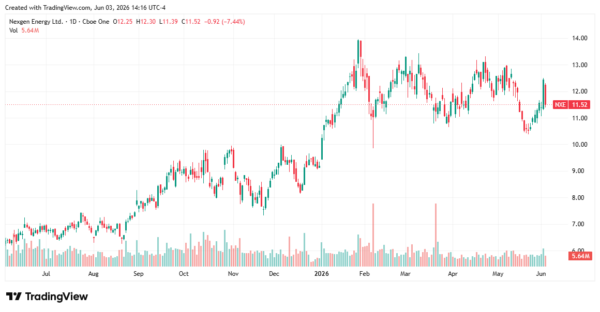
NexGen Energy (NYSE: NXE), a company specializing in uranium exploration and development, is primarily focused on the Athabasca Basin. Its flagship project is the Rook I project, which includes significant discoveries such as Arrow and South Arrow.

In March, the company secured final approval from the Canadian government needed to develop its Rook I project, clearing the way for construction of what is expected to become one of the world’s largest uranium mines.

“The company said the Canadian Nuclear Safety Commission approved the project’s environmental assessment and issued a prepare site and construct license, allowing it to proceed with full construction of the uranium development in Saskatchewan,” as noted by Seeking Alpha. With that, UBS analysts initiated a buy rating on the stock with a $20 price target. 
uranium stocks-StockEarnings

A Blue-Chip Name in the Nuclear Power Trade

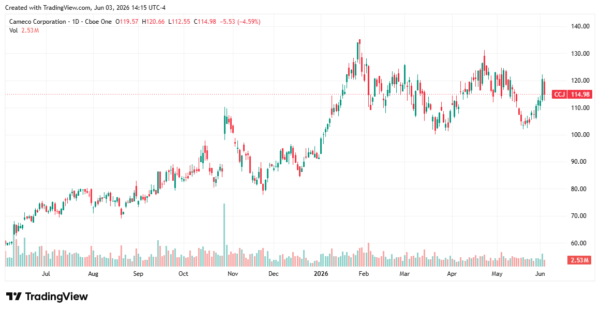
Cameco (NYSE: CCJ) just increased its stake in Cigar Lake uranium to 57.4%.

Cigar Lake’s reserve and resource base includes proven and probable reserves estimated at 172.4M lbs of U3O8, measured and indicated resources of 26.3M lbs, and inferred resources of 20M lbs; the mine is expected to produce 17.5M-18M lbs of uranium concentrate this year.

The company also has “plans to continue production and development activities in the area currently being mined while continuing to advance the development work related to Cigar Lake extension that is required to extend the life of the mine to 2036,” as noted by Seeking Alpha.
uranium stocks-StockEarnings

A Basket Approach to Uranium Investing

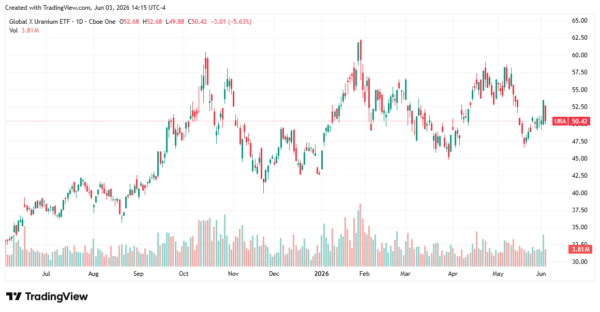
With an expense ratio of 0.69%, the oversold Global X Uranium ETF (NYSEARCA: URA) provides investors access to a broad range of companies involved in uranium mining and the production of nuclear components, including those in extraction, refining, exploration, or manufacturing of equipment for the uranium and nuclear industries. It holds about 50 related uranium stocks. 

That includes Cameco, NexGen Energy, Uranium Energy, Paladin Energy, Denison Mines, and NuScale Power.
uranium stocks-StockEarnings

The Case for Uranium Has Rarely Been Stronger

Uranium is becoming increasingly critical to the future of global power generation. Rising nuclear energy demand, growing electricity consumption from AI data centers, tightening uranium supplies, and renewed government support for domestic production are creating a favorable backdrop for uranium stocks.


Over the last 26 years, he’s taught thousands of investors how to trade news flow and herd mentality using a unique blend of technical and fundamental analysis. Cooper was among the few analysts to spot the financial crisis of 2008, the top of subprime and Alt-A, the death of Lehman Brothers, Bear Stearns, and New Century Financial, and even the Dow’s collapse to 6,500, as well as its recovery. He even called for gold to rally well above $1.500 when it traded under $600. At the moment, Cooper makes use of technical, fundamental and news analysis, to help individual investors grow their wealth. He’s a firm believer that hard work and thorough research will lead to investment success.

Join over 1.2M+ investors/traders who receive daily and weekly notable earnings alerts with predicted move