ajax loader

Loading...


Ride-the-Wave Strategy – Best for Stock Traders

Ride-the-Wave targets multi-day price momentum following a company’s earnings announcement (EA). With this strategy:

  1. Buy a stock one day post-EA if a stock reacts positively post-earnings:
    1. Near the close of trading the EA-day for a pre-market-EA
    2. Near the close of the following day for a post-market-EA
  2. Sell-to-close after 7-10 days, or possibly earlier if a desired price target is reached

Similarly,

  1. short a stock one day post-EA if a stock reacts negatively post-earnings:
    1. near the close of trading the EA-day for a premarket-EA
    2. near the close of the following day for a post-market-EA
  2. then buy-to-close after 7-10 days, or possibly earlier if a desired price target is reached

Important: Ride-the-Wave is predicated on significant price momentum triggered by an EA. The 7-10 day scenario is the maximum trade hold-time. If you see post EA-momentum is halted or reversed by a significant opposite move, re-evaluate your presence in the trade.

This popular StockEarnings screen below will give you a list of stocks that historically exhibit significant price momentum following an EA for the next seven days:

  1. Stocks exhibiting positive post-EA price moves are buy-candidates
  2. Stocks exhibiting negative post-EA price moves are sell/short-candidates

The screen includes those stocks whose Earnings just came out in last two days.

Screen criteria:

  1. Earnings Date Start Date : Current Date + -1 Day
  2. Earnings Date End Date : Current Date + -2 Days
  3. Predicted Move (Next Day) Max : 7%
  4. Predicted Move (On 7th Day) Min : 7%

Strategy Guideline:

  1. Buy the stock if stock has reacted positively. Short the stock if stock has reacted negatively (see above).
  2. Close the position in 7-10 days, or possibly earlier based on price move.

Volatility Crush Strategy - Best for Options Traders

The Volatility Crush strategy is used with stocks that typically experience relatively low-to-moderate price moves (≤4%) following their Earnings Announcements (EA). The basic trade idea is to sell put or call options right before the EA, collecting a credit when options premium is very high due to elevated implied volatility (IV). You then close the position right after the EA by buying the option back much cheaper due to the significant drop in IV that occurs after the mystery of the EA disappears. In assessing this trade, you need to do your homework to ensure you collect sufficient premium to make the trade worthwhile.

This trade is practical due to the low-to-moderate price-move after the EA, which generally won’t significantly affect the options price, unlike an “action” stock, which experience great price moves post-EA. With these symbols, if you’re on the right side of the price move, that’s a great thing. But if you’re on the wrong side of the move, not so great. Consequently, by minimizing the effect of the post-EA price move, you have a much better chance to profit from the reduction in IV without it being ruined by a violent price move.

For this trade, open the position either (1) the night before the EA when the company announces earnings or (2) during the EA day when it announces post-market, generally capturing IV at or close to its peak.

For this trade, open the position either (1) the night before the EA when the company announces earnings or (2) during the EA day when it announces post-market, generally capturing IV at or close to its peak.

This popular stockearnings screen will give you a list of stocks which do not react more than 4% fpost-EA. It includes only those stocks whose earnings are releasing next day.

Screen criteria:

  1. Earnings Date Start Date : Current Date + 1
  2. Earnings Date End Date : Current Date + 1
  3. Predicted Move (Next Day) Max : 4%
  4. Options Type: Weekly

Strategy Guideline:

  1. Options Strategy: Sell Call and Put
  2. Options Strike Price: Current Stock Price – (% Predicated Move x 2)
  3. Expiration Date: It should generally be the closest expiry immediately after the EA.
  4. Buy Insurance: Buying back Call and Put at Strike price which 10% lower than Sell Strike Price is optional but recommended.

Watch Video for More Detail

Volatility Rush Strategy - Best for Options Traders

The Volatility Rush takes advantage of increasing options premiums into earnings announcements (EA) caused by an anticipated rise in Implied Volatility (IV). With this strategy, Buy a Call and Put at-the-money (a long straddle) 2-3 weeks before the EA when IV is lower. Sell the position either (1) the night before the EA when the company announces earnings pre-market, or (2) during the EA day when it announces post-market, generally capturing IV at or close to its peak.

This popular screen will give you a list of stocks whose Options premiums tend to rise into Earnings. It includes only those stocks whose Earnings are at least two weeks away from today.

Screen criteria:

  1. Earnings Date Start Date : Current Date + 15 Days
  2. Earnings Date End Date : Current Date + 30 Days
  3. Predicted Move (Next Day) Min : 5%
  4. Options Type: Weekly or Monthly if that lines up with the two to three-week lead-time for entering the trade

Strategy Guideline:

  1. Buy a Straddle at or close to the money two to three weeks pre-EA.
  2. Sell the position either the night before the EA when the company announces earnings pre-market, or during the EA day when it announces post-market.
  3. Expiration date should generally be the closest expiry immediately after the EA.
  4. Straddle price should not be more 60% of predicted move.

Predicted Move (Volatility)

Similar to Implied Volatility in Options. Expected volatility % based on our Proprietary Volatility Predication Model. We are expecting that stock price will likely to reach % in either direction by the end of next trading session after Earnings are released and not necessarily the closing volatility %.

Why is it important?

    This indicator helps

  1. Knowing expected volatility in stocks after Earnings helps to decide trading stocks before Earnings Announcement.
  2. Taking Advantage of volatility collapse following Earnings Results by using Advance Options strategies such as Spread and Straddles.

Since Last Earnings

Change in share price since last Earnings release.

Why is it Important?

When share has gained more than 10% since it's last Earning release, it tends to over react to minor bad news and give up some gains if not all. So, it contains more downside volatility than upside When share has dropped more than 10% since it's last Earning release, it tends to over react to minor good news and recover some drops if not all. So, it contains more upside volatility than downside.

EPS Surprise (%)

Occurs when a company's reported quarterly or annual profits are above or below analysts' expectations. Here is the formula to derive % EPS Surprice:

Actual EPS - Estimated EPS
------------------------------------- x 100
Estimated EPS

Why is it Important?

Earnings surprises can have a huge impact on a company's stock price. Several studies suggest that positive earnings surprises not only lead to an immediate hike in a stock's price, but also to a gradual increase over time. Hence, it's not surprising that some companies are known for routinely beating earning projections. A negative earnings surprise will usually result in a decline in share price.

Next Day Price Change (%)

Next Regular trading session Closing price following Earnings result.

For After Market Close Earnings, It is a next trading day closing price. For Before Market Open Earnings, It is the same trading day closing price.

Why is it Important?

Next Day price change is a reaction of Earnings result.

Why Investors Are Questioning Crowdstrike’s Second Act

Posted on Jun 04, 2026 by Grayson Cavern

Why Investors Are Questioning Crowdstrike’s Second Act

Every great growth company eventually runs into the same problem. The business that made investors rich becomes easy to understand, model, and value, which means attention naturally shifts away from what the company has already proven and toward what it might become next. That’s exactly how I think CrowdStrike Holdings Inc (NASDAQ: CRWD) 2027 first quarter earnings should be viewed.

The company reported first-quarter fiscal 2027 revenue of $1.10 billion, up 26% year over year, while adjusted EPS surged 51% to $1.10. Yet the stock lost roughly 10% after earnings. Here’s what I discovered;

The Quarter That Shouldn’t Have Triggered A Selloff


Revenue grew 26%. Earnings grew 51%.

Read those figures together because the relationship between them matters more than either figure on its own. A company can grow revenue by spending aggressively, discounting heavily, or sacrificing profitability in pursuit of market share. What usually gets harder as software companies mature is growing earnings faster than revenue. CrowdStrike did exactly that.

The rest of the quarter reinforced the same conclusion. Annual recurring revenue climbed to $5.61 billion, operating cash flow reached a record $384 million, free cash flow hit a record $279 million, and management raised full-year guidance. These are hard figures proving that the business is becoming more efficient as it scales, extracting more profit and cash flow from every customer already inside the platform.

The problem is, investors spend years asking software companies to become more profitable, generate more cash, and prove they can convert growth into earnings. CrowdStrike delivered all three in the same quarter, yet the market responded as though something important had gone missing. 

The Ghost Hanging Over This Report Isn’t a Competitor

Most commentary will frame this quarter as a competitive battle between CrowdStrike, Microsoft, Palo Alto Networks, and SentinelOne. I think that’s looking in the wrong direction.

The company casting the longest shadow over this earnings report isn’t a competitor. It’s CrowdStrike itself.

Revenue growing 26% would be exceptional for most software businesses operating at this scale. For CrowdStrike, a portion of the market immediately compares it to the version of the company that once grew at breathtaking rates while reshaping the cybersecurity landscape almost quarter after quarter. Investors understand that business, trust it, and know exactly how to value it. 

One Job Title Explains Why Investors Are Nervous

CrowdStrike recently appointed Bartley Richardson – the engineering leader for agentic AI, cybersecurity AI, and AI infrastructure at Nvidia – as Chief AI and Autonomous Systems Officer.

I keep coming back to that title because it reveals far more about management’s ambitions than most investors seem willing to acknowledge: autonomous Systems.

At roughly the same time, CrowdStrike expanded monitoring capabilities for Anthropic’s Claude environments while continuing to position itself as a leader in AI-era cybersecurity. These announcements suggest management is steering the company toward something much larger than endpoint protection. For decades, cybersecurity companies have focused on helping humans identify threats faster and respond more efficiently.

CrowdStrike now sounds like a company trying to reduce the number of security decisions humans need to make in the first place.

That’s a much larger and harder opportunity to measure. And markets rarely pay premium valuations for opportunities they cannot confidently measure.

Wall Street’s Doubting Thomases Haven’t Left The Building

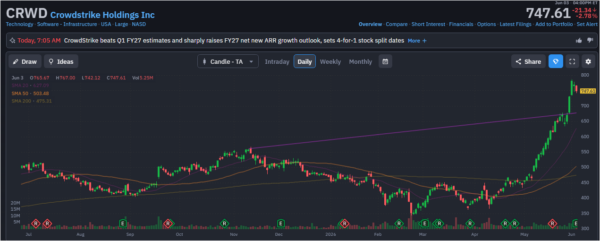
The stock chart tells the story better than the earnings release.

CrowdStrike entered earnings after rallying from roughly $350 in March to nearly $780 before the report, a move of more than 120% in just over three months. Moves like that happen when investors start pricing in a future that hasn’t arrived yet. 

When earnings arrived, more than 16 million shares changed hands during the selloff, making it one of the heaviest trading sessions. Despite the decline, CrowdStrike remains comfortably above its 20-day moving average near $627, its 50-day moving average near $503, and its 200-day moving average near $475.

That distinction matters because institutions don’t abandon positions while a stock remains comfortably above every major trend line. Instead, they reprice expectations. Consequently, investors are now demanding evidence that CrowdStrike’s next growth engine is becoming real before they assign it the same premium valuation they once gave the first one.
crowdstrike-StockEarning

Right Question, Wrong Timing

After studying the quarter, I don’t think the market is questioning CrowdStrike’s ability to execute. A company generating record cash flow, growing earnings twice as fast as revenue, raising guidance, and expanding recurring revenue has already answered that question.

The question investors are asking now is different.

Can autonomous security become as important to CrowdStrike as endpoint security once was?

Management appears convinced the answer is yes. The leadership hire, the strategic direction, and the language surrounding autonomous systems all point the same way. The market isn’t convinced yet, and I get it, but I think they’re asking the right question too early.

The first act built one of the most dominant cybersecurity platforms in the world. The second act is still under construction. If management succeeds in turning autonomous security into a meaningful business rather than an interesting concept, this quarter may eventually be remembered as the moment investors became impatient just before CrowdStrike started building its next growth engine.


Join over 1.2M+ investors/traders who receive daily and weekly notable earnings alerts with predicted move