ajax loader

Loading...


Ride-the-Wave Strategy – Best for Stock Traders

Ride-the-Wave targets multi-day price momentum following a company’s earnings announcement (EA). With this strategy:

  1. Buy a stock one day post-EA if a stock reacts positively post-earnings:
    1. Near the close of trading the EA-day for a pre-market-EA
    2. Near the close of the following day for a post-market-EA
  2. Sell-to-close after 7-10 days, or possibly earlier if a desired price target is reached

Similarly,

  1. short a stock one day post-EA if a stock reacts negatively post-earnings:
    1. near the close of trading the EA-day for a premarket-EA
    2. near the close of the following day for a post-market-EA
  2. then buy-to-close after 7-10 days, or possibly earlier if a desired price target is reached

Important: Ride-the-Wave is predicated on significant price momentum triggered by an EA. The 7-10 day scenario is the maximum trade hold-time. If you see post EA-momentum is halted or reversed by a significant opposite move, re-evaluate your presence in the trade.

This popular StockEarnings screen below will give you a list of stocks that historically exhibit significant price momentum following an EA for the next seven days:

  1. Stocks exhibiting positive post-EA price moves are buy-candidates
  2. Stocks exhibiting negative post-EA price moves are sell/short-candidates

The screen includes those stocks whose Earnings just came out in last two days.

Screen criteria:

  1. Earnings Date Start Date : Current Date + -1 Day
  2. Earnings Date End Date : Current Date + -2 Days
  3. Predicted Move (Next Day) Max : 7%
  4. Predicted Move (On 7th Day) Min : 7%

Strategy Guideline:

  1. Buy the stock if stock has reacted positively. Short the stock if stock has reacted negatively (see above).
  2. Close the position in 7-10 days, or possibly earlier based on price move.

Volatility Crush Strategy - Best for Options Traders

The Volatility Crush strategy is used with stocks that typically experience relatively low-to-moderate price moves (≤4%) following their Earnings Announcements (EA). The basic trade idea is to sell put or call options right before the EA, collecting a credit when options premium is very high due to elevated implied volatility (IV). You then close the position right after the EA by buying the option back much cheaper due to the significant drop in IV that occurs after the mystery of the EA disappears. In assessing this trade, you need to do your homework to ensure you collect sufficient premium to make the trade worthwhile.

This trade is practical due to the low-to-moderate price-move after the EA, which generally won’t significantly affect the options price, unlike an “action” stock, which experience great price moves post-EA. With these symbols, if you’re on the right side of the price move, that’s a great thing. But if you’re on the wrong side of the move, not so great. Consequently, by minimizing the effect of the post-EA price move, you have a much better chance to profit from the reduction in IV without it being ruined by a violent price move.

For this trade, open the position either (1) the night before the EA when the company announces earnings or (2) during the EA day when it announces post-market, generally capturing IV at or close to its peak.

For this trade, open the position either (1) the night before the EA when the company announces earnings or (2) during the EA day when it announces post-market, generally capturing IV at or close to its peak.

This popular stockearnings screen will give you a list of stocks which do not react more than 4% fpost-EA. It includes only those stocks whose earnings are releasing next day.

Screen criteria:

  1. Earnings Date Start Date : Current Date + 1
  2. Earnings Date End Date : Current Date + 1
  3. Predicted Move (Next Day) Max : 4%
  4. Options Type: Weekly

Strategy Guideline:

  1. Options Strategy: Sell Call and Put
  2. Options Strike Price: Current Stock Price – (% Predicated Move x 2)
  3. Expiration Date: It should generally be the closest expiry immediately after the EA.
  4. Buy Insurance: Buying back Call and Put at Strike price which 10% lower than Sell Strike Price is optional but recommended.

Watch Video for More Detail

Volatility Rush Strategy - Best for Options Traders

The Volatility Rush takes advantage of increasing options premiums into earnings announcements (EA) caused by an anticipated rise in Implied Volatility (IV). With this strategy, Buy a Call and Put at-the-money (a long straddle) 2-3 weeks before the EA when IV is lower. Sell the position either (1) the night before the EA when the company announces earnings pre-market, or (2) during the EA day when it announces post-market, generally capturing IV at or close to its peak.

This popular screen will give you a list of stocks whose Options premiums tend to rise into Earnings. It includes only those stocks whose Earnings are at least two weeks away from today.

Screen criteria:

  1. Earnings Date Start Date : Current Date + 15 Days
  2. Earnings Date End Date : Current Date + 30 Days
  3. Predicted Move (Next Day) Min : 5%
  4. Options Type: Weekly or Monthly if that lines up with the two to three-week lead-time for entering the trade

Strategy Guideline:

  1. Buy a Straddle at or close to the money two to three weeks pre-EA.
  2. Sell the position either the night before the EA when the company announces earnings pre-market, or during the EA day when it announces post-market.
  3. Expiration date should generally be the closest expiry immediately after the EA.
  4. Straddle price should not be more 60% of predicted move.

Predicted Move (Volatility)

Similar to Implied Volatility in Options. Expected volatility % based on our Proprietary Volatility Predication Model. We are expecting that stock price will likely to reach % in either direction by the end of next trading session after Earnings are released and not necessarily the closing volatility %.

Why is it important?

    This indicator helps

  1. Knowing expected volatility in stocks after Earnings helps to decide trading stocks before Earnings Announcement.
  2. Taking Advantage of volatility collapse following Earnings Results by using Advance Options strategies such as Spread and Straddles.

Since Last Earnings

Change in share price since last Earnings release.

Why is it Important?

When share has gained more than 10% since it's last Earning release, it tends to over react to minor bad news and give up some gains if not all. So, it contains more downside volatility than upside When share has dropped more than 10% since it's last Earning release, it tends to over react to minor good news and recover some drops if not all. So, it contains more upside volatility than downside.

EPS Surprise (%)

Occurs when a company's reported quarterly or annual profits are above or below analysts' expectations. Here is the formula to derive % EPS Surprice:

Actual EPS - Estimated EPS
------------------------------------- x 100
Estimated EPS

Why is it Important?

Earnings surprises can have a huge impact on a company's stock price. Several studies suggest that positive earnings surprises not only lead to an immediate hike in a stock's price, but also to a gradual increase over time. Hence, it's not surprising that some companies are known for routinely beating earning projections. A negative earnings surprise will usually result in a decline in share price.

Next Day Price Change (%)

Next Regular trading session Closing price following Earnings result.

For After Market Close Earnings, It is a next trading day closing price. For Before Market Open Earnings, It is the same trading day closing price.

Why is it Important?

Next Day price change is a reaction of Earnings result.

CRISPR Therapeutics Stock: CASGEVY Growth Signals Bigger Move Ahead

Posted on Aug 04, 2026 by Chris Markoch

CRISPR Therapeutics Stock: CASGEVY Growth Signals Bigger Move Ahead

CRISPR Therapeutics (NASDAQ: CRSP) delivered second-quarter 2026 results that confirmed what investors already suspected. CASGEVY, the company’s landmark gene-editing therapy, is finally translating clinical validation into commercial traction.

The stock climbed 3.29% on the news, closing near $49.57. Revenue from the CRISPR/Cas9 therapy jumped 151% year-over-year to $76 million, a leap that was largely priced in given CASGEVY’s steady rollout since approval. What matters more is what comes next.

CRISPR Therapeutics isn’t a story about this quarter’s numbers. It’s a story about optionality. The company now has six clinical-stage programs spanning cardiovascular disease, autoimmune conditions, and oncology. Each represents a call option on a market worth billions.

That’s the tension defining this stock right now. The near-term financials remain unremarkable by traditional standards. Net loss narrowed to $91.2 million from $208.5 million a year ago, but this is still a company burning cash to fund a decade-long bet on gene editing’s future.

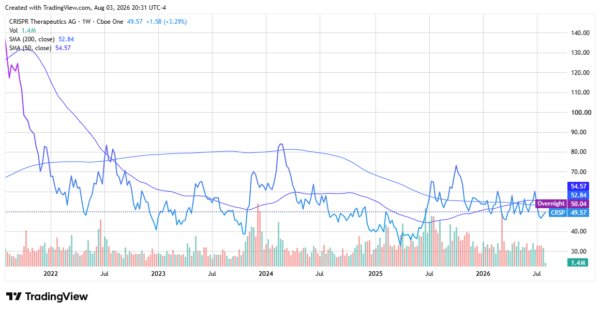
Yet the chart tells a different story from the income statement. Shares have spent nearly two years compressing into a narrower and narrower range. That kind of coiling action often precedes a decisive move. The question is whether investors are approaching a moment they can’t afford to miss, or whether the pattern breaks the other way.

CASGEVY’s Commercial Engine Is Finally Running


CASGEVY generated $76 million in second quarter revenue, up 78% sequentially. That acceleration matters more than the headline year-over-year figure. Quarter-over-quarter growth shows real prescribing momentum building inside hospitals and treatment centers, not just an easy comparison against a slow launch period.

The FDA’s approval expanding CASGEVY to children as young as 2 years old is the bigger catalyst. It arrived in just 53 days after filing, unusually fast for a first-in-class gene therapy. That approval opens treatment to roughly 5,500 additional patients with sickle cell disease or transfusion-dependent beta thalassemia who previously had no eligibility.

crispr_StockEarnings

CASGEVY is now approved in 39 countries. Germany secured reimbursement for patients 12 and older in May, and regulatory submissions are underway in Saudi Arabia and the U.K. for younger patients. Each new market and age expansion adds incremental revenue to a therapy still in its early commercial innings.

Under the Vertex partnership, CRISPR Therapeutics keeps 40% of CASGEVY profits. As the patient pool scales globally, that revenue share becomes the funding engine for everything else in the pipeline. This is the bridge connecting today’s cash burn to tomorrow’s broader ambitions.

A Pipeline Built for Optionality, Not Just CASGEVY

CASGEVY was the company’s proof of concept. The real long-term thesis lives in what comes after it. CRISPR Therapeutics now runs a diversified in vivo editing platform targeting cardiovascular disease through CTX310, CTX340, and CTX321, all delivered via lipid nanoparticles directly in patients rather than through complex ex vivo cell processing.

CTX340 for refractory hypertension and CTX460 for alpha-1 antitrypsin deficiency both entered Phase 1 trials this quarter. That’s meaningful pipeline progression, not just incremental updates. Zugo-cel, the company’s allogeneic CAR-T candidate, is advancing across autoimmune disease and blood cancers simultaneously, effectively doubling its shots on goal.

With $2.36 billion in cash and marketable securities, management has the runway to fund this expansion without near-term dilution pressure. That balance sheet strength is what allows a genuinely speculative, multi-program bet to keep playing out on a multi-year timeline. Investors aren’t paying for one drug. They’re paying for a platform.

The Chart Is Coiling Near Key Support

CRSP shares are consolidating in a pattern technicians call a coil, a tightening range that often precedes a breakout in either direction. The stock currently trades at $49.57, just below its 50-day simple moving average of $54.57 and 200-day average of $52.84.

Notably, the 50-day average sits above the 200-day, a bullish structural setup even as price tests support beneath both lines. Volume remains moderate at 1.4 million shares weekly, suggesting no panic selling, just quiet accumulation. A decisive close above $54.57 could confirm the breakout thesis. A drop toward the low-$40s range would suggest the coil is breaking down instead.
crispr_StockEarnings

Investor Psychology at a Turning Point

CRISPR Therapeutics sits at an uncomfortable but familiar juncture for early-stage biotech investors. The fundamentals are improving steadily, quarter after quarter, while the stock price has gone nowhere for two years. That gap between operational progress and market perception is exactly where opportunity tends to hide.

This remains a long-term speculative position. Real pipeline maturity, particularly for cardiovascular and autoimmune programs, is still years away from commercial reality. Clinical trials fail. Regulatory timelines slip. Nothing here is guaranteed.

But for investors comfortable with that risk, the combination of accelerating CASGEVY revenue, a well-funded diversified pipeline, and a technically compressed chart creates a setup worth watching closely. The spring looks coiled. Whether it releases upward remains, as always, the market’s call to make.


A former marketing copywriter turned freelance financial writer and market analyst. I have a passion for delivering insights to investors. I write regularly about stocks for StockEarnings and MarketBeat. Posts are not advice.

Join over 1.2M+ investors/traders who receive daily and weekly notable earnings alerts with predicted move