ajax loader

Loading...


Ride-the-Wave Strategy – Best for Stock Traders

Ride-the-Wave targets multi-day price momentum following a company’s earnings announcement (EA). With this strategy:

  1. Buy a stock one day post-EA if a stock reacts positively post-earnings:
    1. Near the close of trading the EA-day for a pre-market-EA
    2. Near the close of the following day for a post-market-EA
  2. Sell-to-close after 7-10 days, or possibly earlier if a desired price target is reached

Similarly,

  1. short a stock one day post-EA if a stock reacts negatively post-earnings:
    1. near the close of trading the EA-day for a premarket-EA
    2. near the close of the following day for a post-market-EA
  2. then buy-to-close after 7-10 days, or possibly earlier if a desired price target is reached

Important: Ride-the-Wave is predicated on significant price momentum triggered by an EA. The 7-10 day scenario is the maximum trade hold-time. If you see post EA-momentum is halted or reversed by a significant opposite move, re-evaluate your presence in the trade.

This popular StockEarnings screen below will give you a list of stocks that historically exhibit significant price momentum following an EA for the next seven days:

  1. Stocks exhibiting positive post-EA price moves are buy-candidates
  2. Stocks exhibiting negative post-EA price moves are sell/short-candidates

The screen includes those stocks whose Earnings just came out in last two days.

Screen criteria:

  1. Earnings Date Start Date : Current Date + -1 Day
  2. Earnings Date End Date : Current Date + -2 Days
  3. Predicted Move (Next Day) Max : 7%
  4. Predicted Move (On 7th Day) Min : 7%

Strategy Guideline:

  1. Buy the stock if stock has reacted positively. Short the stock if stock has reacted negatively (see above).
  2. Close the position in 7-10 days, or possibly earlier based on price move.

Volatility Crush Strategy - Best for Options Traders

The Volatility Crush strategy is used with stocks that typically experience relatively low-to-moderate price moves (≤4%) following their Earnings Announcements (EA). The basic trade idea is to sell put or call options right before the EA, collecting a credit when options premium is very high due to elevated implied volatility (IV). You then close the position right after the EA by buying the option back much cheaper due to the significant drop in IV that occurs after the mystery of the EA disappears. In assessing this trade, you need to do your homework to ensure you collect sufficient premium to make the trade worthwhile.

This trade is practical due to the low-to-moderate price-move after the EA, which generally won’t significantly affect the options price, unlike an “action” stock, which experience great price moves post-EA. With these symbols, if you’re on the right side of the price move, that’s a great thing. But if you’re on the wrong side of the move, not so great. Consequently, by minimizing the effect of the post-EA price move, you have a much better chance to profit from the reduction in IV without it being ruined by a violent price move.

For this trade, open the position either (1) the night before the EA when the company announces earnings or (2) during the EA day when it announces post-market, generally capturing IV at or close to its peak.

For this trade, open the position either (1) the night before the EA when the company announces earnings or (2) during the EA day when it announces post-market, generally capturing IV at or close to its peak.

This popular stockearnings screen will give you a list of stocks which do not react more than 4% fpost-EA. It includes only those stocks whose earnings are releasing next day.

Screen criteria:

  1. Earnings Date Start Date : Current Date + 1
  2. Earnings Date End Date : Current Date + 1
  3. Predicted Move (Next Day) Max : 4%
  4. Options Type: Weekly

Strategy Guideline:

  1. Options Strategy: Sell Call and Put
  2. Options Strike Price: Current Stock Price – (% Predicated Move x 2)
  3. Expiration Date: It should generally be the closest expiry immediately after the EA.
  4. Buy Insurance: Buying back Call and Put at Strike price which 10% lower than Sell Strike Price is optional but recommended.

Watch Video for More Detail

Volatility Rush Strategy - Best for Options Traders

The Volatility Rush takes advantage of increasing options premiums into earnings announcements (EA) caused by an anticipated rise in Implied Volatility (IV). With this strategy, Buy a Call and Put at-the-money (a long straddle) 2-3 weeks before the EA when IV is lower. Sell the position either (1) the night before the EA when the company announces earnings pre-market, or (2) during the EA day when it announces post-market, generally capturing IV at or close to its peak.

This popular screen will give you a list of stocks whose Options premiums tend to rise into Earnings. It includes only those stocks whose Earnings are at least two weeks away from today.

Screen criteria:

  1. Earnings Date Start Date : Current Date + 15 Days
  2. Earnings Date End Date : Current Date + 30 Days
  3. Predicted Move (Next Day) Min : 5%
  4. Options Type: Weekly or Monthly if that lines up with the two to three-week lead-time for entering the trade

Strategy Guideline:

  1. Buy a Straddle at or close to the money two to three weeks pre-EA.
  2. Sell the position either the night before the EA when the company announces earnings pre-market, or during the EA day when it announces post-market.
  3. Expiration date should generally be the closest expiry immediately after the EA.
  4. Straddle price should not be more 60% of predicted move.

Predicted Move (Volatility)

Similar to Implied Volatility in Options. Expected volatility % based on our Proprietary Volatility Predication Model. We are expecting that stock price will likely to reach % in either direction by the end of next trading session after Earnings are released and not necessarily the closing volatility %.

Why is it important?

    This indicator helps

  1. Knowing expected volatility in stocks after Earnings helps to decide trading stocks before Earnings Announcement.
  2. Taking Advantage of volatility collapse following Earnings Results by using Advance Options strategies such as Spread and Straddles.

Since Last Earnings

Change in share price since last Earnings release.

Why is it Important?

When share has gained more than 10% since it's last Earning release, it tends to over react to minor bad news and give up some gains if not all. So, it contains more downside volatility than upside When share has dropped more than 10% since it's last Earning release, it tends to over react to minor good news and recover some drops if not all. So, it contains more upside volatility than downside.

EPS Surprise (%)

Occurs when a company's reported quarterly or annual profits are above or below analysts' expectations. Here is the formula to derive % EPS Surprice:

Actual EPS - Estimated EPS
------------------------------------- x 100
Estimated EPS

Why is it Important?

Earnings surprises can have a huge impact on a company's stock price. Several studies suggest that positive earnings surprises not only lead to an immediate hike in a stock's price, but also to a gradual increase over time. Hence, it's not surprising that some companies are known for routinely beating earning projections. A negative earnings surprise will usually result in a decline in share price.

Next Day Price Change (%)

Next Regular trading session Closing price following Earnings result.

For After Market Close Earnings, It is a next trading day closing price. For Before Market Open Earnings, It is the same trading day closing price.

Why is it Important?

Next Day price change is a reaction of Earnings result.

Stuck Stock: How Marriott’s Business Kept Moving While Its Stock Stayed Put

Posted on Aug 03, 2026 by Grayson Cavern

Stuck Stock: How Marriott’s Business Kept Moving While Its Stock Stayed Put

Some earnings reports answer questions, others create better ones. Now Marriott International (NASDAQ: MAR) delivered the kind of quarter 2 earnings most companies would gladly take.

Adjusted earnings per share came in at $3.19, comfortably ahead of Wall Street’s $3.05 estimate. Adjusted EBITDA climbed 13% to $1.49 billion, and worldwide gross fee revenue increased another 13%. Yet revenue of $7.07 billion fell short of expectations, and the market’s response was swift. Shares dropped almost 4%, leaving the stock trading almost exactly where it was after the previous earnings season. 

That felt… odd. A business that keeps producing higher earnings shouldn’t spend an entire quarter running in place unless investors have found something more important than another EPS beat.

So I went back through the filing. The further I read, the less interested I became in the revenue miss as my attention drifted toward a different part of the income statement that showed how Marriott’s most profitable revenue streams were growing faster than the business itself. Franchise fees accelerated 19%, net fee revenue rose 13%, while adjusted EBITDA expanded more than twice as fast as total revenue. 

How Franchise Fees Rewrote The Earnings Story


Marriott still gets described as a hotel company. But the company finished the quarter with 10,082 properties and more than 1.81 million rooms across 144 countries and territories. Yet only 50 of those properties are actually owned or leased by Marriott. The overwhelming majority generate earnings through management and franchise agreements rather than hotel ownership. 

More specifically, franchise fees climbed 19% year over year to $1.02 billion, making them the fastest-growing major revenue stream in the quarter. Net fee revenue increased 13% to $1.55 billion, matching the growth in adjusted EBITDA and comfortably outpacing the company’s 5% revenue growth. Base management fees, meanwhile, edged up just 1%. 

The pattern is difficult to ignore because Marriott isn’t relying on adding more owned hotels to lift earnings. It is collecting a larger share of its profits from brands, management contracts and franchise agreements spread across a network someone else largely paid to build.

That’s one reason the revenue miss didn’t bother me as much as it did the market. A difficult quarter in one region can weigh on reported sales. Expanding fee income across thousands of franchised and managed properties tells me something far more durable is happening beneath the surface.

Look at the business through that lens and the quarter reads differently. Every franchise agreement shifts more of the construction costs, maintenance bills and operating headaches onto the property owner, while Marriott adds another stream of recurring, high-margin fee income to its own books

Wall Street Isn’t Paying Up For Incremental Progress

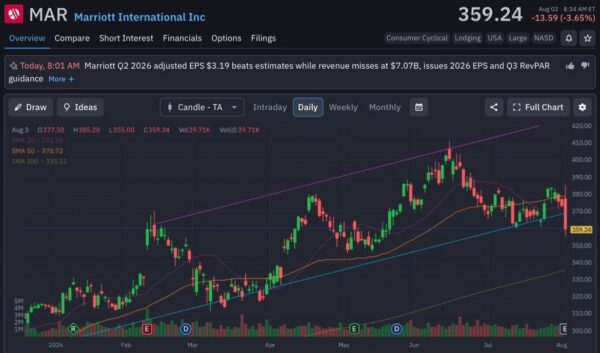
Three months ago, Marriott was trading around $360 after first-quarter earnings. Three months, another earnings report, and another EPS beat later, it’s… still around $360.

Indecision? No. Valuation discipline? Most likely. You see, since peaking near $405 in June, the stock has carved out a series of lower highs, with every rally stalling beneath the descending trendline that now defines the upper boundary of the chart. The post-earnings selloff pushed shares below both the 20-day moving average ($371.58) and the 50-day moving average ($378.72) before buyers stepped in around $355, almost exactly where the rising trendline from April intersects with price. Even after the pullback, the 200-day moving average ($335.52) continues to slope higher, leaving the longer-term uptrend intact.

That combination tells its own story. The exits aren’t crowded. Neither are the entrances. Institutions don’t appear to be questioning Marriott’s business. They’re questioning how much more they’re willing to pay for it. I can understand that.

The company continues to execute with remarkable consistency, but consistency has become the expectation, not the surprise. Once a business reaches Marriott’s quality, another earnings beat rarely changes anyone’s valuation framework. Investors begin looking for something capable of expanding the multiple, not merely defending it.

The stock has spent an entire quarter reflecting that mindset
marriott-StockEarnings

Sometimes Great Businesses Need Time More Than Catalysts

Marriott keeps producing the kind of quarter most companies would celebrate. The market keeps responding with a shrug.

I’m okay with that. One quarter rarely changes how I value a business that’s spent decades proving it knows exactly what it is. If anything, this report reinforced that confidence. The economics continue to improve, even if the stock refuses to acknowledge it for now.

For the moment, Marriott looks like a business quietly compounding beneath the surface while its share price takes a breather. Markets eventually notice businesses that keep getting better. They just don’t always do it on our timetable.

Sooner or later, one of them catches up with the other. My bet is it won’t be the business

Join over 1.2M+ investors/traders who receive daily and weekly notable earnings alerts with predicted move