ajax loader

Loading...


Ride-the-Wave Strategy – Best for Stock Traders

Ride-the-Wave targets multi-day price momentum following a company’s earnings announcement (EA). With this strategy:

  1. Buy a stock one day post-EA if a stock reacts positively post-earnings:
    1. Near the close of trading the EA-day for a pre-market-EA
    2. Near the close of the following day for a post-market-EA
  2. Sell-to-close after 7-10 days, or possibly earlier if a desired price target is reached

Similarly,

  1. short a stock one day post-EA if a stock reacts negatively post-earnings:
    1. near the close of trading the EA-day for a premarket-EA
    2. near the close of the following day for a post-market-EA
  2. then buy-to-close after 7-10 days, or possibly earlier if a desired price target is reached

Important: Ride-the-Wave is predicated on significant price momentum triggered by an EA. The 7-10 day scenario is the maximum trade hold-time. If you see post EA-momentum is halted or reversed by a significant opposite move, re-evaluate your presence in the trade.

This popular StockEarnings screen below will give you a list of stocks that historically exhibit significant price momentum following an EA for the next seven days:

  1. Stocks exhibiting positive post-EA price moves are buy-candidates
  2. Stocks exhibiting negative post-EA price moves are sell/short-candidates

The screen includes those stocks whose Earnings just came out in last two days.

Screen criteria:

  1. Earnings Date Start Date : Current Date + -1 Day
  2. Earnings Date End Date : Current Date + -2 Days
  3. Predicted Move (Next Day) Max : 7%
  4. Predicted Move (On 7th Day) Min : 7%

Strategy Guideline:

  1. Buy the stock if stock has reacted positively. Short the stock if stock has reacted negatively (see above).
  2. Close the position in 7-10 days, or possibly earlier based on price move.

Volatility Crush Strategy - Best for Options Traders

The Volatility Crush strategy is used with stocks that typically experience relatively low-to-moderate price moves (≤4%) following their Earnings Announcements (EA). The basic trade idea is to sell put or call options right before the EA, collecting a credit when options premium is very high due to elevated implied volatility (IV). You then close the position right after the EA by buying the option back much cheaper due to the significant drop in IV that occurs after the mystery of the EA disappears. In assessing this trade, you need to do your homework to ensure you collect sufficient premium to make the trade worthwhile.

This trade is practical due to the low-to-moderate price-move after the EA, which generally won’t significantly affect the options price, unlike an “action” stock, which experience great price moves post-EA. With these symbols, if you’re on the right side of the price move, that’s a great thing. But if you’re on the wrong side of the move, not so great. Consequently, by minimizing the effect of the post-EA price move, you have a much better chance to profit from the reduction in IV without it being ruined by a violent price move.

For this trade, open the position either (1) the night before the EA when the company announces earnings or (2) during the EA day when it announces post-market, generally capturing IV at or close to its peak.

For this trade, open the position either (1) the night before the EA when the company announces earnings or (2) during the EA day when it announces post-market, generally capturing IV at or close to its peak.

This popular stockearnings screen will give you a list of stocks which do not react more than 4% fpost-EA. It includes only those stocks whose earnings are releasing next day.

Screen criteria:

  1. Earnings Date Start Date : Current Date + 1
  2. Earnings Date End Date : Current Date + 1
  3. Predicted Move (Next Day) Max : 4%
  4. Options Type: Weekly

Strategy Guideline:

  1. Options Strategy: Sell Call and Put
  2. Options Strike Price: Current Stock Price – (% Predicated Move x 2)
  3. Expiration Date: It should generally be the closest expiry immediately after the EA.
  4. Buy Insurance: Buying back Call and Put at Strike price which 10% lower than Sell Strike Price is optional but recommended.

Watch Video for More Detail

Volatility Rush Strategy - Best for Options Traders

The Volatility Rush takes advantage of increasing options premiums into earnings announcements (EA) caused by an anticipated rise in Implied Volatility (IV). With this strategy, Buy a Call and Put at-the-money (a long straddle) 2-3 weeks before the EA when IV is lower. Sell the position either (1) the night before the EA when the company announces earnings pre-market, or (2) during the EA day when it announces post-market, generally capturing IV at or close to its peak.

This popular screen will give you a list of stocks whose Options premiums tend to rise into Earnings. It includes only those stocks whose Earnings are at least two weeks away from today.

Screen criteria:

  1. Earnings Date Start Date : Current Date + 15 Days
  2. Earnings Date End Date : Current Date + 30 Days
  3. Predicted Move (Next Day) Min : 5%
  4. Options Type: Weekly or Monthly if that lines up with the two to three-week lead-time for entering the trade

Strategy Guideline:

  1. Buy a Straddle at or close to the money two to three weeks pre-EA.
  2. Sell the position either the night before the EA when the company announces earnings pre-market, or during the EA day when it announces post-market.
  3. Expiration date should generally be the closest expiry immediately after the EA.
  4. Straddle price should not be more 60% of predicted move.

Predicted Move (Volatility)

Similar to Implied Volatility in Options. Expected volatility % based on our Proprietary Volatility Predication Model. We are expecting that stock price will likely to reach % in either direction by the end of next trading session after Earnings are released and not necessarily the closing volatility %.

Why is it important?

    This indicator helps

  1. Knowing expected volatility in stocks after Earnings helps to decide trading stocks before Earnings Announcement.
  2. Taking Advantage of volatility collapse following Earnings Results by using Advance Options strategies such as Spread and Straddles.

Since Last Earnings

Change in share price since last Earnings release.

Why is it Important?

When share has gained more than 10% since it's last Earning release, it tends to over react to minor bad news and give up some gains if not all. So, it contains more downside volatility than upside When share has dropped more than 10% since it's last Earning release, it tends to over react to minor good news and recover some drops if not all. So, it contains more upside volatility than downside.

EPS Surprise (%)

Occurs when a company's reported quarterly or annual profits are above or below analysts' expectations. Here is the formula to derive % EPS Surprice:

Actual EPS - Estimated EPS
------------------------------------- x 100
Estimated EPS

Why is it Important?

Earnings surprises can have a huge impact on a company's stock price. Several studies suggest that positive earnings surprises not only lead to an immediate hike in a stock's price, but also to a gradual increase over time. Hence, it's not surprising that some companies are known for routinely beating earning projections. A negative earnings surprise will usually result in a decline in share price.

Next Day Price Change (%)

Next Regular trading session Closing price following Earnings result.

For After Market Close Earnings, It is a next trading day closing price. For Before Market Open Earnings, It is the same trading day closing price.

Why is it Important?

Next Day price change is a reaction of Earnings result.

2 Senior Housing REITs to Watch as Demand for Care Facilities Grows

Posted on Nov 23, 2026 by Ian Cooper

2 Senior Housing REITs to Watch as Demand for Care Facilities Grows

Americans aged 65 and older accounted for 17% of the U.S. population in 2020, or about 55.8 million, according to the U.S. Census Bureau. That demographic shift is creating a growing investment opportunity for senior housing REITs, which own and operate properties serving an aging population.

Some will turn 80 this year, which is expected to create bigger demand for senior and care facilities. In fact, as quoted by CNBC, “The 80+ population is set to increase meaningfully over the next few years, which will drive a material increase in demand for senior housing,” wrote Jefferies analyst Joe Dickstein.”

We also have to consider that people are living longer, which increases demand even more. Plus, there’s a growing shortage of caregivers to meet the explosive demand. These trends could create a favorable long-term backdrop for senior housing REITs and healthcare property owners.

As noted by Medsien.com, “The growing aging population is driving demand for more medical care, as we face provider shortages. Patients 65 and older account for 34% of the demand for physicians. And by 2034, patients over 65 will account for 42% of the demand. An aging population means higher use of health care services and a greater need for family and professional caregivers.”

So, what’s the best way to invest?

We suggest care facility real estate investment trusts not only for their exposure to a growing market but also for their yield. Senior housing REITs offer investors a way to participate in this demographic trend through publicly traded real estate companies, while potentially collecting dividend income along the way.

American Healthcare REIT Offers Diversified Healthcare Exposure


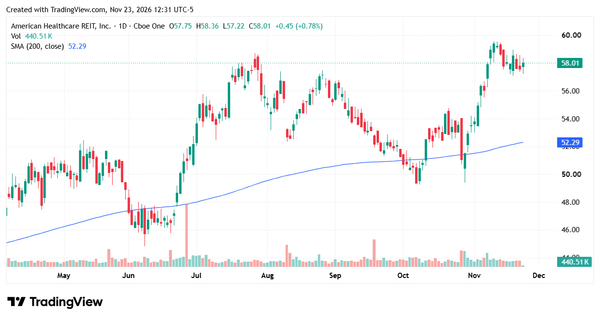
With a yield of 1.74%, American Healthcare REIT (NYSE: AHR) is a real estate investment trust that acquires, owns, and operates a diversified portfolio of clinical healthcare real estate, focusing primarily on senior housing communities, skilled nursing, and outpatient medical buildings across the United States, the United Kingdom, and the Isle of Man. Its diversified portfolio gives investors exposure to several areas of the healthcare real estate market, making it one of the senior housing REITs worth watching.

In its most recent earnings report, the company posted Q3 funds from operations of 58 cents, beating estimates by 22 cents. Revenue of $742.1 million, up 29.5% year over year, beat by $17.26 million. It also just paid a 25-cent per share dividend on Oct. 16 to shareholders of record as of Sept. 30. 

“We strengthened three things this quarter: the team, the portfolio and the platform that connects them,” said Jeff Hanson, the Company’s Chairman and Chief Executive Officer, as quoted in an earnings release. “We added executive leadership across finance, asset management, and technology, added nearly $2.1 billion of new investments in 2026, and brought new operating partners onto a platform that pairs their local expertise with portfolio-wide collaborations among the top operators in the senior housing industry.”
senior housing reits - StockEarnings

CareTrust REIT Offers a Higher Dividend Yield

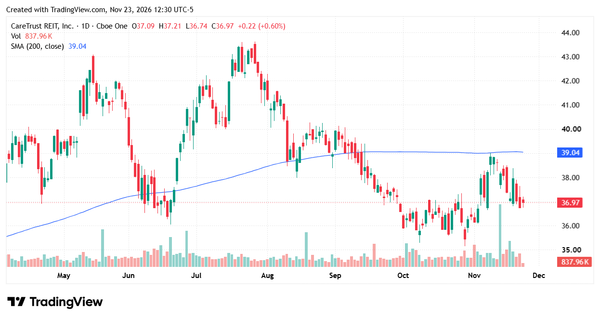
We can also look at the CareTrust REIT (NYSE: CTRE), a “real estate investment trust engaged in the ownership, acquisition, development and leasing of skilled nursing, seniors housing and other healthcare-related properties.” It also yields 4.1% and just paid out a 39-cent-per-share dividend on Oct. 15 to shareholders of record as of Sept. 30. That higher yield could make CareTrust particularly attractive to income investors comparing senior housing REITs.

It also just posted Q3 funds from operations of 53 cents, which beat by a penny. Revenue of $176.4 million, up 33.2% year over year, beat by $17.45 million. 

CareTrust’s Chief Executive Officer, Dave Sedgwick, commented, “Normalized FFO per share increased 20% year-over-year, and the team set another record of approximately $2.9 billion invested across skilled nursing, SHOP, and UK care homes, all while positioning the balance sheet for continued strong growth in the near to mid-term.

The CareTrust flywheel continues to accretively deliver year-over-year growth of our asset base and FFO. The relationship with LNT is a multiplier to our SHOP and UK care home growth engines. We’ve never been more excited for the runway ahead.”
senior housing reits - StockEarnings

Two Senior Housing REITs for an Aging America

American Healthcare REIT and CareTrust REIT give income investors two ways to invest in the aging-population trend. These senior housing REITs have different portfolio strategies and dividend profiles, offering investors a choice between diversified healthcare real estate exposure and a higher current yield.

CareTrust offers the higher dividend yield of the two, while American Healthcare REIT gives investors exposure to senior living, skilled nursing and outpatient medical properties. For investors watching the senior housing REITs market, both companies deserve attention as demand for care facilities grows.


Over the last 26 years, he’s taught thousands of investors how to trade news flow and herd mentality using a unique blend of technical and fundamental analysis. Cooper was among the few analysts to spot the financial crisis of 2008, the top of subprime and Alt-A, the death of Lehman Brothers, Bear Stearns, and New Century Financial, and even the Dow’s collapse to 6,500, as well as its recovery. He even called for gold to rally well above $1.500 when it traded under $600. At the moment, Cooper makes use of technical, fundamental and news analysis, to help individual investors grow their wealth. He’s a firm believer that hard work and thorough research will lead to investment success.

Join over 1.2M+ investors/traders who receive daily and weekly notable earnings alerts with predicted move