Coca-Cola (NYSE: KO) and PepsiCo (NASDAQ: PEP) are back on investors’ radar as the market runs for cover. On Nov. 5, the S&P 500 had its worst day since the 2025 “Liberation Day” tariff sell-off. AI infrastructure stocks led the decline, and the pressure hasn’t fully lifted.
However, when the selling pressure eases, investors tend to rediscover fundamentals. Right now, that leans towards large-cap, blue-chip names, such as consumer staples stocks
That doesn’t make consumer staples a guaranteed safe harbor. Inflation and elevated interest rates are still squeezing a value-conscious consumer. Analysts believe the sector is likely to stay under pressure into 2027.
Putting those misgivings aside, many consumer-facing stocks are still posting strong fundamental numbers. To that end, Coca-Cola and Pepsi continue to generate steady free cash flow. Both reward shareholders with dividends that have grown for more than 50 straight years.
Over the last five years, however, KO stock has been the better investment by a wide margin. That may be ready to change.
Why Coca-Cola Has Outrun Pepsi
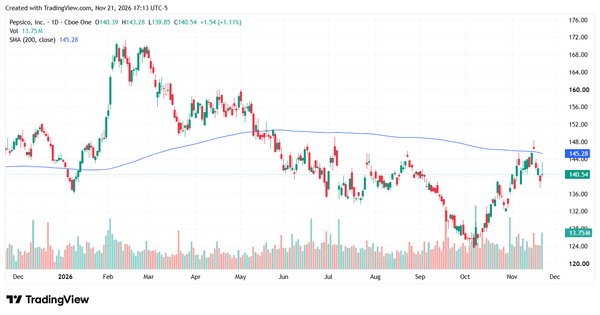
Over the last five years, KO stock has gained about 68%. PEP stock is down about 14% over the same period. The gap widened in 2026. Coca-Cola is up roughly 35% this year, while Pepsi is about flat.
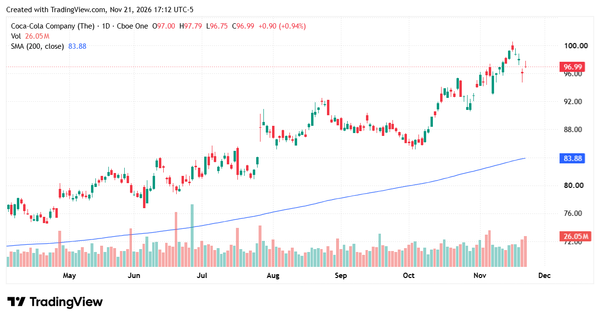
Coca-Cola’s edge starts with focus. It’s a pure-play beverage company, and about 60% of its operating revenue comes from outside the U.S. That has cushioned it from a softer American consumer. In the third quarter, Coca-Cola grew global unit case volume 5% and raised its full-year outlook.
PepsiCo has had a harder road. Its food brands, including Lay’s and Doritos, generate about 58% of revenue. North American snack volumes have stalled despite price cuts of up to 15% on key brands. Activist Elliott Management took a roughly $4 billion stake in 2025. The turnaround it’s pushing for is still a work in progress.
Pepsi Offers Blue-Chip Quality Without the Premium Price
Coca-Cola’s rally has come at a price. KO now trades at roughly 28x trailing earnings, close to the 30x mark. That’s above its historical range and a premium to the S&P 500.
This is where the bull case may run out of steam. Investors are paying up for safety. But a premium multiple leaves little room for error. If growth cools, the stock has further to fall. Coca-Cola now has to keep delivering just to justify its price.
PepsiCo tells a different story. PEP trades at about 17x trailing earnings and roughly 15x forward estimates. That’s only a slight discount to the S&P 500. However, it’s well below the low-to-mid 20s multiple Pepsi carried for much of the last decade.
That discount isn’t an accident. Pepsi’s North American business has real problems. But much of the bad news appears to be priced in. Even a return to 20x earnings would mean double-digit upside before any earnings growth.
That gives value-minded investors two potential levers. Modest earnings growth could lift the stock. A recovery in sentiment could expand the multiple. Coca-Cola, by contrast, needs almost everything to go right.
PEP Pays Investors Nearly Twice as Much to Wait
Both companies are Dividend Kings. Coca-Cola has raised its payout for 64 consecutive years. PepsiCo has done it for 54. Both generate healthy free cash flow to support those payments.
But all things being equal, PEP’s yield is more compelling. The stock pays an annual dividend of $5.92 per share, a yield of about 4.1%. Coca-Cola pays $2.12 per share. After this year’s rally, that’s a yield of about 2.2%.
Put simply, a $10,000 investment in PEP generates about $410 in annual income. The same amount in KO produces about $220.
Coverage matters, and Pepsi’s is adequate. Over the last 12 months, PepsiCo generated about $10.5 billion in free cash flow. It paid roughly $7.9 billion in dividends. That’s a thinner cushion than Coca-Cola’s. It’s worth watching if margins stay under pressure.
PEP’s yield is also well above its five-year average of about 3%. Historically, that signals a stock trading at a discount. In a flight to safety, Pepsi investors are being paid to wait for a turnaround.
The Contrarian Case: Investors Can Buy the GLP-1 Fear at a Discount
Consumer-facing stocks are likely to remain under pressure. GLP-1 weight-loss drugs add another layer of risk. A PwC analysis of Numerator data found adoption reached 21% of U.S. households by May 2026. That’s up from 9% in January 2025. Users are buying fewer sweets and salty snacks.
Both companies face this headwind. Pepsi’s exposure is arguably greater because of its snack business. That’s the bear case, and it’s a fair one.
But contrarians should notice what the market is already pricing in. Pepsi’s valuation reflects GLP-1 risk. Coca-Cola’s premium suggests it’s largely immune. If the impact proves manageable, PEP stock has more room to surprise. The company is already adapting with reformulated snacks, smaller packs, and protein-forward products.
Pepsi Offers the Better Risk-Reward From Here
Coca-Cola has earned its premium. The business is executing well, and its five-year outperformance is no fluke. But investors buying KO today pay close to 30x earnings for a 2.2% yield.
PEP offers a yield above 4% at roughly 17x earnings. Its problems are real, but they’re visible and largely priced in. For investors seeking safety, value, and income in a volatile market, Pepsi may be the better opportunity. It just may take some patience.