ajax loader

Loading...


Ride-the-Wave Strategy – Best for Stock Traders

Ride-the-Wave targets multi-day price momentum following a company’s earnings announcement (EA). With this strategy:

  1. Buy a stock one day post-EA if a stock reacts positively post-earnings:
    1. Near the close of trading the EA-day for a pre-market-EA
    2. Near the close of the following day for a post-market-EA
  2. Sell-to-close after 7-10 days, or possibly earlier if a desired price target is reached

Similarly,

  1. short a stock one day post-EA if a stock reacts negatively post-earnings:
    1. near the close of trading the EA-day for a premarket-EA
    2. near the close of the following day for a post-market-EA
  2. then buy-to-close after 7-10 days, or possibly earlier if a desired price target is reached

Important: Ride-the-Wave is predicated on significant price momentum triggered by an EA. The 7-10 day scenario is the maximum trade hold-time. If you see post EA-momentum is halted or reversed by a significant opposite move, re-evaluate your presence in the trade.

This popular StockEarnings screen below will give you a list of stocks that historically exhibit significant price momentum following an EA for the next seven days:

  1. Stocks exhibiting positive post-EA price moves are buy-candidates
  2. Stocks exhibiting negative post-EA price moves are sell/short-candidates

The screen includes those stocks whose Earnings just came out in last two days.

Screen criteria:

  1. Earnings Date Start Date : Current Date + -1 Day
  2. Earnings Date End Date : Current Date + -2 Days
  3. Predicted Move (Next Day) Max : 7%
  4. Predicted Move (On 7th Day) Min : 7%

Strategy Guideline:

  1. Buy the stock if stock has reacted positively. Short the stock if stock has reacted negatively (see above).
  2. Close the position in 7-10 days, or possibly earlier based on price move.

Volatility Crush Strategy - Best for Options Traders

The Volatility Crush strategy is used with stocks that typically experience relatively low-to-moderate price moves (≤4%) following their Earnings Announcements (EA). The basic trade idea is to sell put or call options right before the EA, collecting a credit when options premium is very high due to elevated implied volatility (IV). You then close the position right after the EA by buying the option back much cheaper due to the significant drop in IV that occurs after the mystery of the EA disappears. In assessing this trade, you need to do your homework to ensure you collect sufficient premium to make the trade worthwhile.

This trade is practical due to the low-to-moderate price-move after the EA, which generally won’t significantly affect the options price, unlike an “action” stock, which experience great price moves post-EA. With these symbols, if you’re on the right side of the price move, that’s a great thing. But if you’re on the wrong side of the move, not so great. Consequently, by minimizing the effect of the post-EA price move, you have a much better chance to profit from the reduction in IV without it being ruined by a violent price move.

For this trade, open the position either (1) the night before the EA when the company announces earnings or (2) during the EA day when it announces post-market, generally capturing IV at or close to its peak.

For this trade, open the position either (1) the night before the EA when the company announces earnings or (2) during the EA day when it announces post-market, generally capturing IV at or close to its peak.

This popular stockearnings screen will give you a list of stocks which do not react more than 4% fpost-EA. It includes only those stocks whose earnings are releasing next day.

Screen criteria:

  1. Earnings Date Start Date : Current Date + 1
  2. Earnings Date End Date : Current Date + 1
  3. Predicted Move (Next Day) Max : 4%
  4. Options Type: Weekly

Strategy Guideline:

  1. Options Strategy: Sell Call and Put
  2. Options Strike Price: Current Stock Price – (% Predicated Move x 2)
  3. Expiration Date: It should generally be the closest expiry immediately after the EA.
  4. Buy Insurance: Buying back Call and Put at Strike price which 10% lower than Sell Strike Price is optional but recommended.

Watch Video for More Detail

Volatility Rush Strategy - Best for Options Traders

The Volatility Rush takes advantage of increasing options premiums into earnings announcements (EA) caused by an anticipated rise in Implied Volatility (IV). With this strategy, Buy a Call and Put at-the-money (a long straddle) 2-3 weeks before the EA when IV is lower. Sell the position either (1) the night before the EA when the company announces earnings pre-market, or (2) during the EA day when it announces post-market, generally capturing IV at or close to its peak.

This popular screen will give you a list of stocks whose Options premiums tend to rise into Earnings. It includes only those stocks whose Earnings are at least two weeks away from today.

Screen criteria:

  1. Earnings Date Start Date : Current Date + 15 Days
  2. Earnings Date End Date : Current Date + 30 Days
  3. Predicted Move (Next Day) Min : 5%
  4. Options Type: Weekly or Monthly if that lines up with the two to three-week lead-time for entering the trade

Strategy Guideline:

  1. Buy a Straddle at or close to the money two to three weeks pre-EA.
  2. Sell the position either the night before the EA when the company announces earnings pre-market, or during the EA day when it announces post-market.
  3. Expiration date should generally be the closest expiry immediately after the EA.
  4. Straddle price should not be more 60% of predicted move.

Predicted Move (Volatility)

Similar to Implied Volatility in Options. Expected volatility % based on our Proprietary Volatility Predication Model. We are expecting that stock price will likely to reach % in either direction by the end of next trading session after Earnings are released and not necessarily the closing volatility %.

Why is it important?

    This indicator helps

  1. Knowing expected volatility in stocks after Earnings helps to decide trading stocks before Earnings Announcement.
  2. Taking Advantage of volatility collapse following Earnings Results by using Advance Options strategies such as Spread and Straddles.

Since Last Earnings

Change in share price since last Earnings release.

Why is it Important?

When share has gained more than 10% since it's last Earning release, it tends to over react to minor bad news and give up some gains if not all. So, it contains more downside volatility than upside When share has dropped more than 10% since it's last Earning release, it tends to over react to minor good news and recover some drops if not all. So, it contains more upside volatility than downside.

EPS Surprise (%)

Occurs when a company's reported quarterly or annual profits are above or below analysts' expectations. Here is the formula to derive % EPS Surprice:

Actual EPS - Estimated EPS
------------------------------------- x 100
Estimated EPS

Why is it Important?

Earnings surprises can have a huge impact on a company's stock price. Several studies suggest that positive earnings surprises not only lead to an immediate hike in a stock's price, but also to a gradual increase over time. Hence, it's not surprising that some companies are known for routinely beating earning projections. A negative earnings surprise will usually result in a decline in share price.

Next Day Price Change (%)

Next Regular trading session Closing price following Earnings result.

For After Market Close Earnings, It is a next trading day closing price. For Before Market Open Earnings, It is the same trading day closing price.

Why is it Important?

Next Day price change is a reaction of Earnings result.

Salesforce (CRM) Just Turned The AI Debate On Its Head In Q2

Posted on Aug 31, 2026 by Grayson Cavern

Salesforce (CRM) Just Turned The AI Debate On Its Head In Q2

Salesforce (NYSE: CRM) reported $11.35 billion in Q2 FY2027 revenue and $5.90 in adjusted EPS, beating Wall Street estimates of $11.32 billion and $5.25, respectively.

I’ve been watching Salesforce through the same lens since Q1, when revenue reached $11.13 billion, and EPS came in at $3.88, both ahead of expectations, yet CRM finished the session down 0.88%.

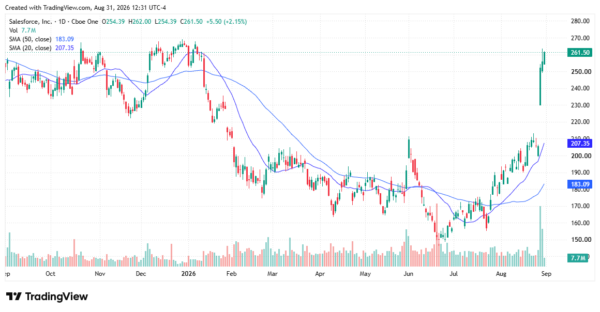
This time, investors reacted very differently, sending the stock up 22.6% after earnings as the market finally began to pay attention to what customers are doing on the platform.

That reaction gives us a much better starting point than another earnings beat, because while Salesforce spent Q1 trying to convince investors that AI would strengthen its position rather than destroy it. Q2 gives us a much clearer look at whether customers are actually behaving that way.

The AI Fears Are Running Into Customer Behavior


Salesforce has spent months fighting the idea that better AI models would make traditional enterprise software less necessary, but the customer numbers coming out of Q2 make that argument harder to sustain.

Agentforce ARR crossed $1.5 billion, up more than 240% year over year, while Agentforce and Data 360 reached nearly $3.9 billion in combined ARR, up more than 210%.

Then the usage numbers become more interesting: customers generated 3.2 billion Agentic Work Units during Q2, up 97% from the prior quarter. Another 2,000 customers put agents into production, up 70% sequentially. Agentforce One Edition and Agentforce for Apps bookings more than doubled quarter over quarter.

But one number stood out among others – half of Agentforce bookings came from customers replenishing consumed credits. That sounds simple, but it gets right into the heart of the AI debate. A customer testing an AI product once tells me very little. But a customer burns through its credits and comes back for more? That’s the biggest tell that the product has entered the workflow. Which is exactly where Salesforce’s existing position becomes useful.

The Moat Looks Different When AI Needs What Salesforce Already Owns

Large companies have spent years stuffing their customer data, workflows, permissions and business rules into Salesforce and ripping that machinery out remains a much bigger job than replacing a chatbot.

The Q2 transcript gives us a real-world example through Uber Technologies (NYSE: UBER) for Business. The company pointed Agentforce at its existing Salesforce data and workflows, launched within six weeks and generated 60% more leads within two weeks.

Salesforce also says nine of the world’s top 10 AI companies use Salesforce and Slack, with their spending up 435% year over year. That creates an interesting reversal of the SaaS apocalypse argument, because the companies building the new AI economy still need enterprise data, permissions, workflows and business context to make those models useful within a real company.

Salesforce already runs much of that infrastructure, and the company is pushing the AI layer directly into it rather than asking customers to start over elsewhere. This is why the result could look less like AI replacing Salesforce and more like AI making the Salesforce installation customers already paid for more valuable.

Numbers Are Starting To Back Up The Reacceleration

Salesforce now has something it lacked when investors punished the stock after Q1, because management can point to stronger new-business activity while customer attrition sits near record lows.

Management said first-half net new annual order value growth significantly outpaced annual order value growth, which it believes puts the company on track for second-half organic revenue reacceleration. Q2 cRPO reached $33.5 billion, up 14% year over year and 14% in constant currency.

Salesforce also raised FY27 revenue guidance to $46.1 billion to $46.4 billion, with the $200 million increase consisting of $100 million from organic growth and $200 million from the pending Contentful and Fin acquisitions, partly offset by a $100 million foreign-exchange headwind.

Management expects Q3 revenue of $11.42 billion to $11.5 billion and cRPO growth of about 14%. Meanwhile, Salesforce produced $1.1 billion in free cash flow during Q2, up 81% year over year, while operating cash flow reached $1.3 billion, up 71%.

None of this says the risk has disappeared. In fact, Salesforce still needs to turn AI adoption into durable organic growth, and the company carries plenty of expectations after this move. If that reacceleration fails to materialize, the stock can give some of this rally back.

CRM Finally Looks Like The Market Believes It

One look at the chart and it tells the story better than another paragraph about management confidence ever could, because CRM spent months trapped below its major moving averages while investors waited for the business to prove itself.

After Q1, the stock sat around $177.51, below the declining 50-day and 200-day averages, while repeatedly defending the mid-$150s.

This quarter, CRM has pushed above the 20-day moving average near $203.58, the 50-day near $180.89, and the 200-day near $200.32, reaching roughly $256.48 after the earnings move. Volume also exploded to roughly 34.36 million shares on the earnings session. That is a completely different market.
salesforce - StockEarnings

I Would Rather Own The Evidence Than The Story

I like CRM here because the market finally has something tangible to argue about beyond whether AI will kill enterprise software.

The bull case now rests on customers using Agentforce, expanding their spending and leaning harder into a platform they already know. The bear still has a path if organic growth refuses to accelerate or the AI spending fails to translate into enough revenue.

But after watching this stock get punished while the business kept building, I would rather follow what customers are doing than what the loudest AI skeptics think should happen.


Join over 1.2M+ investors/traders who receive daily and weekly notable earnings alerts with predicted move