ajax loader

Loading...


Ride-the-Wave Strategy – Best for Stock Traders

Ride-the-Wave targets multi-day price momentum following a company’s earnings announcement (EA). With this strategy:

  1. Buy a stock one day post-EA if a stock reacts positively post-earnings:
    1. Near the close of trading the EA-day for a pre-market-EA
    2. Near the close of the following day for a post-market-EA
  2. Sell-to-close after 7-10 days, or possibly earlier if a desired price target is reached

Similarly,

  1. short a stock one day post-EA if a stock reacts negatively post-earnings:
    1. near the close of trading the EA-day for a premarket-EA
    2. near the close of the following day for a post-market-EA
  2. then buy-to-close after 7-10 days, or possibly earlier if a desired price target is reached

Important: Ride-the-Wave is predicated on significant price momentum triggered by an EA. The 7-10 day scenario is the maximum trade hold-time. If you see post EA-momentum is halted or reversed by a significant opposite move, re-evaluate your presence in the trade.

This popular StockEarnings screen below will give you a list of stocks that historically exhibit significant price momentum following an EA for the next seven days:

  1. Stocks exhibiting positive post-EA price moves are buy-candidates
  2. Stocks exhibiting negative post-EA price moves are sell/short-candidates

The screen includes those stocks whose Earnings just came out in last two days.

Screen criteria:

  1. Earnings Date Start Date : Current Date + -1 Day
  2. Earnings Date End Date : Current Date + -2 Days
  3. Predicted Move (Next Day) Max : 7%
  4. Predicted Move (On 7th Day) Min : 7%

Strategy Guideline:

  1. Buy the stock if stock has reacted positively. Short the stock if stock has reacted negatively (see above).
  2. Close the position in 7-10 days, or possibly earlier based on price move.

Volatility Crush Strategy - Best for Options Traders

The Volatility Crush strategy is used with stocks that typically experience relatively low-to-moderate price moves (≤4%) following their Earnings Announcements (EA). The basic trade idea is to sell put or call options right before the EA, collecting a credit when options premium is very high due to elevated implied volatility (IV). You then close the position right after the EA by buying the option back much cheaper due to the significant drop in IV that occurs after the mystery of the EA disappears. In assessing this trade, you need to do your homework to ensure you collect sufficient premium to make the trade worthwhile.

This trade is practical due to the low-to-moderate price-move after the EA, which generally won’t significantly affect the options price, unlike an “action” stock, which experience great price moves post-EA. With these symbols, if you’re on the right side of the price move, that’s a great thing. But if you’re on the wrong side of the move, not so great. Consequently, by minimizing the effect of the post-EA price move, you have a much better chance to profit from the reduction in IV without it being ruined by a violent price move.

For this trade, open the position either (1) the night before the EA when the company announces earnings or (2) during the EA day when it announces post-market, generally capturing IV at or close to its peak.

For this trade, open the position either (1) the night before the EA when the company announces earnings or (2) during the EA day when it announces post-market, generally capturing IV at or close to its peak.

This popular stockearnings screen will give you a list of stocks which do not react more than 4% fpost-EA. It includes only those stocks whose earnings are releasing next day.

Screen criteria:

  1. Earnings Date Start Date : Current Date + 1
  2. Earnings Date End Date : Current Date + 1
  3. Predicted Move (Next Day) Max : 4%
  4. Options Type: Weekly

Strategy Guideline:

  1. Options Strategy: Sell Call and Put
  2. Options Strike Price: Current Stock Price – (% Predicated Move x 2)
  3. Expiration Date: It should generally be the closest expiry immediately after the EA.
  4. Buy Insurance: Buying back Call and Put at Strike price which 10% lower than Sell Strike Price is optional but recommended.

Watch Video for More Detail

Volatility Rush Strategy - Best for Options Traders

The Volatility Rush takes advantage of increasing options premiums into earnings announcements (EA) caused by an anticipated rise in Implied Volatility (IV). With this strategy, Buy a Call and Put at-the-money (a long straddle) 2-3 weeks before the EA when IV is lower. Sell the position either (1) the night before the EA when the company announces earnings pre-market, or (2) during the EA day when it announces post-market, generally capturing IV at or close to its peak.

This popular screen will give you a list of stocks whose Options premiums tend to rise into Earnings. It includes only those stocks whose Earnings are at least two weeks away from today.

Screen criteria:

  1. Earnings Date Start Date : Current Date + 15 Days
  2. Earnings Date End Date : Current Date + 30 Days
  3. Predicted Move (Next Day) Min : 5%
  4. Options Type: Weekly or Monthly if that lines up with the two to three-week lead-time for entering the trade

Strategy Guideline:

  1. Buy a Straddle at or close to the money two to three weeks pre-EA.
  2. Sell the position either the night before the EA when the company announces earnings pre-market, or during the EA day when it announces post-market.
  3. Expiration date should generally be the closest expiry immediately after the EA.
  4. Straddle price should not be more 60% of predicted move.

Predicted Move (Volatility)

Similar to Implied Volatility in Options. Expected volatility % based on our Proprietary Volatility Predication Model. We are expecting that stock price will likely to reach % in either direction by the end of next trading session after Earnings are released and not necessarily the closing volatility %.

Why is it important?

    This indicator helps

  1. Knowing expected volatility in stocks after Earnings helps to decide trading stocks before Earnings Announcement.
  2. Taking Advantage of volatility collapse following Earnings Results by using Advance Options strategies such as Spread and Straddles.

Since Last Earnings

Change in share price since last Earnings release.

Why is it Important?

When share has gained more than 10% since it's last Earning release, it tends to over react to minor bad news and give up some gains if not all. So, it contains more downside volatility than upside When share has dropped more than 10% since it's last Earning release, it tends to over react to minor good news and recover some drops if not all. So, it contains more upside volatility than downside.

EPS Surprise (%)

Occurs when a company's reported quarterly or annual profits are above or below analysts' expectations. Here is the formula to derive % EPS Surprice:

Actual EPS - Estimated EPS
------------------------------------- x 100
Estimated EPS

Why is it Important?

Earnings surprises can have a huge impact on a company's stock price. Several studies suggest that positive earnings surprises not only lead to an immediate hike in a stock's price, but also to a gradual increase over time. Hence, it's not surprising that some companies are known for routinely beating earning projections. A negative earnings surprise will usually result in a decline in share price.

Next Day Price Change (%)

Next Regular trading session Closing price following Earnings result.

For After Market Close Earnings, It is a next trading day closing price. For Before Market Open Earnings, It is the same trading day closing price.

Why is it Important?

Next Day price change is a reaction of Earnings result.

5 Oversold Stocks the RSI Says Could Be Ready to Rebound

Posted on Nov 24, 2026 by Chris Markoch

5 Oversold Stocks the RSI Says Could Be Ready to Rebound

Oversold stocks are suddenly easy to find. On Friday, Nov. 20, the CBOE Volatility Index (VIX) briefly touched 40. That’s its highest level since the April 2025 tariff turmoil. The S&P 500 fell 3.6% that day, capping its worst week in seven months.

Fear like that may tempt investors to sit in cash until the dust settles. But trying to time a recovery rarely works. Some of the market’s best days tend to arrive right after its worst ones.

A more effective strategy may be to look for oversold stocks, including stocks that may have recently looked overvalued. That’s where the relative strength index (RSI) can help. RSI is a momentum indicator that measures the speed of recent price moves on a scale of 0 to 100.

A reading below 30 is generally considered oversold. Traders use it most, but long-term investors can, too. Charts often signal a bullish reversal before the fundamentals confirm it. Here are five stocks with RSI readings near or below 20 as of the market close on Nov. 20, 2026.

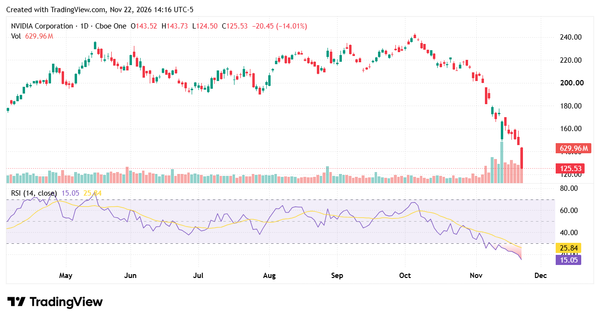
Own the AI Leader at a Bargain-Bin Multiple: NVIDIA (NVDA)


NVIDIA (NASDAQ: NVDA) stock has an RSI of 15, giving it one of the most extreme readings among large-cap stocks. Shares fell 14% on Friday to $125.56. That leaves the stock nearly 48% below its Oct. 6 closing high.

The selloff has little to do with the business. On Nov. 17, NVIDIA reported record quarterly revenue of $115.8 billion. That topped the $109.1 billion analysts expected. The stock fell anyway. Investors are worried about AI spending returns. They also fear the new Democratic-controlled Congress could slow the data center buildout.

At Friday’s close, NVIDIA trades at about 13.5 times trailing earnings. That’s a multiple usually reserved for slow-growth companies. For long-term investors, this could be a textbook gap between perception and fundamentals. The NVDA chart is pricing in a collapse the income statement hasn’t shown.
oversold stocks - StockEarnings

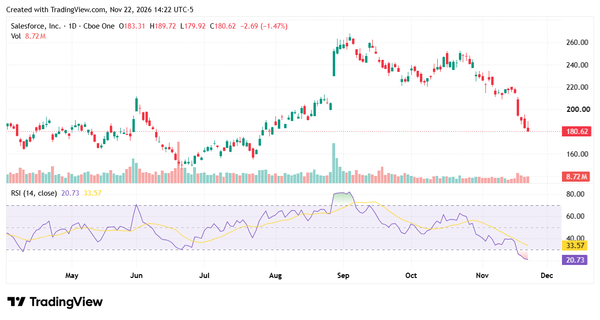
Lock In a Software Leader at a Value Price: Salesforce (CRM)

Salesforce (NYSE: CRM) has an RSI of 20.2 and closed Friday at $180.43. Shares are down roughly 32% in 2026 after starting the year near $265.

The selloff reflects fears that AI-native competitors will erode Salesforce’s customer relationship management franchise. Job cuts disclosed on Nov. 17 added to the pressure.

The numbers tell a different story. In its fiscal second quarter, Salesforce crushed EPS estimates. It also raised full-year revenue guidance to $46.1 billion to $46.4 billion. Management guides to adjusted EPS of $16.67 to $16.71 for fiscal 2027. At Friday’s price, that’s roughly 11 times earnings.

Salesforce is also buying growth. It has announced deals for Braze and Cresta since October. The next test comes with earnings in early December. A solid report could be the catalyst that turns an oversold chart into a rebound.
oversold stocks - StockEarnings

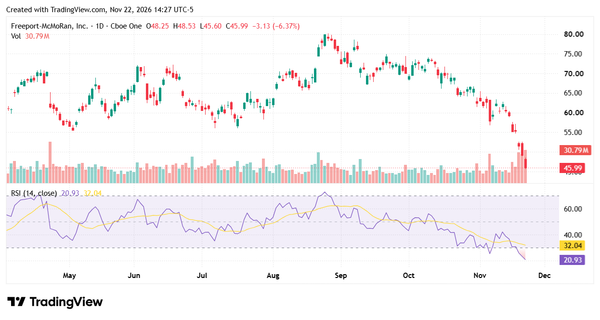
Tap Into the Long-Term Electrification Trade: Freeport-McMoRan (FCX)

Freeport-McMoRan (NYSE: FCX) has an RSI that sits at 21.4 after shares fell 6.4% on Friday to $45.99. The stock already dropped about 7% in single sessions on Nov. 5, 16, and 18. It now trades roughly 42% below its August high near $80.

The pressure is easy to explain. Copper prices recently slipped to their lowest level since July. Freeport is a leveraged bet on the metal. The company also faces lingering production questions at its Grasberg mine in Indonesia. Analysts have taken notice, and the stock carries a recent downgrade.

The long-term case is harder to dismiss. Copper demand is tied to grid upgrades, electric vehicles, and the same data centers powering AI. New supply is slow to come online because mines take years to build. A stock this oversold may already reflect much of the bad news.
oversold stocks - StockEarnings

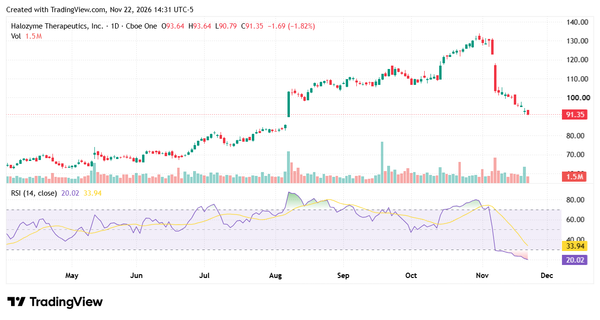
Collect a Growing Royalty Stream: Halozyme Therapeutics (HALO)

Halozyme Therapeutics (NASDAQ: HALO) stock’s RSI of 20 reflects a sharp pullback, not a broken business. Shares closed at $91.35 on Friday, down from about $103 on Nov. 9. The stock had rallied more than 80% this year before its third-quarter report.

Halozyme’s ENHANZE technology helps partners turn IV drugs into faster under-the-skin injections. The company earns royalties on those sales. Third-quarter revenue rose 39% to $493 million. Royalty revenue jumped 44% to $341 million. Management raised 2026 revenue guidance to $1.86 billion to $1.925 billion.

There’s more support beneath the surface. A Dutch court found Merck infringed a Halozyme patent with its injectable Keytruda. The company has also repurchased $400 million of stock in 2026. With a P/E near 23, Halozyme is growing faster than its multiple suggests. This looks like profit-taking after a big run.
oversold stocks - StockEarnings

Buy China’s AI Cloud Growth on Sale: Alibaba Group (BABA)

Alibaba (NYSE: BABA) has an RSI of 22, which puts it just inside oversold territory. Shares closed Friday at $81.03 after the company’s Nov. 19 earnings report. Investors focused on an adjusted EPS miss and a 60% jump in capital spending.

That overlooks the bigger story. Revenue grew 10% to 271.5 billion yuan, or about $40.5 billion. AI cloud and compute revenue surged 53% to nearly 61 billion yuan. Recurring revenue from external cloud customers climbed 67%.

Alibaba is also moving to spin off its T-Head chip unit with a separate Hong Kong listing. That could unlock value the market isn’t pricing in today. At a P/E near 12, investors pay a modest price for real AI growth. China-related risks haven’t gone away, so position sizing matters.
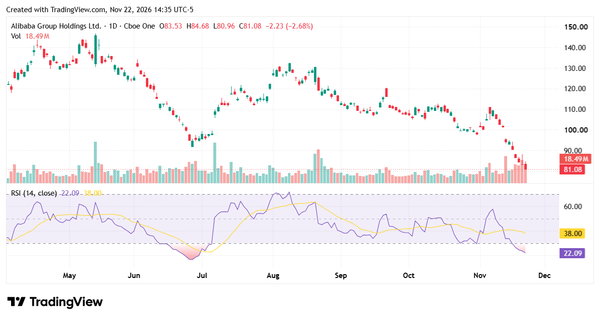
oversold stocks - StockEarnings

Use Fear to Your Advantage, With a Plan

A low RSI isn’t a buy signal on its own. Oversold stocks can stay oversold longer than expected, especially with the VIX near 40. That’s why RSI works best alongside fundamentals.

Each of these five companies pairs a deeply oversold chart with a business that’s still growing. Investors don’t need to pick the exact bottom. Scaling in over several weeks can reduce the risk of buying oversold stocks too early. When fear fades, the chart often turns first. The fundamentals tend to follow.


A former marketing copywriter turned freelance financial writer and market analyst. I have a passion for delivering insights to investors. I write regularly about stocks for StockEarnings and MarketBeat. Posts are not advice.

Join over 1.2M+ investors/traders who receive daily and weekly notable earnings alerts with predicted move