ajax loader

Loading...


Ride-the-Wave Strategy – Best for Stock Traders

Ride-the-Wave targets multi-day price momentum following a company’s earnings announcement (EA). With this strategy:

  1. Buy a stock one day post-EA if a stock reacts positively post-earnings:
    1. Near the close of trading the EA-day for a pre-market-EA
    2. Near the close of the following day for a post-market-EA
  2. Sell-to-close after 7-10 days, or possibly earlier if a desired price target is reached

Similarly,

  1. short a stock one day post-EA if a stock reacts negatively post-earnings:
    1. near the close of trading the EA-day for a premarket-EA
    2. near the close of the following day for a post-market-EA
  2. then buy-to-close after 7-10 days, or possibly earlier if a desired price target is reached

Important: Ride-the-Wave is predicated on significant price momentum triggered by an EA. The 7-10 day scenario is the maximum trade hold-time. If you see post EA-momentum is halted or reversed by a significant opposite move, re-evaluate your presence in the trade.

This popular StockEarnings screen below will give you a list of stocks that historically exhibit significant price momentum following an EA for the next seven days:

  1. Stocks exhibiting positive post-EA price moves are buy-candidates
  2. Stocks exhibiting negative post-EA price moves are sell/short-candidates

The screen includes those stocks whose Earnings just came out in last two days.

Screen criteria:

  1. Earnings Date Start Date : Current Date + -1 Day
  2. Earnings Date End Date : Current Date + -2 Days
  3. Predicted Move (Next Day) Max : 7%
  4. Predicted Move (On 7th Day) Min : 7%

Strategy Guideline:

  1. Buy the stock if stock has reacted positively. Short the stock if stock has reacted negatively (see above).
  2. Close the position in 7-10 days, or possibly earlier based on price move.

Volatility Crush Strategy - Best for Options Traders

The Volatility Crush strategy is used with stocks that typically experience relatively low-to-moderate price moves (≤4%) following their Earnings Announcements (EA). The basic trade idea is to sell put or call options right before the EA, collecting a credit when options premium is very high due to elevated implied volatility (IV). You then close the position right after the EA by buying the option back much cheaper due to the significant drop in IV that occurs after the mystery of the EA disappears. In assessing this trade, you need to do your homework to ensure you collect sufficient premium to make the trade worthwhile.

This trade is practical due to the low-to-moderate price-move after the EA, which generally won’t significantly affect the options price, unlike an “action” stock, which experience great price moves post-EA. With these symbols, if you’re on the right side of the price move, that’s a great thing. But if you’re on the wrong side of the move, not so great. Consequently, by minimizing the effect of the post-EA price move, you have a much better chance to profit from the reduction in IV without it being ruined by a violent price move.

For this trade, open the position either (1) the night before the EA when the company announces earnings or (2) during the EA day when it announces post-market, generally capturing IV at or close to its peak.

For this trade, open the position either (1) the night before the EA when the company announces earnings or (2) during the EA day when it announces post-market, generally capturing IV at or close to its peak.

This popular stockearnings screen will give you a list of stocks which do not react more than 4% fpost-EA. It includes only those stocks whose earnings are releasing next day.

Screen criteria:

  1. Earnings Date Start Date : Current Date + 1
  2. Earnings Date End Date : Current Date + 1
  3. Predicted Move (Next Day) Max : 4%
  4. Options Type: Weekly

Strategy Guideline:

  1. Options Strategy: Sell Call and Put
  2. Options Strike Price: Current Stock Price – (% Predicated Move x 2)
  3. Expiration Date: It should generally be the closest expiry immediately after the EA.
  4. Buy Insurance: Buying back Call and Put at Strike price which 10% lower than Sell Strike Price is optional but recommended.

Watch Video for More Detail

Volatility Rush Strategy - Best for Options Traders

The Volatility Rush takes advantage of increasing options premiums into earnings announcements (EA) caused by an anticipated rise in Implied Volatility (IV). With this strategy, Buy a Call and Put at-the-money (a long straddle) 2-3 weeks before the EA when IV is lower. Sell the position either (1) the night before the EA when the company announces earnings pre-market, or (2) during the EA day when it announces post-market, generally capturing IV at or close to its peak.

This popular screen will give you a list of stocks whose Options premiums tend to rise into Earnings. It includes only those stocks whose Earnings are at least two weeks away from today.

Screen criteria:

  1. Earnings Date Start Date : Current Date + 15 Days
  2. Earnings Date End Date : Current Date + 30 Days
  3. Predicted Move (Next Day) Min : 5%
  4. Options Type: Weekly or Monthly if that lines up with the two to three-week lead-time for entering the trade

Strategy Guideline:

  1. Buy a Straddle at or close to the money two to three weeks pre-EA.
  2. Sell the position either the night before the EA when the company announces earnings pre-market, or during the EA day when it announces post-market.
  3. Expiration date should generally be the closest expiry immediately after the EA.
  4. Straddle price should not be more 60% of predicted move.

Predicted Move (Volatility)

Similar to Implied Volatility in Options. Expected volatility % based on our Proprietary Volatility Predication Model. We are expecting that stock price will likely to reach % in either direction by the end of next trading session after Earnings are released and not necessarily the closing volatility %.

Why is it important?

    This indicator helps

  1. Knowing expected volatility in stocks after Earnings helps to decide trading stocks before Earnings Announcement.
  2. Taking Advantage of volatility collapse following Earnings Results by using Advance Options strategies such as Spread and Straddles.

Since Last Earnings

Change in share price since last Earnings release.

Why is it Important?

When share has gained more than 10% since it's last Earning release, it tends to over react to minor bad news and give up some gains if not all. So, it contains more downside volatility than upside When share has dropped more than 10% since it's last Earning release, it tends to over react to minor good news and recover some drops if not all. So, it contains more upside volatility than downside.

EPS Surprise (%)

Occurs when a company's reported quarterly or annual profits are above or below analysts' expectations. Here is the formula to derive % EPS Surprice:

Actual EPS - Estimated EPS
------------------------------------- x 100
Estimated EPS

Why is it Important?

Earnings surprises can have a huge impact on a company's stock price. Several studies suggest that positive earnings surprises not only lead to an immediate hike in a stock's price, but also to a gradual increase over time. Hence, it's not surprising that some companies are known for routinely beating earning projections. A negative earnings surprise will usually result in a decline in share price.

Next Day Price Change (%)

Next Regular trading session Closing price following Earnings result.

For After Market Close Earnings, It is a next trading day closing price. For Before Market Open Earnings, It is the same trading day closing price.

Why is it Important?

Next Day price change is a reaction of Earnings result.

NVIDIA Stock: Why I’m Still Investing in Jensen Huang’s Brain

Posted on Nov 24, 2026 by Grayson Cavern

NVIDIA Stock: Why I’m Still Investing in Jensen Huang’s Brain

Two days before Thanksgiving, NVIDIA (NASDAQ: NVDA) has handed investors a decision they cannot comfortably postpone. The stock surged 31.48% after the board reinstated Jensen Huang as CEO, adding approximately $952 billion to its market value.

Now traders must decide whether to chase the rebound, protect existing gains, or risk missing another leg higher during the holiday break. Thursday’s market closure and Friday’s shortened session leave a narrow window to position themselves before the long weekend.

Huang’s Reinstatement Triggered a Historic Reversal


NVIDIA’s board unanimously reinstated Huang as president, CEO, and director on Nov. 23, following discussions with him and input from senior US government officials. The board said his return posed no national-security risk, although its independent investigation into reports that Huang had been targeted by a foreign intelligence effort will continue.

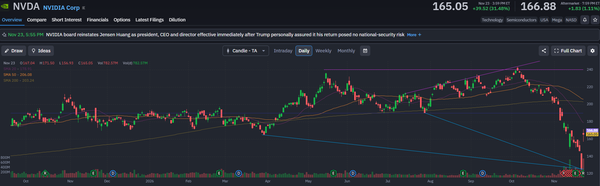
Investors responded immediately. NVDA closed at $165.05, gaining $39.52, with trading volume reaching approximately 783 million shares. The move added a record amount of market value for a US company in one session.

Anyone can say the market was buying the return of a familiar executive. But that would be reactionary, because if anything, it was more of buying continuity in the leadership of the company sitting at the center of the AI infrastructure buildout. Huang’s relationships, understanding of accelerated computing, and strategic decisions are deeply tied to NVIDIA’s position. His departure created uncertainty about who could carry that vision forward. Reinstating him removed much of that uncertainty, at least for now.

NVDA’s Rally Reached Far Beyond NVIDIA

The reaction across the AI supply chain showed how far that confidence extends. Dell Technologies (NYSE: DELL) gained about 21%, Nebius (NASDAQ: NBIS) and CoreWeave (NASDAQ: CRWV) advanced around 20% to 22%, while Micron (NASDAQ: MU) climbed 19%. Taiwan Semiconductor (NYSE: TSM), Marvell (NASDAQ: MRVL) and Arm (NASDAQ: ARM) also posted substantial gains. The Nasdaq 100 added nearly $2 trillion in market value. 

I wouldn’t dismiss this as investors blindly buying anything with an AI label. Nvidia’s GPUs depend on memory, advanced manufacturing, networking equipment, servers, and data-center capacity. When confidence in NVIDIA improves, investors have reason to reassess the companies supplying and building around its technology. The gains in Micron, TSMC and Dell reflected that connection.

But the rally also exposed the concentration risk running through the AI trade. If uncertainty surrounding one executive can shake confidence across so many businesses, investors need to consider how much of their technology exposure depends on Nvidia’s execution.

Why I’m Still Bullish On Jensen’s Brain

Huang’s leadership matters because Nvidia’s opportunity extends beyond selling more powerful chips. His view of where computing is heading has helped shape the company’s position across accelerated computing, AI infrastructure, and the developer ecosystem. His support for open AI models has also featured in the debate surrounding his departure, although the precise reasons behind the board’s earlier decision remain unconfirmed.

Just like I said after the company’s quarter 3 earnings, investing in Jensen’s brain is a compelling way to think about owning NVIDIA. I’m backing his ability to anticipate what developers and businesses will need, then position NVIDIA to supply the computing infrastructure behind that demand. More developers building and adapting models can expand demand for computing capacity, giving NVIDIA opportunities across a broader customer base.

But there is a price to this dependence. Monday demonstrated how sensitive NVIDIA can be to uncertainty around its founder. The board’s reversal also leaves governance questions, particularly with its investigation still underway. Huang’s return restores the leadership investors wanted, but NVIDIA must continue demonstrating that its oversight can match the scale of its business.

The Chart Has Not Recovered as Quickly as Sentiment

Monday’s 31.48% gain looks spectacular until we consider the damage that came before it. NVDA closed at $165.05, below its 20-day moving average of $178.91, 50-day average of $206.08, and 200-day average of $203.24. There’s a decline from roughly $240 in October toward $150 in November before Monday’s reversal.

So I’d watch $179 first. Reclaiming the 20-day average would give the rebound a better footing, while the $200 to $206 region presents a tougher hurdle where the longer moving averages sit close together. Around $150 is the downside area to watch if buyers fail to defend the recovery. Monday’s volume confirms that investors came back in force, but the stock still needs follow-through before the technical damage can be considered repaired.
The Thanksgiving Deadline

Thanksgiving gives NVDA investors a deadline, but it doesn’t make chasing a 31% rally any less risky. Existing shareholders must decide how much of Monday’s gain they want to protect, while investors waiting to enter face the possibility of missing another advance. I’d rather see the stock hold its recovery and reclaim $179 than rush into a position because the market is about to close.

I’m still bullish on Jensen’s brain. His return has restored confidence in NVIDIA’s leadership and reminded Wall Street how much of the AI trade is tied to his judgment. Now I want the business and the stock to confirm that confidence. If NVIDIA can turn Monday’s relief into sustained demand, stronger results, and a recovery through its moving averages, there will be a better case for the next leg higher. I wouldn’t let the Thanksgiving clock make that decision for me.


Join over 1.2M+ investors/traders who receive daily and weekly notable earnings alerts with predicted move