ajax loader

Loading...


Ride-the-Wave Strategy – Best for Stock Traders

Ride-the-Wave targets multi-day price momentum following a company’s earnings announcement (EA). With this strategy:

  1. Buy a stock one day post-EA if a stock reacts positively post-earnings:
    1. Near the close of trading the EA-day for a pre-market-EA
    2. Near the close of the following day for a post-market-EA
  2. Sell-to-close after 7-10 days, or possibly earlier if a desired price target is reached

Similarly,

  1. short a stock one day post-EA if a stock reacts negatively post-earnings:
    1. near the close of trading the EA-day for a premarket-EA
    2. near the close of the following day for a post-market-EA
  2. then buy-to-close after 7-10 days, or possibly earlier if a desired price target is reached

Important: Ride-the-Wave is predicated on significant price momentum triggered by an EA. The 7-10 day scenario is the maximum trade hold-time. If you see post EA-momentum is halted or reversed by a significant opposite move, re-evaluate your presence in the trade.

This popular StockEarnings screen below will give you a list of stocks that historically exhibit significant price momentum following an EA for the next seven days:

  1. Stocks exhibiting positive post-EA price moves are buy-candidates
  2. Stocks exhibiting negative post-EA price moves are sell/short-candidates

The screen includes those stocks whose Earnings just came out in last two days.

Screen criteria:

  1. Earnings Date Start Date : Current Date + -1 Day
  2. Earnings Date End Date : Current Date + -2 Days
  3. Predicted Move (Next Day) Max : 7%
  4. Predicted Move (On 7th Day) Min : 7%

Strategy Guideline:

  1. Buy the stock if stock has reacted positively. Short the stock if stock has reacted negatively (see above).
  2. Close the position in 7-10 days, or possibly earlier based on price move.

Volatility Crush Strategy - Best for Options Traders

The Volatility Crush strategy is used with stocks that typically experience relatively low-to-moderate price moves (≤4%) following their Earnings Announcements (EA). The basic trade idea is to sell put or call options right before the EA, collecting a credit when options premium is very high due to elevated implied volatility (IV). You then close the position right after the EA by buying the option back much cheaper due to the significant drop in IV that occurs after the mystery of the EA disappears. In assessing this trade, you need to do your homework to ensure you collect sufficient premium to make the trade worthwhile.

This trade is practical due to the low-to-moderate price-move after the EA, which generally won’t significantly affect the options price, unlike an “action” stock, which experience great price moves post-EA. With these symbols, if you’re on the right side of the price move, that’s a great thing. But if you’re on the wrong side of the move, not so great. Consequently, by minimizing the effect of the post-EA price move, you have a much better chance to profit from the reduction in IV without it being ruined by a violent price move.

For this trade, open the position either (1) the night before the EA when the company announces earnings or (2) during the EA day when it announces post-market, generally capturing IV at or close to its peak.

For this trade, open the position either (1) the night before the EA when the company announces earnings or (2) during the EA day when it announces post-market, generally capturing IV at or close to its peak.

This popular stockearnings screen will give you a list of stocks which do not react more than 4% fpost-EA. It includes only those stocks whose earnings are releasing next day.

Screen criteria:

  1. Earnings Date Start Date : Current Date + 1
  2. Earnings Date End Date : Current Date + 1
  3. Predicted Move (Next Day) Max : 4%
  4. Options Type: Weekly

Strategy Guideline:

  1. Options Strategy: Sell Call and Put
  2. Options Strike Price: Current Stock Price – (% Predicated Move x 2)
  3. Expiration Date: It should generally be the closest expiry immediately after the EA.
  4. Buy Insurance: Buying back Call and Put at Strike price which 10% lower than Sell Strike Price is optional but recommended.

Watch Video for More Detail

Volatility Rush Strategy - Best for Options Traders

The Volatility Rush takes advantage of increasing options premiums into earnings announcements (EA) caused by an anticipated rise in Implied Volatility (IV). With this strategy, Buy a Call and Put at-the-money (a long straddle) 2-3 weeks before the EA when IV is lower. Sell the position either (1) the night before the EA when the company announces earnings pre-market, or (2) during the EA day when it announces post-market, generally capturing IV at or close to its peak.

This popular screen will give you a list of stocks whose Options premiums tend to rise into Earnings. It includes only those stocks whose Earnings are at least two weeks away from today.

Screen criteria:

  1. Earnings Date Start Date : Current Date + 15 Days
  2. Earnings Date End Date : Current Date + 30 Days
  3. Predicted Move (Next Day) Min : 5%
  4. Options Type: Weekly or Monthly if that lines up with the two to three-week lead-time for entering the trade

Strategy Guideline:

  1. Buy a Straddle at or close to the money two to three weeks pre-EA.
  2. Sell the position either the night before the EA when the company announces earnings pre-market, or during the EA day when it announces post-market.
  3. Expiration date should generally be the closest expiry immediately after the EA.
  4. Straddle price should not be more 60% of predicted move.

Predicted Move (Volatility)

Similar to Implied Volatility in Options. Expected volatility % based on our Proprietary Volatility Predication Model. We are expecting that stock price will likely to reach % in either direction by the end of next trading session after Earnings are released and not necessarily the closing volatility %.

Why is it important?

    This indicator helps

  1. Knowing expected volatility in stocks after Earnings helps to decide trading stocks before Earnings Announcement.
  2. Taking Advantage of volatility collapse following Earnings Results by using Advance Options strategies such as Spread and Straddles.

Since Last Earnings

Change in share price since last Earnings release.

Why is it Important?

When share has gained more than 10% since it's last Earning release, it tends to over react to minor bad news and give up some gains if not all. So, it contains more downside volatility than upside When share has dropped more than 10% since it's last Earning release, it tends to over react to minor good news and recover some drops if not all. So, it contains more upside volatility than downside.

EPS Surprise (%)

Occurs when a company's reported quarterly or annual profits are above or below analysts' expectations. Here is the formula to derive % EPS Surprice:

Actual EPS - Estimated EPS
------------------------------------- x 100
Estimated EPS

Why is it Important?

Earnings surprises can have a huge impact on a company's stock price. Several studies suggest that positive earnings surprises not only lead to an immediate hike in a stock's price, but also to a gradual increase over time. Hence, it's not surprising that some companies are known for routinely beating earning projections. A negative earnings surprise will usually result in a decline in share price.

Next Day Price Change (%)

Next Regular trading session Closing price following Earnings result.

For After Market Close Earnings, It is a next trading day closing price. For Before Market Open Earnings, It is the same trading day closing price.

Why is it Important?

Next Day price change is a reaction of Earnings result.

Dick’s Sporting Goods Sold Off: Buyers Should Be Aware

Posted on Aug 26, 2026 by Chris Markoch

Dick’s Sporting Goods Sold Off: Buyers Should Be Aware

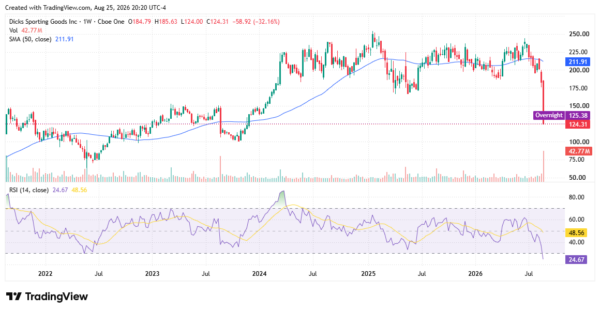
Dick’s Sporting Goods (NYSE: DKS) stock cratered more than 30% on August 25, 2026, after the retailer posted its second-quarter results. Long-term shareholders watched roughly two years of gains disappear in a single session. The company missed on both revenue and earnings, and it lowered its full-year outlook.

The headline numbers looked rough on the surface. Diluted earnings per share fell to $3.50, down from $4.71 a year ago. Non-GAAP EPS came in at $3.53, versus $4.38 last year. Net sales jumped 53% to $5.6 billion, but that growth was driven almost entirely by the Foot Locker acquisition, not by organic strength.

The core DICK’S Business actually performed well, with 4.9% comparable sales growth. The real story is Foot Locker, which is dragging down results and forcing management to rethink its 2026 plan. This piece breaks down where the pressure is coming from, why margins are under strain, and whether this sell-off has priced in more damage than the fundamentals actually support.

DICK’S Sporting Goods Earnings Reveal a Tale of Two Businesses


Foot Locker is the clear source of investor anxiety. Pro forma comparable sales for the Foot Locker Business declined 3.6% in the quarter, a steep drop from modest growth expectations. Management pointed to weak footwear launches and a heavier reliance on legacy retro product, both of which underperformed both industry benchmarks and internal targets.

That weakness pushed management to lower its full-year Foot Locker comparable sales outlook to a range of negative 2.0% to 0.0%. Operating income guidance for both DICK’S and Foot Locker segments was also reduced.

Perhaps more concerning for margin-focused investors: management said the athletic footwear and apparel marketplace has become “increasingly promotional.” The company plans to remain competitively priced to protect market share, which means leaning more heavily on promotions in the coming quarters. Promotions drive traffic, but they also compress gross margins. That’s a headwind investors should watch closely as the holiday season approaches, when promotional intensity typically peaks anyway.

Foot Locker Is the Biggest Problem for DICK’S Sporting Goods

Complicating the picture further, Dick’s continues investing heavily in its physical footprint. Gross capital expenditures rose 41% year-over-year, to $743 million for the first half of fiscal 2026. Full-year guidance calls for roughly $1.6 billion in gross capital spending.

Much of that money is flowing into experiential formats: DICK’S House of Sport and DICK’S Field House locations. These larger-format stores carry higher build-out costs and take time to mature financially. In the near term, they add depreciation and pre-opening expense without a matching revenue lift.

Layer this reinvestment on top of Foot Locker’s promotional pressure, and it’s easy to see why operating margin compressed sharply. Consolidated operating margin fell to 7.9% from 12.4% a year ago. Some of that decline reflects one-time acquisition costs. But even on a non-GAAP basis, margin dropped from 13.0% to 8.1%.

None of this means the long-term store strategy is wrong. House of Sport locations have historically driven strong returns once ramped. But investors need patience while that plays out alongside Foot Locker’s turnaround.

Dick's - StockEarnings

DICK’S Store Investments Are Squeezing Margins in the Near Term

Here’s where perception may be running ahead of fundamentals. Full-year non-GAAP EPS guidance now sits at $11.00 to $12.00, down from $13.50 to $14.50 last quarter. At the low end, that’s roughly a 21% year-over-year decline. The stock, however, fell more than 30% in one session — a reaction that looks disproportionate to the guidance cut itself.

Importantly, the dividend appears secure. The board just declared a $1.25 per-share quarterly dividend, unchanged from the prior payout, payable September 25.

Share buybacks have slowed. Dick’s repurchased $141 million in stock in the first half of fiscal 2026, down from $299 million a year earlier, as capital shifted toward the Foot Locker integration. Still, $3.0 billion remains authorized for future repurchases. As integration costs fade and cash flow normalizes, buyback activity could reaccelerate.

DICK’S Sporting Goods Stock Sell-Off May Be Overdone

This looks less like a broken business and more like a market reacting emotionally to integration turbulence. The core DICK’S Business still posted comps growth of 4.9%. That’s not a company in decline.

Foot Locker’s integration is clearly messier and slower than hoped, and that’s the primary risk here: further delays or higher-than-expected costs could continue to pressure margins longer than investors want. But a 30%+ drop against a 21% guidance cut suggests the market may be pricing in worse outcomes than management has actually signaled.

For existing shareholders, this may be a moment to consider adding to positions. For those who’ve been waiting for a better entry point on DKS, it may have just arrived — just not in the way anyone expected.
dick's - StockEarnings

A former marketing copywriter turned freelance financial writer and market analyst. I have a passion for delivering insights to investors. I write regularly about stocks for StockEarnings and MarketBeat. Posts are not advice.

Join over 1.2M+ investors/traders who receive daily and weekly notable earnings alerts with predicted move