ajax loader

Loading...


Ride-the-Wave Strategy – Best for Stock Traders

Ride-the-Wave targets multi-day price momentum following a company’s earnings announcement (EA). With this strategy:

  1. Buy a stock one day post-EA if a stock reacts positively post-earnings:
    1. Near the close of trading the EA-day for a pre-market-EA
    2. Near the close of the following day for a post-market-EA
  2. Sell-to-close after 7-10 days, or possibly earlier if a desired price target is reached

Similarly,

  1. short a stock one day post-EA if a stock reacts negatively post-earnings:
    1. near the close of trading the EA-day for a premarket-EA
    2. near the close of the following day for a post-market-EA
  2. then buy-to-close after 7-10 days, or possibly earlier if a desired price target is reached

Important: Ride-the-Wave is predicated on significant price momentum triggered by an EA. The 7-10 day scenario is the maximum trade hold-time. If you see post EA-momentum is halted or reversed by a significant opposite move, re-evaluate your presence in the trade.

This popular StockEarnings screen below will give you a list of stocks that historically exhibit significant price momentum following an EA for the next seven days:

  1. Stocks exhibiting positive post-EA price moves are buy-candidates
  2. Stocks exhibiting negative post-EA price moves are sell/short-candidates

The screen includes those stocks whose Earnings just came out in last two days.

Screen criteria:

  1. Earnings Date Start Date : Current Date + -1 Day
  2. Earnings Date End Date : Current Date + -2 Days
  3. Predicted Move (Next Day) Max : 7%
  4. Predicted Move (On 7th Day) Min : 7%

Strategy Guideline:

  1. Buy the stock if stock has reacted positively. Short the stock if stock has reacted negatively (see above).
  2. Close the position in 7-10 days, or possibly earlier based on price move.

Volatility Crush Strategy - Best for Options Traders

The Volatility Crush strategy is used with stocks that typically experience relatively low-to-moderate price moves (≤4%) following their Earnings Announcements (EA). The basic trade idea is to sell put or call options right before the EA, collecting a credit when options premium is very high due to elevated implied volatility (IV). You then close the position right after the EA by buying the option back much cheaper due to the significant drop in IV that occurs after the mystery of the EA disappears. In assessing this trade, you need to do your homework to ensure you collect sufficient premium to make the trade worthwhile.

This trade is practical due to the low-to-moderate price-move after the EA, which generally won’t significantly affect the options price, unlike an “action” stock, which experience great price moves post-EA. With these symbols, if you’re on the right side of the price move, that’s a great thing. But if you’re on the wrong side of the move, not so great. Consequently, by minimizing the effect of the post-EA price move, you have a much better chance to profit from the reduction in IV without it being ruined by a violent price move.

For this trade, open the position either (1) the night before the EA when the company announces earnings or (2) during the EA day when it announces post-market, generally capturing IV at or close to its peak.

For this trade, open the position either (1) the night before the EA when the company announces earnings or (2) during the EA day when it announces post-market, generally capturing IV at or close to its peak.

This popular stockearnings screen will give you a list of stocks which do not react more than 4% fpost-EA. It includes only those stocks whose earnings are releasing next day.

Screen criteria:

  1. Earnings Date Start Date : Current Date + 1
  2. Earnings Date End Date : Current Date + 1
  3. Predicted Move (Next Day) Max : 4%
  4. Options Type: Weekly

Strategy Guideline:

  1. Options Strategy: Sell Call and Put
  2. Options Strike Price: Current Stock Price – (% Predicated Move x 2)
  3. Expiration Date: It should generally be the closest expiry immediately after the EA.
  4. Buy Insurance: Buying back Call and Put at Strike price which 10% lower than Sell Strike Price is optional but recommended.

Watch Video for More Detail

Volatility Rush Strategy - Best for Options Traders

The Volatility Rush takes advantage of increasing options premiums into earnings announcements (EA) caused by an anticipated rise in Implied Volatility (IV). With this strategy, Buy a Call and Put at-the-money (a long straddle) 2-3 weeks before the EA when IV is lower. Sell the position either (1) the night before the EA when the company announces earnings pre-market, or (2) during the EA day when it announces post-market, generally capturing IV at or close to its peak.

This popular screen will give you a list of stocks whose Options premiums tend to rise into Earnings. It includes only those stocks whose Earnings are at least two weeks away from today.

Screen criteria:

  1. Earnings Date Start Date : Current Date + 15 Days
  2. Earnings Date End Date : Current Date + 30 Days
  3. Predicted Move (Next Day) Min : 5%
  4. Options Type: Weekly or Monthly if that lines up with the two to three-week lead-time for entering the trade

Strategy Guideline:

  1. Buy a Straddle at or close to the money two to three weeks pre-EA.
  2. Sell the position either the night before the EA when the company announces earnings pre-market, or during the EA day when it announces post-market.
  3. Expiration date should generally be the closest expiry immediately after the EA.
  4. Straddle price should not be more 60% of predicted move.

Predicted Move (Volatility)

Similar to Implied Volatility in Options. Expected volatility % based on our Proprietary Volatility Predication Model. We are expecting that stock price will likely to reach % in either direction by the end of next trading session after Earnings are released and not necessarily the closing volatility %.

Why is it important?

    This indicator helps

  1. Knowing expected volatility in stocks after Earnings helps to decide trading stocks before Earnings Announcement.
  2. Taking Advantage of volatility collapse following Earnings Results by using Advance Options strategies such as Spread and Straddles.

Since Last Earnings

Change in share price since last Earnings release.

Why is it Important?

When share has gained more than 10% since it's last Earning release, it tends to over react to minor bad news and give up some gains if not all. So, it contains more downside volatility than upside When share has dropped more than 10% since it's last Earning release, it tends to over react to minor good news and recover some drops if not all. So, it contains more upside volatility than downside.

EPS Surprise (%)

Occurs when a company's reported quarterly or annual profits are above or below analysts' expectations. Here is the formula to derive % EPS Surprice:

Actual EPS - Estimated EPS
------------------------------------- x 100
Estimated EPS

Why is it Important?

Earnings surprises can have a huge impact on a company's stock price. Several studies suggest that positive earnings surprises not only lead to an immediate hike in a stock's price, but also to a gradual increase over time. Hence, it's not surprising that some companies are known for routinely beating earning projections. A negative earnings surprise will usually result in a decline in share price.

Next Day Price Change (%)

Next Regular trading session Closing price following Earnings result.

For After Market Close Earnings, It is a next trading day closing price. For Before Market Open Earnings, It is the same trading day closing price.

Why is it Important?

Next Day price change is a reaction of Earnings result.

Archer Aviation’s Bold Pivot Could Transform ACHR Stock

Posted on Aug 12, 2026 by Chris Markoch

Archer Aviation’s Bold Pivot Could Transform ACHR Stock

Archer Aviation (NYSE: ACHR) just delivered a second-quarter report that had little to do with normal headline numbers like revenue and earnings per share (EPS). The air taxi developer posted a wider-than-expected loss, but investors barely blinked.

Instead, they focused on two moves that are reshaping what Archer actually is: a planned acquisition of three Boeing (NYSE: BA) units, and a jointly developed defense aircraft with Anduril Industries. Together, these deals mark Archer’s transition from a single-purpose civilian air taxi startup into a diversified aerospace and defense platform.

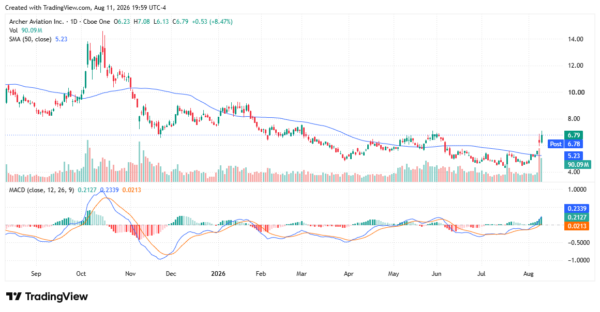
The stock jumped more than 8% following the report, and the technical chart shows a stock breaking out of a months-long downtrend. That reaction wasn’t about EPS, or lack thereof. It was about revenue visibility and strategic direction.

Archer still lost money in the quarter, and the FAA certification path for its Midnight aircraft remains a work in progress. Those are real considerations. But the bigger story is that Archer no longer looks like a company betting everything on one aircraft and one regulatory outcome. It now has defense contracts, a hardware acquisition that adds meaningful revenue, and a second aircraft platform aimed squarely at military budgets. That’s a fundamentally different investment case than the one that existed a year ago.

Boeing Deal Turns Revenue Story From Promise Into Progress


Archer’s quarterly revenue came in at $5 million, up sharply from the prior quarter. That’s still a small number for a company burning through more than $150 million a quarter in operating cash. But the Boeing transaction changes the trajectory. Archer agreed to acquire Boeing’s Wisk Aero, Insitu, and SkyGrid businesses in exchange for a Boeing equity stake, a deal expected to close by year-end.

Insitu alone is expected to add more than $200 million in annual revenue once the acquisition closes. That figure dwarfs Archer’s current quarterly sales base. It also gives the company an established, revenue-generating defense drone business to lean on while Midnight works through certification. Boeing’s involvement as both a seller and an investor adds a layer of validation that resonates with institutional investors closely watching the FAA process.

Management has been clear that this deal won’t eliminate Archer’s cash burn. It will, however, offset a meaningful portion of it while diversifying revenue away from a single aircraft program. For a company that has spent years fielding questions about “when,” the Boeing deal gives analysts something closer to “how much” and “how soon.”

Chart Shows Textbook Setup for a Short-Term Squeeze

The technical picture backs up the fundamental shift. Archer shares surged 8.47% on heavy volume above 90 million shares, closing near $6.79 after opening at $6.23. That single-day move pushed the stock decisively above its 50-day simple moving average, which sits at $5.23. Price had spent nearly ten months grinding below that average, a pattern that typically signals sustained selling pressure.

The MACD indicator is also flashing an early bullish signal. The MACD line, at 0.2127, is closing in on the signal line at 0.2339, with the histogram narrowing toward a potential crossover. That kind of setup, paired with a volume spike well above the recent average, often precedes short covering. Archer has historically carried elevated short interest given the skepticism around eVTOL timelines.

If momentum holds and the stock clears resistance near recent swing highs, short sellers who have been leaning the wrong way could accelerate the move. That doesn’t guarantee a sustained rally, but it does raise the odds of a sharp, fast short-term move higher.
archer_StockEarnings

Certification Concerns Are Real, But Investors May Be Overstating Them

Some investors remain frustrated by the lack of a firm certification date for Midnight. Archer isn’t providing a hard timeline, and that ambiguity has weighed on sentiment for months. Combined with continued unprofitability, it’s easy to see why some remain cautious.

But it’s worth separating two very different problems: a slow process and a failing process. Nothing in Archer’s disclosures suggests the FAA has raised doubts about eventual certification. Piloted city-to-city Midnight flights completed in July run in coordination with the FAA and point toward progress rather than stagnation.

Every eVTOL manufacturer faces this same regulatory uncertainty. It isn’t an Archer-specific flaw; it’s an industry-wide reality of introducing a new aircraft category. Investors weighing Archer against that backdrop should judge the company by whether milestones keep coming, not by whether a specific date is named.

The Bigger Picture: A Broader, More Resilient Company

Archer’s second quarter reinforced a shift that’s been building for months. This is no longer a company whose fate rests entirely on one certification timeline. The Boeing acquisitions add real, near-term revenue. The Anduril partnership opens a defense channel with its own funding and demand drivers, independent of civilian air taxi adoption.

Risks remain. Cash burn continues, and integration of three new businesses adds execution complexity. But Archer now has multiple paths to relevance instead of one. For investors willing to look past quarterly losses, that diversification is the real story behind this earnings report.


A former marketing copywriter turned freelance financial writer and market analyst. I have a passion for delivering insights to investors. I write regularly about stocks for StockEarnings and MarketBeat. Posts are not advice.

Join over 1.2M+ investors/traders who receive daily and weekly notable earnings alerts with predicted move