AST SpaceMobile (NASDAQ: ASTS) just gave investors a pretty funny quarter 2 earnings report: revenue came in at $31.5 million, up sharply from $1.2 million a year ago, yet the company still missed the roughly $34.5 million consensus estimate, while EPS came in at -$0.77 against an expected -$0.37.
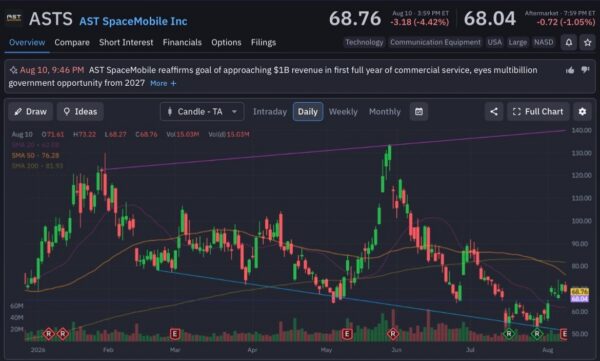
Wall Street didn’t give ASTS much credit for the progress, either, with the shares falling 4.42% to $68.76 on August 10 and another 1.05% after hours. That makes the earnings miss almost beside the point for now, because ASTS is still spending today to build the business investors are hoping will produce the real payoff tomorrow. Revenue is moving in the right direction, but the company hasn’t reached the part of the story where those investments start carrying their own weight, and that’s where this gets interesting.
AST SpaceMobile Has Already Sold The Network It Is Still Building
AST SpaceMobile’s commercial footprint is getting ahead of its physical one, which is a pretty unusual place for a young infrastructure company to find itself: more than 60 mobile network operators now cover over 3 billion subscribers collectively, while ASTS has built an approximately $1.30 billion revenue backlog from commercial partners and U.S. government contract awards.
That changes the interpretation of the satellite buildout, because ASTS isn’t launching BlueBirds into orbit and then hoping somebody figures out what to do with them; the company is putting hardware in place for customers that have already spent years building their own wireless networks and now have a reason to extend them into space. ASTS says BlueBird 14 through 16 are expected to be ready to ship in August, with additional satellites moving through production and assembly, while its current plan calls for approximately 45 satellites in orbit in early 2027.
$2.7 Billion In Cash Gives ASTS Room To Build
AST SpaceMobile is spending heavily because there isn’t much point in having a backlog if the network can’t physically handle it, and Q2 makes clear just how much capital is going into that buildout: cash, cash equivalents and restricted cash stood at roughly $2.7 billion at June 30, while property and equipment had climbed to $2.28 billion from $1.57 billion at year-end 2025.
The balance sheet therefore tells a more useful story than the $31.5 million quarterly revenue figure alone, because ASTS is deliberately absorbing enormous costs today to put productive assets into orbit tomorrow. The company says it remains on track for $150 million–$200 million of 2026 revenue, has received more than $125 million in U.S. government awards, and expects its constellation to reach roughly 45 satellites in orbit in early 2027.
That makes ASTS’s cash position one of the most important numbers in the report, because it gives management time to finish the network without having to prove the entire commercial model this quarter. The catch is that $2.7 billion buys time; it doesn’t make the satellites productive. Every BlueBird that reaches orbit brings ASTS closer to the point where the backlog, MNO partnerships and government contracts can start behaving like an operating business rather than a collection of promises.
$76 Is Still The Wall
ASTS has put together a respectable rebound from the $53–$55 area in late July, but the chart still has some unfinished business before I’d call this a real trend reversal. The stock closed at $68.76 on August 10 after trading as high as $73.22, with 15.03 million shares changing hands; it is now above the 20-day moving average at $62.08, but remains below the 50-day at $76.28 and 200-day at $81.93.
That puts $76–$82 in the spotlight, because ASTS would need to reclaim both moving averages before this rebound starts looking materially different from the failed rallies that preceded it. The encouraging part is that the stock has built a higher low around the high-$50s and pushed back toward $70 with increasing volume, but I’d want to see a decisive move through $76 before getting aggressive. If that happens, $82 becomes the next test and the mid-$80s the obvious target; another rejection there would leave ASTS stuck in the same broad range that has contained it for months.
ASTS Now Has To Turn Orbit Into Revenue
The pieces are starting to line up for AST SpaceMobile, but I think investors should resist the temptation to treat the $1.30 billion backlog as money already sitting in the bank. The company still has to launch the satellites, activate the network, move through beta service and ultimately prove that mobile operators and government customers will turn those commitments into the kind of recurring revenue management is targeting.
That is why the next batch of BlueBirds matters so much to me. ASTS says BlueBird 14 through 16 are expected to be ready to ship in August, with BlueBird 17 through 46 already in various stages of production and assembly, while the company targets roughly 45 satellites in orbit in early 2027.
If management keeps that cadence, the market has a legitimate reason to start valuing ASTS on the network it is becoming rather than the revenue it produces today.
I’d keep the chart simple: $76–$82 is the hurdle, while the $60s are where the recent recovery needs to hold. ASTS doesn’t need another grand promise at this point; it needs satellites in orbit, service going live and revenue following the hardware. Do that, and the stock has plenty of room to grow into the expectations already attached to it.