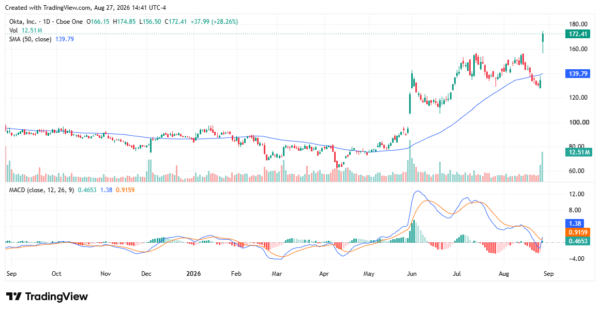
Okta (NASDAQ: OKTA) delivered a double beat in its Q2 fiscal 2027 earnings report on Aug. 26. Shares were up 28.26% intraday on Aug. 27, touching a high of $174.85, with the stock’s 50-day moving average sitting far below at $139.79. Non-GAAP earnings came in at $1.05 per diluted share, and total revenue hit $805 million, up 11% year over year. Subscription revenue grew even faster, up 12%. The company also raised its full-year guidance, now projecting fiscal 2027 revenue of $3.216 billion to $3.226 billion.
But the headline numbers only tell part of the story. Page 12 of the investor presentation is titled, bluntly, “Okta is the superior choice vs. Microsoft.” It’s a rare move for a company to name a specific rival that directly in an earnings presentation. The page lays out four categories where the upstart claims to beat Microsoft (NASDAQ: MSFT):
- Ease of Use
- Execution on Identity Challenges
- Depth of Integrations
- Mitigating Vendor Risk
That kind of direct callout signals that Okta sees Microsoft as the primary obstacle to its ownership of identity security in the agentic AI economy.
At the same time, cybersecurity giant CrowdStrike (NASDAQ: CRWD) reported its own blowout quarter on the same day, with shares jumping double digits. The market is telling a bigger story: cybersecurity spending is accelerating as AI reshapes enterprise risk. The question for investors is which companies capture that spending, and how the company’s positioning against Microsoft factors into that outcome.
Okta Draws a Line Against Microsoft
Okta’s presentation doesn’t just gesture at competition. It devotes an entire slide to comparing itself with Microsoft point by point. The first category, ease of use, cites a specific gap: Microsoft had to make multi-factor authentication mandatory to push adoption past 34% among admins, even offering it for free. The company says over 90% of its admins adopted MFA voluntarily, before any mandate.
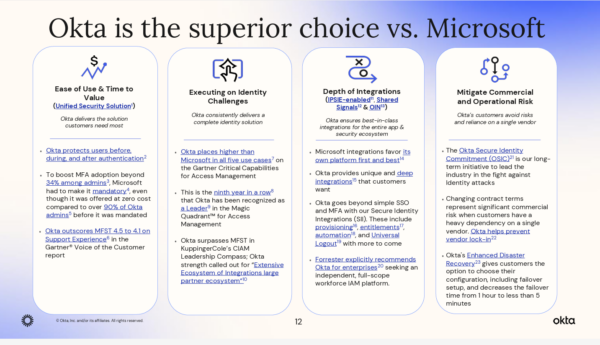
The second category argues that the company executes better on core identity challenges. Okta says it placed higher than Microsoft in all five use cases in Gartner’s Critical Capabilities for Access Management report, and has been named a Leader in Gartner’s Magic Quadrant for Access Management nine years running.
The third and fourth categories go after integration depth and vendor risk. Okta claims Microsoft’s integrations favor its own platform first, while offering deeper hooks like provisioning, entitlements, and universal logout across a wider ecosystem.
On risk, the company points to its Secure Identity Commitment and faster disaster recovery, framing single-vendor dependency on Microsoft as a real commercial liability. Together, the slide asks customers to see neutrality as an advantage, not a limitation, especially as AI agents span multiple platforms and need an identity layer that isn’t tied to any one of them.
Okta Claims Its Own Lane, Apart From CrowdStrike Too
Okta isn’t just drawing a contrast with Microsoft. It’s also distinguishing itself from CrowdStrike, another cybersecurity name that posted a strong quarter on the same day. CrowdStrike’s shares jumped over 11% after beating estimates with 26% revenue growth, with executives citing AI-driven threats as a tailwind. That’s a similar narrative to Okta’s, but the two companies occupy different parts of the security stack.
CrowdStrike focuses on endpoint detection and response. Okta focuses on identity. CEO Todd McKinnon has framed identity as the true “control plane” for securing AI agents, arguing every agent needs a trusted identity before it can act. New products, including Okta for AI Agents, made up roughly 30% of bookings this quarter, with an average ACV lift of about 40% when bundled into deals.
This positioning gives Okta room to grow without inviting direct comparison to CrowdStrike’s steeper valuation. Instead, Okta can present itself as the identity specialist inside a broader, multi-vendor security stack, one that becomes more essential as AI agents multiply across enterprise systems.
The two companies also differ sharply in how they talk about AI revenue today. Okta closed dozens of AI-agent deals in Q2, including several million-dollar wins, but management called the business very early and said it won’t materially affect fiscal 2027 results.
CrowdStrike took the opposite approach, highlighting its AI Detection and Response product by name and touting ARR that nearly tripled sequentially. Much of that gap comes down to plumbing. CrowdStrike’s AI product rides on an endpoint agent already installed across its customer base, making it a quick add-on sale. Okta’s AI security work is woven into its broader identity platform, a longer sales cycle that’s harder to break out as a standalone number.
Institutional Buyers Are Still Playing Catch-Up
Institutions own more than 80% of the stock’s float, a level that reflects how deeply professional money is embedded in this stock. But that ownership dropped meaningfully during the third quarter of fiscal 2025, when institutional selling outpaced buying. Since then, buying activity has outpaced selling, though institutions still haven’t fully rebuilt their prior position.
That gap suggests professional investors are still catching up to the company’s turnaround story rather than leading it. As more institutions rebuild exposure, it could provide a tailwind for the stock. This dynamic also helps explain why analysts moved quickly to raise price targets this week. Morgan Stanley lifted its target to $200 from $180, Needham raised its target to $200 from $140, and KeyCorp raised its target to $190 from $180.
The Chart Suggests a Pullback Is Coming
Despite the bullish fundamentals, OKTA’s chart flashes a caution sign for short-term traders. The stock’s 50-day simple moving average sits at $139.79, far below the post-earnings spike to a $174.85 intraday high. Rallies this sharp, a 28% single-day move on the chart, rarely hold their full gain without some retracement.
Investors who missed the initial pop may want to watch the 50-day SMA as a potential re-entry level. A pullback toward that zone wouldn’t undermine the broader thesis. It would simply reflect normal profit-taking after an outsized move. Identity security and cybersecurity broadly appear to be at the start of a multi-year growth cycle tied to AI adoption. A short-term dip could offer a second chance to build a position before that cycle matures.
The Bigger Picture for Okta Investors
Okta’s Q2 report did more than beat estimates. It clarified the company’s strategic identity within a crowded cybersecurity landscape. By directly challenging Microsoft on a dedicated slide and carving out separation from CrowdStrike, Okta is telling investors exactly how it plans to win the next phase of enterprise security spending.
Institutional buyers appear to be catching on, even if they haven’t fully caught up. Analyst price target increases reflect growing confidence in that thesis. Short-term traders should stay alert to a possible pullback toward the 50-day moving average. But for investors focused on the multi-year opportunity around AI-driven identity security, Okta’s latest quarter reinforces a story that’s still in its early innings.