ajax loader

Loading...


Ride-the-Wave Strategy – Best for Stock Traders

Ride-the-Wave targets multi-day price momentum following a company’s earnings announcement (EA). With this strategy:

  1. Buy a stock one day post-EA if a stock reacts positively post-earnings:
    1. Near the close of trading the EA-day for a pre-market-EA
    2. Near the close of the following day for a post-market-EA
  2. Sell-to-close after 7-10 days, or possibly earlier if a desired price target is reached

Similarly,

  1. short a stock one day post-EA if a stock reacts negatively post-earnings:
    1. near the close of trading the EA-day for a premarket-EA
    2. near the close of the following day for a post-market-EA
  2. then buy-to-close after 7-10 days, or possibly earlier if a desired price target is reached

Important: Ride-the-Wave is predicated on significant price momentum triggered by an EA. The 7-10 day scenario is the maximum trade hold-time. If you see post EA-momentum is halted or reversed by a significant opposite move, re-evaluate your presence in the trade.

This popular StockEarnings screen below will give you a list of stocks that historically exhibit significant price momentum following an EA for the next seven days:

  1. Stocks exhibiting positive post-EA price moves are buy-candidates
  2. Stocks exhibiting negative post-EA price moves are sell/short-candidates

The screen includes those stocks whose Earnings just came out in last two days.

Screen criteria:

  1. Earnings Date Start Date : Current Date + -1 Day
  2. Earnings Date End Date : Current Date + -2 Days
  3. Predicted Move (Next Day) Max : 7%
  4. Predicted Move (On 7th Day) Min : 7%

Strategy Guideline:

  1. Buy the stock if stock has reacted positively. Short the stock if stock has reacted negatively (see above).
  2. Close the position in 7-10 days, or possibly earlier based on price move.

Volatility Crush Strategy - Best for Options Traders

The Volatility Crush strategy is used with stocks that typically experience relatively low-to-moderate price moves (≤4%) following their Earnings Announcements (EA). The basic trade idea is to sell put or call options right before the EA, collecting a credit when options premium is very high due to elevated implied volatility (IV). You then close the position right after the EA by buying the option back much cheaper due to the significant drop in IV that occurs after the mystery of the EA disappears. In assessing this trade, you need to do your homework to ensure you collect sufficient premium to make the trade worthwhile.

This trade is practical due to the low-to-moderate price-move after the EA, which generally won’t significantly affect the options price, unlike an “action” stock, which experience great price moves post-EA. With these symbols, if you’re on the right side of the price move, that’s a great thing. But if you’re on the wrong side of the move, not so great. Consequently, by minimizing the effect of the post-EA price move, you have a much better chance to profit from the reduction in IV without it being ruined by a violent price move.

For this trade, open the position either (1) the night before the EA when the company announces earnings or (2) during the EA day when it announces post-market, generally capturing IV at or close to its peak.

For this trade, open the position either (1) the night before the EA when the company announces earnings or (2) during the EA day when it announces post-market, generally capturing IV at or close to its peak.

This popular stockearnings screen will give you a list of stocks which do not react more than 4% fpost-EA. It includes only those stocks whose earnings are releasing next day.

Screen criteria:

  1. Earnings Date Start Date : Current Date + 1
  2. Earnings Date End Date : Current Date + 1
  3. Predicted Move (Next Day) Max : 4%
  4. Options Type: Weekly

Strategy Guideline:

  1. Options Strategy: Sell Call and Put
  2. Options Strike Price: Current Stock Price – (% Predicated Move x 2)
  3. Expiration Date: It should generally be the closest expiry immediately after the EA.
  4. Buy Insurance: Buying back Call and Put at Strike price which 10% lower than Sell Strike Price is optional but recommended.

Watch Video for More Detail

Volatility Rush Strategy - Best for Options Traders

The Volatility Rush takes advantage of increasing options premiums into earnings announcements (EA) caused by an anticipated rise in Implied Volatility (IV). With this strategy, Buy a Call and Put at-the-money (a long straddle) 2-3 weeks before the EA when IV is lower. Sell the position either (1) the night before the EA when the company announces earnings pre-market, or (2) during the EA day when it announces post-market, generally capturing IV at or close to its peak.

This popular screen will give you a list of stocks whose Options premiums tend to rise into Earnings. It includes only those stocks whose Earnings are at least two weeks away from today.

Screen criteria:

  1. Earnings Date Start Date : Current Date + 15 Days
  2. Earnings Date End Date : Current Date + 30 Days
  3. Predicted Move (Next Day) Min : 5%
  4. Options Type: Weekly or Monthly if that lines up with the two to three-week lead-time for entering the trade

Strategy Guideline:

  1. Buy a Straddle at or close to the money two to three weeks pre-EA.
  2. Sell the position either the night before the EA when the company announces earnings pre-market, or during the EA day when it announces post-market.
  3. Expiration date should generally be the closest expiry immediately after the EA.
  4. Straddle price should not be more 60% of predicted move.

Predicted Move (Volatility)

Similar to Implied Volatility in Options. Expected volatility % based on our Proprietary Volatility Predication Model. We are expecting that stock price will likely to reach % in either direction by the end of next trading session after Earnings are released and not necessarily the closing volatility %.

Why is it important?

    This indicator helps

  1. Knowing expected volatility in stocks after Earnings helps to decide trading stocks before Earnings Announcement.
  2. Taking Advantage of volatility collapse following Earnings Results by using Advance Options strategies such as Spread and Straddles.

Since Last Earnings

Change in share price since last Earnings release.

Why is it Important?

When share has gained more than 10% since it's last Earning release, it tends to over react to minor bad news and give up some gains if not all. So, it contains more downside volatility than upside When share has dropped more than 10% since it's last Earning release, it tends to over react to minor good news and recover some drops if not all. So, it contains more upside volatility than downside.

EPS Surprise (%)

Occurs when a company's reported quarterly or annual profits are above or below analysts' expectations. Here is the formula to derive % EPS Surprice:

Actual EPS - Estimated EPS
------------------------------------- x 100
Estimated EPS

Why is it Important?

Earnings surprises can have a huge impact on a company's stock price. Several studies suggest that positive earnings surprises not only lead to an immediate hike in a stock's price, but also to a gradual increase over time. Hence, it's not surprising that some companies are known for routinely beating earning projections. A negative earnings surprise will usually result in a decline in share price.

Next Day Price Change (%)

Next Regular trading session Closing price following Earnings result.

For After Market Close Earnings, It is a next trading day closing price. For Before Market Open Earnings, It is the same trading day closing price.

Why is it Important?

Next Day price change is a reaction of Earnings result.

Snowflake’s Q2 Blowout Just Rewrote the Growth Story

Posted on Sep 03, 2026 by Chris Markoch

Snowflake’s Q2 Blowout Just Rewrote the Growth Story

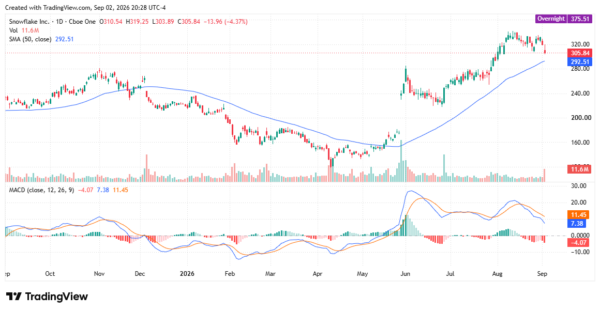
Snowflake (NYSE: SNOW) reported second-quarter fiscal 2027 earnings after the close on September 2, and the market’s verdict was immediate: shares surged nearly 23% in after-hours trading, jumping from a $305.84 regular-session close to $375.51 in overnight trading.

That reversal is the story in miniature. Snowflake had actually sold off nearly 4.4% during the regular session heading into the print, with shares sliding under both their 50-day and 200-day moving averages as investors grew nervous ahead of a report that needed to clear an unusually high bar.
snowflake - StockEarnings

What it delivered was acceleration, not deceleration — product revenue growth actually sped up for a third consecutive quarter, defying the gravity that usually pulls high-multiple growth stocks back to earth as they scale. The report is a useful case study in how perception and fundamentals can drift apart within a single trading day, only to snap back into alignment the moment the numbers hit the tape.

Snowflake Earnings Beat Estimates as Revenue Growth Accelerates


Total revenue came in at $1.55 billion, up 35% year-over-year and comfortably ahead of the $1.49 billion Wall Street expected. Product revenue — the figure investors watch most closely, since it reflects actual platform consumption rather than one-time services work — grew 37% year-over-year to $1.49 billion. That marked a seven-percentage-point acceleration from the 30% growth rate Snowflake exited fiscal 2026 with, and the third straight quarter in which growth sped up rather than slowed.

Adjusted earnings per share landed at 62 cents, well above the consensus estimate of 46 cents and Snowflake’s fifth consecutive quarterly beat. On a GAAP basis, the company narrowed its net loss to $191.7 million, or $0.55 per share, down from a $297.9 million loss a year earlier. Profitability improved alongside growth: non-GAAP operating margin expanded to roughly 15%, up from 11% in the year-ago quarter, and management raised its full-year margin outlook to 14.5% from 13.5%.

Snowflake Customer Growth Shows Stronger Platform Demand

The perception-versus-fundamentals tension around Snowflake has often centered on a simple question: is growth coming from genuine expansion, or from a shrinking pool of easy comparisons? This quarter answered it.

Net revenue retention held at 126%, meaning existing customers are spending well beyond their prior-year contracts. The company added 692 net new customers, up 32% year-over-year, bringing its total base to 14,554. Customers spending more than $1 million annually grew 27% year-over-year to 828, with 48 net additions in the quarter alone. Snowflake now also counts 829 Forbes Global 2000 customers, representing more than 41% penetration among the world’s largest enterprises.

Remaining performance obligations — a proxy for contracted future business — rose 30% year-over-year to $9.0 billion, with 54% expected to convert to revenue over the next twelve months. That combination of accelerating current revenue and growing forward-looking commitments is the piece that tends to move a stock double digits: it tells investors the growth isn’t just holding, it’s compounding.

Snowflake AI Growth Is Accelerating as Customers Expand Usage

Every software company now claims an AI story, and the market has grown skeptical of narratives without numbers attached. Snowflake’s AI products offered something more concrete. CoCo, its AI coding agent, closed the quarter with 9,100 accounts, up more than 2,000 from the prior quarter, while CoWork reached 5,800 accounts.

CEO Sridhar Ramaswamy described AI as compounding the company’s advantages, creating what he called a flywheel effect that pulls new workloads onto the platform and lifts overall consumption. Executives on the call attributed roughly half of the growth acceleration to AI-driven usage, spanning tools from AI functions and document processing to Cortex Code and machine learning notebooks. Production use cases climbed 89% year-over-year, a sign that AI experimentation is converting into workloads customers actually depend on rather than staying stuck in pilot mode.

That momentum came with a trade-off. Non-GAAP product gross margin came in at 75% for the quarter, down a point from a year earlier, and management’s full-year guidance for the metric moved lower still, to 74%, since AI workloads currently carry lower contribution margins than the core data platform.

Management framed this as a deliberate sequencing choice — prioritizing adoption and platform consumption now, with unit economics expected to improve as AI workloads scale. It’s the one line in the report that argues against a purely one-sided read: the AI flywheel is real, but it isn’t yet as profitable, workload for workload, as the business it’s layered onto.

Snowflake Raises Fiscal 2027 Guidance After Strong Q2 Earnings

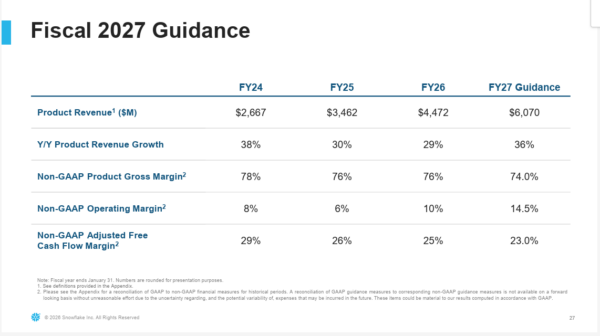
Beats matter, but guidance is what typically decides whether a stock jumps 5% or 25%. Snowflake raised its full-year fiscal 2027 product revenue outlook to $6.07 billion, up from $5.84 billion previously, implying 36% annual growth. For the third quarter, management guided to product revenue growth of 37% to 38% year-over-year, above the $1.50 billion analysts had modeled in dollar terms.

Operating margin guidance moved higher too, even as product gross margin guidance moved lower — a combination that tells investors management is comfortable trading a few points of gross margin for faster adoption, while still finding operating leverage elsewhere in the business. That’s a more nuanced signal than a simple beat-and-raise, and the market treated it as credible rather than as a red flag.
snowflake - StockEarnings

SNOW Stock Surge Highlights the Gap Between Price and Fundamentals

Going into this report, the bear case on Snowflake was visible in real time: shares fell nearly 4.4% in the hours before the print, a sign that the market was bracing for disappointment after a year of gains that left little room for error. The fundamentals told a different story once the release hit. Growth didn’t decelerate — it accelerated, for the third quarter running, while margins expanded and forward bookings grew even faster than revenue.

When a company’s actual trajectory turns out to be stronger than the market’s cautious same-day pricing implied, the reaction tends to be sharp and immediate, which is exactly what a same-session round trip from a 4.4% decline to a near-23% afterhours pop represents. The question for Snowflake now isn’t whether the AI narrative is real — Wednesday’s numbers answered that — but whether the company can keep compounding acceleration on top of acceleration without eventually running into the same law of large numbers the bears were originally worried about.


A former marketing copywriter turned freelance financial writer and market analyst. I have a passion for delivering insights to investors. I write regularly about stocks for StockEarnings and MarketBeat. Posts are not advice.

Join over 1.2M+ investors/traders who receive daily and weekly notable earnings alerts with predicted move