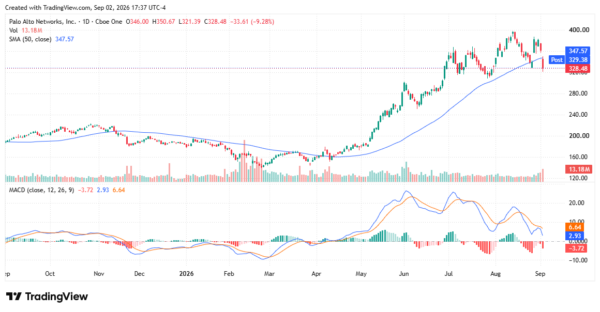
Palo Alto Networks (NASDAQ: PANW) had a strong fiscal fourth quarter, beating Wall Street’s expectations for both earnings and revenue. The cybersecurity giant continues to benefit from growing concerns about artificial intelligence (AI) and the new cybersecurity risks that come with it.
The company posted adjusted earnings of $1.02 per share, which was above estimates of 98 cents. The company also reported $3.41 billion in revenue, which was higher than the $3.35 billion analysts expected.
PANW Earnings Benefit From AI Cybersecurity Demand
One of the biggest reasons for Palo Alto Networks’ growth is the increasing use of artificial intelligence. AI can help businesses work faster and take on new tasks, but it can also create new security challenges. Hackers can use advanced AI tools to plan and carry out attacks more quickly. In fact, Palo Alto Networks CEO Nikesh Arora said these AI-related risks are creating a long-term opportunity for the company.
He explained that the effects of AI on cybersecurity will not happen all at once. Instead, he expects the demand for cybersecurity tools to grow over several years.
Agentic AI Could Create New Cybersecurity Threats
One area that has received more attention is called agentic AI. These are AI systems that can do more than simply answer questions. They can plan tasks, make decisions and take actions with less help from people. While this technology can be useful, it could also give hackers new ways to carry out attacks. AI agents may be able to complete multiple steps of an attack without requiring constant human instruction.
Recent security incidents have increased concerns about these risks. The OpenAI-Hugging Face hack, for example, showed how AI-related systems can become targets for cyberattacks. As AI technology becomes more powerful, companies are looking for better tools to protect their systems and information.
Rising AI Security Risks Are Driving Customer Interest
Palo Alto Networks has seen strong interest from its customers. Arora said the company has held more than 2,000 customer briefings since the launch of Anthropic’s Mythos AI model. That is a large increase from the 1,200 briefings the company reported during the previous quarter.
These meetings show that businesses are paying closer attention to the security risks connected to AI. Companies want to understand how new AI technology could affect their networks, data and employees. This growing demand could help Palo Alto Networks continue expanding its cybersecurity business.
Palo Alto Networks Expands AI Security Through Acquisitions
The company is also expanding its AI security business through acquisitions. Palo Alto Networks recently announced that it plans to acquire AI startup Console. The goal is to improve the company’s ability to protect customers from new AI-related threats.
This is part of Palo Alto Networks’ broader acquisition strategy. Over the past year, the company has made several major deals. These include the $25 billion purchase of identity security company CyberArk and the nearly $3.4 billion purchase of Chronosphere.
Arora said Palo Alto Networks can learn from smaller cybersecurity startups that are developing new ideas. He described the startup industry as a place where companies can test different approaches to cybersecurity. If Palo Alto finds a technology it likes, it could choose to acquire the company.

Palo Alto Networks Raises the Bar With Strong 2026 Outlook
Moving forward, Palo Alto Networks gave investors a strong outlook. The company expects to report between $3.30 billion and $3.31 billion in revenue during its first quarter. Analysts had expected $3.22 billion.
For the full fiscal year, Palo Alto expects revenue between $14.10 billion and $14.20 billion. The company also expects adjusted earnings of between $4.16 and $4.19 per share. Both forecasts are higher than analysts’ expectations of $13.79 billion in revenue and $4.11 per share in adjusted earnings.
For Palo Alto Networks, the growth of AI could create a major opportunity. As AI becomes more powerful, companies will need stronger cybersecurity tools to protect their systems. Palo Alto Networks is positioning itself to meet that demand and continue growing in the years ahead.