ajax loader

Loading...


Ride-the-Wave Strategy – Best for Stock Traders

Ride-the-Wave targets multi-day price momentum following a company’s earnings announcement (EA). With this strategy:

  1. Buy a stock one day post-EA if a stock reacts positively post-earnings:
    1. Near the close of trading the EA-day for a pre-market-EA
    2. Near the close of the following day for a post-market-EA
  2. Sell-to-close after 7-10 days, or possibly earlier if a desired price target is reached

Similarly,

  1. short a stock one day post-EA if a stock reacts negatively post-earnings:
    1. near the close of trading the EA-day for a premarket-EA
    2. near the close of the following day for a post-market-EA
  2. then buy-to-close after 7-10 days, or possibly earlier if a desired price target is reached

Important: Ride-the-Wave is predicated on significant price momentum triggered by an EA. The 7-10 day scenario is the maximum trade hold-time. If you see post EA-momentum is halted or reversed by a significant opposite move, re-evaluate your presence in the trade.

This popular StockEarnings screen below will give you a list of stocks that historically exhibit significant price momentum following an EA for the next seven days:

  1. Stocks exhibiting positive post-EA price moves are buy-candidates
  2. Stocks exhibiting negative post-EA price moves are sell/short-candidates

The screen includes those stocks whose Earnings just came out in last two days.

Screen criteria:

  1. Earnings Date Start Date : Current Date + -1 Day
  2. Earnings Date End Date : Current Date + -2 Days
  3. Predicted Move (Next Day) Max : 7%
  4. Predicted Move (On 7th Day) Min : 7%

Strategy Guideline:

  1. Buy the stock if stock has reacted positively. Short the stock if stock has reacted negatively (see above).
  2. Close the position in 7-10 days, or possibly earlier based on price move.

Volatility Crush Strategy - Best for Options Traders

The Volatility Crush strategy is used with stocks that typically experience relatively low-to-moderate price moves (≤4%) following their Earnings Announcements (EA). The basic trade idea is to sell put or call options right before the EA, collecting a credit when options premium is very high due to elevated implied volatility (IV). You then close the position right after the EA by buying the option back much cheaper due to the significant drop in IV that occurs after the mystery of the EA disappears. In assessing this trade, you need to do your homework to ensure you collect sufficient premium to make the trade worthwhile.

This trade is practical due to the low-to-moderate price-move after the EA, which generally won’t significantly affect the options price, unlike an “action” stock, which experience great price moves post-EA. With these symbols, if you’re on the right side of the price move, that’s a great thing. But if you’re on the wrong side of the move, not so great. Consequently, by minimizing the effect of the post-EA price move, you have a much better chance to profit from the reduction in IV without it being ruined by a violent price move.

For this trade, open the position either (1) the night before the EA when the company announces earnings or (2) during the EA day when it announces post-market, generally capturing IV at or close to its peak.

For this trade, open the position either (1) the night before the EA when the company announces earnings or (2) during the EA day when it announces post-market, generally capturing IV at or close to its peak.

This popular stockearnings screen will give you a list of stocks which do not react more than 4% fpost-EA. It includes only those stocks whose earnings are releasing next day.

Screen criteria:

  1. Earnings Date Start Date : Current Date + 1
  2. Earnings Date End Date : Current Date + 1
  3. Predicted Move (Next Day) Max : 4%
  4. Options Type: Weekly

Strategy Guideline:

  1. Options Strategy: Sell Call and Put
  2. Options Strike Price: Current Stock Price – (% Predicated Move x 2)
  3. Expiration Date: It should generally be the closest expiry immediately after the EA.
  4. Buy Insurance: Buying back Call and Put at Strike price which 10% lower than Sell Strike Price is optional but recommended.

Watch Video for More Detail

Volatility Rush Strategy - Best for Options Traders

The Volatility Rush takes advantage of increasing options premiums into earnings announcements (EA) caused by an anticipated rise in Implied Volatility (IV). With this strategy, Buy a Call and Put at-the-money (a long straddle) 2-3 weeks before the EA when IV is lower. Sell the position either (1) the night before the EA when the company announces earnings pre-market, or (2) during the EA day when it announces post-market, generally capturing IV at or close to its peak.

This popular screen will give you a list of stocks whose Options premiums tend to rise into Earnings. It includes only those stocks whose Earnings are at least two weeks away from today.

Screen criteria:

  1. Earnings Date Start Date : Current Date + 15 Days
  2. Earnings Date End Date : Current Date + 30 Days
  3. Predicted Move (Next Day) Min : 5%
  4. Options Type: Weekly or Monthly if that lines up with the two to three-week lead-time for entering the trade

Strategy Guideline:

  1. Buy a Straddle at or close to the money two to three weeks pre-EA.
  2. Sell the position either the night before the EA when the company announces earnings pre-market, or during the EA day when it announces post-market.
  3. Expiration date should generally be the closest expiry immediately after the EA.
  4. Straddle price should not be more 60% of predicted move.

Predicted Move (Volatility)

Similar to Implied Volatility in Options. Expected volatility % based on our Proprietary Volatility Predication Model. We are expecting that stock price will likely to reach % in either direction by the end of next trading session after Earnings are released and not necessarily the closing volatility %.

Why is it important?

    This indicator helps

  1. Knowing expected volatility in stocks after Earnings helps to decide trading stocks before Earnings Announcement.
  2. Taking Advantage of volatility collapse following Earnings Results by using Advance Options strategies such as Spread and Straddles.

Since Last Earnings

Change in share price since last Earnings release.

Why is it Important?

When share has gained more than 10% since it's last Earning release, it tends to over react to minor bad news and give up some gains if not all. So, it contains more downside volatility than upside When share has dropped more than 10% since it's last Earning release, it tends to over react to minor good news and recover some drops if not all. So, it contains more upside volatility than downside.

EPS Surprise (%)

Occurs when a company's reported quarterly or annual profits are above or below analysts' expectations. Here is the formula to derive % EPS Surprice:

Actual EPS - Estimated EPS
------------------------------------- x 100
Estimated EPS

Why is it Important?

Earnings surprises can have a huge impact on a company's stock price. Several studies suggest that positive earnings surprises not only lead to an immediate hike in a stock's price, but also to a gradual increase over time. Hence, it's not surprising that some companies are known for routinely beating earning projections. A negative earnings surprise will usually result in a decline in share price.

Next Day Price Change (%)

Next Regular trading session Closing price following Earnings result.

For After Market Close Earnings, It is a next trading day closing price. For Before Market Open Earnings, It is the same trading day closing price.

Why is it Important?

Next Day price change is a reaction of Earnings result.

3 Quantum Computing Stocks After Earnings: What’s Next

Posted on Aug 10, 2026 by Chris Markoch

3 Quantum Computing Stocks After Earnings: What’s Next

Quantum computing stocks were heavily featured in the week of earnings reports between Aug. 3 and Aug. 7. IonQ (NYSE: IONQ), Rigetti Computing (NASDAQ: RGTI), and D-Wave Quantum (NASDAQ: QBTS) all reported second-quarter results within days of each other, giving investors a rare side-by-side look at where the sector actually stands.

The reports told three different stories. IonQ posted its fifth straight quarter of record revenue and closed a major acquisition. Rigetti grew revenue nearly threefold while landing a potential government funding deal. D-Wave saw bookings surge even as quarterly revenue stayed flat and the stock sold off.

That divergence sums up the industry. Quantum computing is no longer a single trade. It’s a basket of companies moving at different speeds, with different business models and different paths to profitability.

For long-term investors, that creates an opportunity to separate commercial traction from hype. The technology itself is advancing quickly, with government backing, enterprise pilots, and early revenue all becoming real rather than theoretical. The companies that convert that momentum into recurring, scalable revenue are the ones likely to lead the next phase of the industry.

Here’s what each earnings report revealed, and what it means going forward.

Why Quantum Computing Could Reshape Entire Industries


Quantum computing promises to solve problems that today’s fastest supercomputers simply can’t handle. Classical computers process information as bits, either a 0 or a 1. Quantum computers use qubits, which can represent multiple states simultaneously. That property allows them to explore huge numbers of possibilities in parallel.

The practical applications are wide-ranging. Drug developers could simulate molecular interactions to speed up discovery. Financial firms could optimize portfolios and model risk with far more precision. Logistics companies could solve complex routing problems in real time. Materials scientists could design new batteries, alloys, or chemicals atom by atom.

Governments have taken notice. National security applications, from cryptography to advanced simulation, are driving public investment alongside private capital. That’s why deals like Rigetti’s letter of intent with the Department of Commerce carry weight beyond the dollar figure attached to them.

The industry is still early. Most quantum computers today are error-prone and limited in scale. But the roadmap toward larger, more reliable systems is becoming clearer, and each earnings season now offers real data instead of just promises. That shift from concept to commercialization is what makes this sector worth watching closely.

IonQ Extends Its Record-Breaking Streak

IonQ delivered the standout report of the group. Second-quarter revenue hit $80.1 million, up 287% year-over-year and its fifth consecutive record quarter. Organic growth reached 132%, well above the company’s own full-year target.

Growth came from expanding global deployments of IonQ’s fifth-generation Tempo systems, including new installations in South Korea and Switzerland. Management raised full-year revenue guidance to a range of $280 million to $290 million.

The bigger story may be strategic. IonQ closed its $1.8 billion acquisition of SkyWater Technology, adding U.S.-based chip design and manufacturing capability. That move supports IonQ’s roadmap toward 256-qubit systems by 2027 and, eventually, chips with 10,000 qubits.

Losses remain heavy, and a large non-cash accounting charge inflated the reported net loss. But for investors focused on execution and market share, IonQ’s operational momentum is difficult to ignore right now.

quantum - StockEarnings

Rigetti Combines Revenue Growth With Government Validation

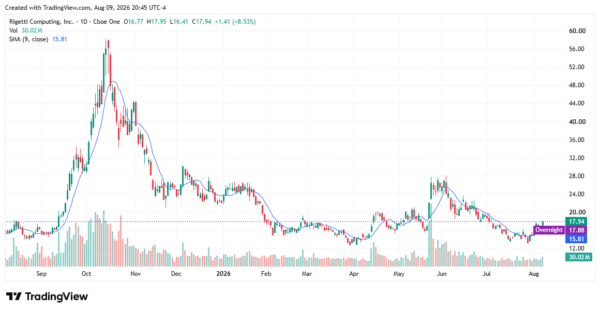
Rigetti’s quarter showed real commercial progress. Revenue climbed to $5.1 million, up 183% year-over-year, driven by sales of its on-premises Novera QPU systems. Gross margin improved to 43%, a meaningful jump from 31% a year earlier.

The headline development was a letter of intent with the U.S. Department of Commerce for up to $100 million in potential CHIPS Act funding. While not yet finalized, and likely to involve some equity issuance, the deal signals government confidence in Rigetti’s superconducting chiplet approach.

Rigetti also expanded its partnership with Hewlett Packard Enterprise and the Pittsburgh Supercomputing Center to build a hybrid quantum-classical system. The company reaffirmed its three-year target of reaching roughly 1,000 qubits. With $541.3 million in cash and no debt, Rigetti has a runway to continue investing in its roadmap as revenue scales.
quantum - StockEarnings

D-Wave’s Bookings Signal Demand Ahead of Revenue

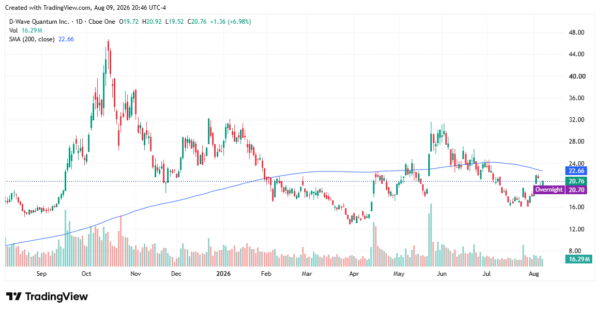
D-Wave’s results were more mixed. Quarterly revenue held essentially flat at $3.1 million, missing analyst expectations, and the stock fell after the report. Adjusted EBITDA losses widened as the company invested more heavily in product development and go-to-market spending.

The more encouraging figures sat beneath the headline number. Bookings jumped 59% year-over-year, and first-half bookings surged more than 1,120% compared to a year earlier. Remaining performance obligations rose sharply as well, suggesting stronger demand than current revenue reflects.

Management expects revenue to increase modestly in the third quarter, followed by a larger jump in the fourth quarter, driven by system shipments and installation work. D-Wave’s dual-platform strategy, offering both annealing and gate-model quantum computing, remains a differentiator. For investors, the question is whether that growing order backlog converts into revenue fast enough to justify patience.
quantum - StockEarnings

A former marketing copywriter turned freelance financial writer and market analyst. I have a passion for delivering insights to investors. I write regularly about stocks for StockEarnings and MarketBeat. Posts are not advice.

Join over 1.2M+ investors/traders who receive daily and weekly notable earnings alerts with predicted move