Deere & Company (NYSE: DE) finished fiscal 2026 with $47.7 billion in revenue, up 4% year over year, although net income declined 3% to $4.86 billion. Q4 revenue fell 2% to $12.12 billion, while diluted EPS slipped to $3.89 from $3.93.
Management now says the North American large-ag equipment cycle has troughed, early orders are improving, and Production & Precision Agriculture sales should grow 5% to 15% in FY2027. Deere forecasts net income of $4.5 billion to $5.25 billion, including a pension settlement charge. In my view, the opportunity lies in what happens when the company’s largest business recovers on top of an operating model that has proved more resilient through this downturn.
Deere Has Learned to Make More Money Through a Downturn
Although Production & Precision Agriculture (PPA) remains the biggest pressure point in Deere’s business, its performance needs to be considered alongside the gains elsewhere in the equipment portfolio. Full-year sales fell 9% to $15.68 billion, while operating profit dropped 33% to $1.78 billion. Q4 sales declined 15%, and operating margin contracted to 10.1% from 12.7%.
What makes the full-year results more encouraging is how the rest of the business performed while large agriculture struggled. Small Agriculture & Turf (SAT) increased full-year sales 15% and operating profit 47%, while Construction & Forestry (C&F) grew sales 22% and operating profit 43%. Their combined operating-profit increase more than offset PPA’s decline, helping Deere’s equipment operations deliver a 12.2% operating margin for the year.
CFO Brent Norwood’s comparison with the 2016 downturn puts that performance into perspective, with equipment operations margins more than 400 basis points higher at a comparable point in the cycle, and nearly 700 basis points higher excluding tariffs. Deere’s tighter production discipline, cost controls and broader earnings contribution give it a stronger base from which to benefit when PPA recovers.
North American Farmers Are Starting to Order Again
The evidence behind management’s claim that the large-ag cycle troughed in 2026 is becoming more tangible through Deere’s latest order and inventory data. North American Early Order Programs for spring-use products finished with double-digit growth. New large-ag dealer inventory was 10% below low year-ago levels. Combine orders were also ahead of the prior-year period, while large-tractor orders extended into Q2. Used high-horsepower tractor inventory was 25% below its peak, while used combine inventory had fallen roughly 30%.
For farmers considering new equipment, falling used inventory means fewer competing machines on dealer lots, while an aging fleet adds another reason to replace equipment.
Even with those encouraging signals, I would not price in a broad agricultural boom yet. Deere forecasts U.S. and Canadian large-ag industry growth of 5% to 15%, but Europe is expected to remain flat to down 5%, with South America flat to up 5%. The PPA margin target of 12.5% to 14.5% also depends on stronger North American shipments and favorable pricing. Better orders must translate into higher factory utilization and profit. Management’s margin target assumes better volume and mix, and the timing of those improvements remains uncertain.
The Earnings Guidance Needs Some Context
Deere’s FY2027 net income forecast has a midpoint of $4.875 billion, almost unchanged from FY2026 and below the roughly $5.91 billion analyst consensus reported by Reuters. The forecast includes a $250 million to $400 million one-time, non-cash pension settlement charge. Deere also expects a roughly $300 million net tariff headwind because the $383 million in tariff recoveries recorded in FY2026 will not recur.
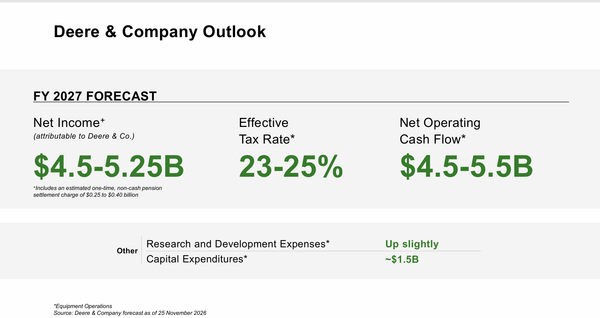
Those adjustments complicate the year-over-year comparison, but I would not add them all back and declare a much higher earnings base. The pension settlement is non-cash, while tariffs, raw-material and freight inflation remain real costs.
The cash-flow outlook also deserves attention because equipment operations produced $4.94 billion in operating cash flow during FY2026, down from $5.1 billion in FY2025. Management forecasts $4.5 billion to $5.5 billion in FY2027. Deere also plans to build working capital in the second half as it prepares inventory and production contingencies ahead of UAW contract negotiations. That preparation is sensible, but inventory could consume cash faster than the recovery generates it. Deere expects most of the working-capital increase in Q4, making the final quarter particularly important for cash conversion.
DE Is Testing Support After a Sharp Pullback
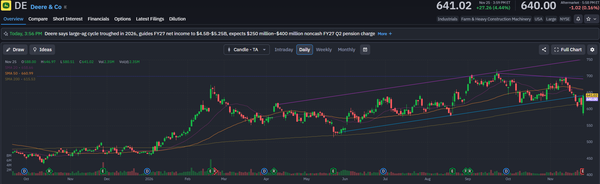
The post-earnings session gave DE a meaningful rebound, with shares closing at $641.02, up 4.44%, after trading as low as $580.51. That reversal suggests buyers defended the rising support trendline connecting the May low with subsequent higher lows.
The longer-term chart structure remains intact for now, with the 200-day moving average around $615.53 sitting below the latest close and the rising trendline converging in the same support region. I would treat $615–$625 as the key area bulls need to defend. Breaking it would put $580-$590 back in play.
Short-term momentum, however, still needs repair because the 20-day moving average at $658.66 and the 50-day average at $660.99 have converged into resistance around $659–$661. A decisive move above that band would open a test of $680, followed by the $700 area where previous rallies stalled. Until then, the rebound remains a support test, not a breakout.
Deere Gets a Buy Rating
I’m rating Deere a Buy because the company has shown that its operating model can protect profitability through a difficult cycle, while stronger North American orders give PPA a route back to growth and SAT and C&F provide earnings support.
I would build a position patiently rather than chase the first rebound, since holding 615–625 and reclaiming 659–661 would strengthen the technical case. A failure at support would make me reassess the timing, even if the longer-term business thesis remains intact. Deere’s improved earnings resilience makes the coming agricultural recovery worth owning, provided management converts order momentum into shipments, margins, and cash.